Junior High

Like many in my age cohort, life becomes a daily exercise in divestment:   Who would want this? Why am I keeping that?

In a cabinet in the garage, was the 1966-67 yearbook of the 1300 student Roosevelt Junior High School in Blaine MN.  I was in my fourth year of teaching, second year there.  The yearbook surfaced in a box – I hadn’t looked at it for many years.  Now, 57 years later, I took the time, and glad I did.  I bet you can identify….  At minimum, we’ve all been a newby teenager once.

57 years is not quite like yesterday, but it was fascinating to browse the 46 or so pages, which brought back lots of memories from that time in my life. (Included below is a portion of the Annual, including three sample pages of some real, genuine, 7th, 8th and 9th graders who filled the halls and desks at Roosevelt that year: (here: Roosevelt 1966 67).  No surprise, those kids look pretty much like kids the same age today, except they’re now in their 70s!)

Here’s the cover of the “Raiders’ annual.  Note especially the name of the artist, Lois Spooner.

This post isn’t about my own memories of 1966-67, or any other year for that matter, but I’d encourage  your personal nostalgia trip, from being a teen, and later, about whatever else comes to mind.  Life is full of events.  Sometimes, pictures are worth a thousand words!

Junior High (generally grades 7-9) or Middle School (grades 6-8), bring together youngsters between about 12-15.  We have or had kids and kin and neighbors navigating those sometimes difficult waters.

Early on in the 1966-67 annual, between the photos of Principal and Assistant Principal, was a succinct statement of philosophy to the reader, most likely a parent of a child in the book: “A junior high school is a bridge between elementary and senior high school.  It is a point where young people can have a chance to mature before they start to accept their responsibilities as adults.  This is the general purpose of Roosevelt Junior High School.

So true.   A child leaves elementary school at the top of the heap, and enters high school as what is often referred to as a “fresh man”, almost literally!  A couple of the stair steps of life.  In between is the transition, sort of ‘running the rapids’ of growing up.

Personally, I was 26 most of 1966-67.  I was second year at Roosevelt, and 4th year of teaching, and learning, 8th graders.  I was one of many of the faculty who had opened the brand new school in suburban Blaine MN a year earlier.    My own classroom was across the hall from about the 4th window on the left in the picture.  I seem to recall room 112.  Five classes a day stopped by for their (hopefully) time on task, and maybe some fragment of learning for life.  The student. maybe had 45 minutes with 30 or so other kids.  There were over 1400 kids and adults in the ‘scrum’ together.  Lots of opportunities for function and dysfunction.

Lois Spooner? I noted her photo was in the book, and she was a 9th grader in 1966-67.  She is on the 9th grade page included with this post.  Odds are pretty good that she was one of those in 8th grade when the school opened in 1965, and odds are one in three  that she was in my class – I think there were three of us teaching 8th grade geography.

Lois was a very good artist, and I bet she and her parents were very proud of this cover art.  I hope life went well for her, she’d likely be in her 70s now!

Time flies.  Make the best of the time you have left.

Roosevelt Jr HS ca 1968, looking southeast. If memory serves, I took the photo from a plane piloted by my brother Frank, then in the Air Force.

COMMENTS:

from Jim:   Dick,

DID bring back memories! So much so, I’m gonna ramble here a bit for you, all the way to changing the subject altogether. (Came back and wrote that sentence after realizing I’d done it…!)

The photo looks like my own Northwest Suburban Chicago Junior High, from which I graduated in ’69, and the sketch even more so. Same exterior entryway. Same one story construction with a partial second story only to accommodate a gymnasium. Mine was definitely a ’60s building – Named for Robert Frost, the favorite poet of the Kennedy clan. It fed into a H.S. named for James B. Conant. More rambling on him in a bit…

I am struck by the differences in the culture of building schools in different times and places. In suburban Chicago, in the ’60s and ’70s at least, no one, but NO ONE, built a High School with capacity for any fewer than 3,000 students on the day it opened, usually with further expansion built right into the plans, and there were a few around that held 5,000 or more. As I recall, there was one district, with only two schools, which enrolled 5,500 in one and something like 7,500 or 8,000 in the other. There are some schools in the TC Metro with size in the 3,000+ range (Wayzata H.S. is one…), but it’s not the norm, nor is it considered the smallest that one would ever build. These were Grade 9-12 schools, with very few exceptions. Suburban districts typically spanned multiple suburbs and had multiple 3000+ enrollment schools. Kind of like the Anoka-Hennepin district here in the TC Metro, only both the districts and the school buildings were even bigger. My school played in an athletic conference made up entirely of two school districts – one with five high schools by the time I graduated in ’73, the other with eight. Due to community growth, I went only one year to Conant, then to a brand new school (Schaumburg, the fourth of the five). The year after I graduated, the fifth (Hoffman Estates) opened. A capacity bump of 7000 students in four years! All five are still open, and each has been expanded since, with the oldest of the five having been completely rebuilt from the ground up some years ago. I recently returned to visit Schaumburg, which can now hold over 4,000, and literally got lost inside wandering the additions…

The Junior Highs, in contrast, were smaller than your Roosevelt in Blaine. Each high school was typically fed by two or three grade 7-8 junior highs. If you do the math, that made a typical junior high about 800 kids – or less – and that feels about right compared to my memories.

Regarding J.B. Conant – He had a long life and several full careers. He was a research chemist, he was a military man in WW I, he was a prof at, and then President of, Harvard, he was a Cold Warrior – a key guy in setting up parts of the US-directed rebuild of western European institutions, and the first US Ambassador to West Germany, which was a pretty high-pressure and high-prestige gig at the time. After all that, in the late 50s and early 60s, he wrote books on public education in the US, and he is frequently credited (or blamed…!) for the very idea of big High Schools which could offer many diverse courses, as the desirable norm. Appropriate, then, that when my district built #3, to be shared by two rival suburbs, each of which wanted it named after their town, the compromise was to name it instead after Conant. Each town got theirs when #4 and #5 were built…

I just skimmed the Wikipedia entry for ol’ J.B. …and I am wondering if it is only a matter of time before there is a move to un-name that High School… He will always be a hero of mine – after all, I became a research chemist, I went for one year to ‘his’ school (my siblings, after re-boundary-ing, each graduated from it), and my first mentor and H.S. chemistry teacher, who was shifted from Conant to Schaumburg the year I was, absolutely idolized the man.

But in our present cultural mood, we un-name things that were named for individuals who did things we don’t approve of today, even if what we (think we) would have done instead had not even been thought of yet… and J.B. Conant has got himself quite the list of good and not-so-good! He worked on WW I poison gases. He developed “Up or Out” as policy at Harvard (i.e. – get tenured, or be terminated). He pioneered the SAT requirement (though perhaps it’s coming back…? At least it seems so this month…!)

Some felt he was somewhat antisemitic. (Sadly, that seems to be coming back recently, too…) The most charitable thing one could say, there, is that he lacked the sympathy of some of his contemporaries to the plight of the highly educated under Hitler, very much not wanting “refugees” like, say, EINSTEIN, for the Harvard faculty…!

He was a key player in getting government support for development of synthetic rubber. Manhattan Project. Was at Alamogordo. On committee that urged Truman to use The Bomb. Original member of the Atomic Energy Commission. For your readers who saw “Oppenheimer”, J.B. was one of the experts who was AGAINST developing the H bomb. I’m unclear on how history will judge some of that, and even on what I think about it today.

On the schools front, besides advocating for big, big, H.S.s, he was also against busing for integration, seeing it as impractical – before it was even a thing anyone was doing… That was in his second book on public education, bearing the today-inconceivable title “Slums and Suburbs”. Seriously.

On the other hand, he was a pioneer of many things that are universally praised today. A particular “pet belief” of mine is that we apportion too much blame to those who did things years ago, when those things were judged “normal”, that we dislike today; and we give far too little credit to those who risked much to pioneer things that we take for granted today. There’s an old joke in the corporate cubicle world that it takes hundreds of “attaboy!”s to counteract just one “awshit”. Evaluation of an historical figure should be PRECISELY the opposite, it seems to me.

Conant’s “attaboy!”s, for instance, include being responsible for a whole bunch of stuff in chemistry that only a chemist can fully appreciate, and the rest of us take for granted. Stuff like determining what chlorophyll IS, chemically. How oxygen interacts with hemoglobin. Basic theories of acids and bases (among American chemists, only two or three made larger contributions to that field – I worked as a grad student in Berkeley in buildings named after two of them. Conant was in their league.). As Harvard Prez, he abolished athletic scholarships, and, with that, being “big time” in sports that have professional leagues, like football. As you watch the NCAA continue its evolution into full-on pro sports, with all the internal contradictions that entails for academia, keep in mind that Conant saw it coming, and did what he could to prevent it. He pioneered Interdepartmental professorships and programs to help fight “silo-ing” of the faculty. He instituted General Education requirements for undergrads. (Hard to believe today that this didn’t “always” exist…) He was a champion at Harvard of the brand-new field of Philosophy of Science. Many of the pioneers of explaining “The Scientific Method” were Harvard profs on Conant’s watch. First Quine, then Kuhn. (While contemporary Philosophers of Science have objected to the details of Kuhn’s magnum opus, The Structure of Scientific Revolutions, at least since I was an undergrad in the mid 70s, what YOU know about “the scientific method”, including the term “paradigm shift”, is probably straight out of Kuhn’s work, which both questioned and built upon Quine, and Conant.

Many of the firsts for women at Harvard came on his watch. First time women at Radcliffe – Harvard’s sister college – had many of the same classes as Harvard, and taught by Harvard profs. Then allowing their enrollment in classes AT Harvard. Women admitted to some of the professional schools at Harvard. First Medicine. Then Law. All on one man’s 20-year watch, 1933-53. Never got to full co-ed undergrad education, but perhaps not his fault. He “retired” to the US State Department in ’53 – and Harvard didn’t become fully co-ed until ’70 or ’77 (depending on which measure one wants to use), or “fully merged” with Radcliffe until ’99. So it took his successors longer to finish the job than it had taken Conant to get most of the way there.

A man of his times, who bent those times, in several ways, toward our time. I think that’s much more than “good enough”.

Preparing for Super Tuesday in Minnesota: February 27, 2024

Read the first section below, first, then take the 20 minutes to watch this recent interview with President Biden.  Carol, who sent this to several of us says: “I just watched this and it made me much more comfortable with Biden’s “age.”  The interview has been watched near 2 million times.

*

Super Tuesday is March 5, and Minnesota is one of the states.  If are a Minnesotan and you read nothing else in this post, look at the links in the 4th and 5th paragraph below.  My personal opinions are below the photo.

As reported in USAToday  Dec. 29: “The states conducting elections on 2024’s Super Tuesday include Alabama, Arkansas, Alaska, California, Colorado, Iowa, Maine, Massachusetts, Minnesota (emphasis added), North Carolina, Oklahoma, Tennessee, Texas, Utah, Vermont and Virginia” .  This is Minnesota’s first official “play” leading to election Nov. 4.

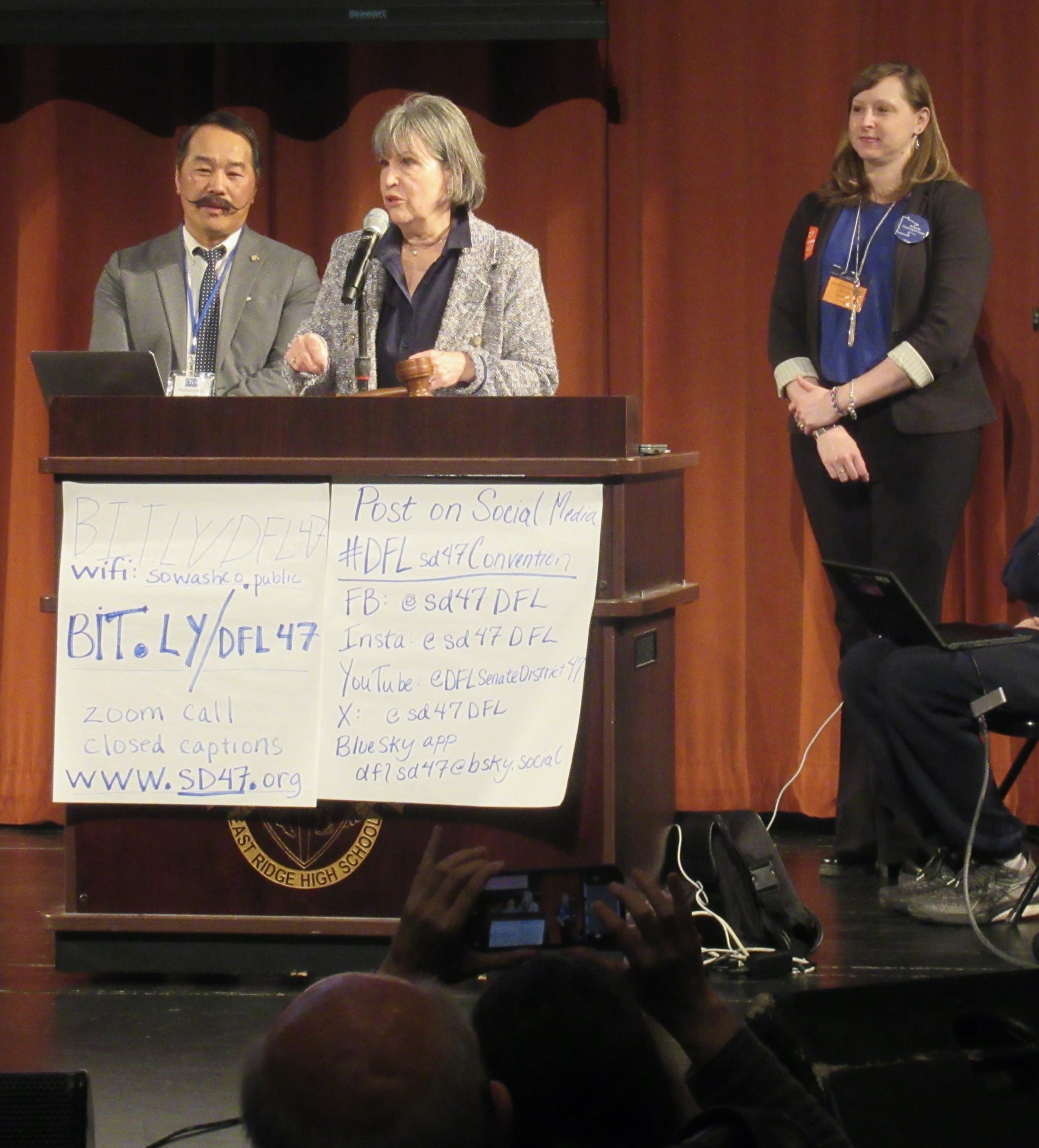
But March 5 isn’t the first act, and this blog post is intended to spotlight the biennial Precinct Caucus, which will be in Minnesota communities Tuesday, February 27, with preliminary training for assorted citizen facilitators on February 20.  In my local Senate District, Woodbury and South Maplewood, there will be a training on February 20 in the early evening, for anyone wishing to get their feet wet in the political process. The details can be found in the links above the photo.

Information from the Minnesota Secretary of State can be read here.  Itincludes links to caucus locations, and applies to Republicans and Democrats and other organized groups equally.  It’s worth taking time to read.

My own community location is at the Woodbury High School.  Here’s the general information for my own district: Democratic Caucus Feb 27 2024.  Other districts have their own information.

1961 Darleen Hartman, Dick Bernard, Doug Daugherty, Mary Canine Valley City State Teachers College.

Personal Opinion: Those who know me well, know that I have been politically involved for most of my adult life.  My role has solely been as citizen.  Disclosure: I am older than President Biden and very strongly support him.  What follows is my message to today’s young people, who will make or break their own future.

The above photo (I am second from left) was taken my last month of college in 1961.  I had turned 21  a short while before, which meant, in those days, that I wasn’t eligible to vote in the 1960 election.  Then came a couple of years in the Army.  Thereafter began a pretty regular practice of involvement in local politics,  precinct caucuses, more recently followed by Primary Elections.

The precinct caucus and the pre-meeting are excellent opportunities to meet candidates, learn about issues, and in general prepare for the primary March 5 and the general election itself, Nov. 5..

I’m in the home stretch of life and for a long-time now, while staying active myself, my mantra has become a plea for young people  to take responsibility for their future, much of which will depend on who they select to represent them in government.

The first memory I have of this attitude was about 1987.  My first grandchild was six months old and I was at a conference in Colorado.  We were asked to introduce ourselves, and  I said my focus would be the generation which included my granddaughter.

That was 37 years ago.

Last week in an e-mail conversation with a friend, also retired, I concluded my note with this: “it is our “kids” who need to take charge and will reap the benefits or pay the price for upcoming decisions, and we’ll no longer be in the picture.

Every one of we elders have “been there, done that” like the kids are going through now, and will continue to go through.  Inevitably they will grow old themselves.

We elders owe to our youth passing on the burden of responsibility to them for their own future.  They will make mistakes, like we did.  But they have to learn the old-fashioned way, by doing.

Another personal mantra: we citizens whether we vote or not, or for whom, collectively share the credit or the blame for the results we see running our state and nation and locality.  The hair shirt of a participatory democracy is taking responsibility for action and inaction.

This is your country…and mine, and ours.

Let’s work together to make it better.

ADDENDUM:

I watched Super Bowl LXVIII last night.  It was a game worthy of a title contest between San Francisco and Kansas City.

I’m not known as someone who follows professional sports.  I had no allegiance to either of the finalist teams.  I suppose it was Travis Kelce and Taylor Swift, neither of whom I have followed in the past, who attracted my attention last night.

Thinking about the game after the fact, one piece of data sticks in my mind about last evening: four ‘stars’, Taylor Swift (34), Travis Kelce (33), Patrick Mahomes (28) and Trey Smith (23).  (In parens are their individuals ages.)

Taylor, Travis and Patrick are well known.  Trey, plays for the victorious Kansas City Chiefs,  I ‘met’ Trey  as the feature of a full half page photo on the front page of the sports section of todays Minneapolis paper.  He was in tears at the end of the game last night.

The four folks exemplify for me, the future of our country.  It makes no difference what their particular ideology might happen to be – they represent the best and the brightest.  Evolving leaders with many years ahead.

*

This morning – February 13 – I got to thinking back to the recent film, Oppenheimer, about the advent of the Atomic Bomb, and its relevance to today’s assault on Truth.

As those of us of a certain age know, the Atomic Bomb and its relatives initially existed as mathematical theories until a live test in the New Mexico desert in the summer of 1945.

Not even the experts knew what might happen at the first detonation.  The action had consequences of many kinds which live on to this day.

We are living an analogous circumstance today, possibly even more dangerous than The Bomb.  It is The Truth (alternative ‘facts’).  It is virtually impossible to know what is real, and what is a fiction.  AI (artificial intelligence)  has erupted and an already bad situation has become much worse.

When I was a youngster, there was a simple definition for a lie: basically making up a story; or telling only parts of it.  I remember a Nuns definition: Omission or Commission.  It was a sin.

Now there are no boundaries, zero, none.  Vestiges of the old days remain, like Rules of Evidence, perjury and the like, but in the Wild West of the First Amendment and media, however defined, anything goes.  We have to choose what to believe.  Maybe what Carol sent me (at the beginning of this post) is true – I have to make the initial judgement.  I trust Carol, I have lots of experience over the years with how Joe Biden has been as a leader.  The video is consistent with how I’ve gotten to know him.  But the ‘cat and mouse’ game is constant.

Oppenheimer and his generation worried that the bomb they created would set off a chain reaction ending life as we knew it.  So far, we’re still here, and it’s only been used as a weapon twice, but threatened often.

We can ask ourselves the same question about a landscape without Truth.

Other recent posts: Israel-Palestine update Feb 5; and Junior High 1966-67 -Feb 10

I also highly recommend the new film, “Killers of the Flower Moon“.  It is a true story, and long, but very stimulating food for thought.  Similarly, The “Boys in the Boat” film is outstanding.


Israel-Palestine

This is my 7th commentary on the general issue of Gaza and Israel.  All of these are linked at the beginning of the first post from October 8, 2023, here.

Since October 7. about 125 days ago, there has been one atrocity after another in the area around the tiny region called Gaza.  I don’t have to review the details for you.  You know them.  As I write there appears to be a tiny possibility of a cease fire after tens of thousands of deaths, immense destruction, and outbursts of violence elsewhere in the region.  One can only imagine what is ahead.

Of course, this brings out the political craziness in our own country we are watching play out at this very moment, bringing in other issues, like immigration, Ukraine, Houthy’s….  About the best any one of us common folks can do is to attempt to be informed.

Re Gaza/Israel, I gave personal impressions at this space on October 8, and again about 30 days later, on November 8.  What I said then speaks for  itself.  There have been 7 posts in all.  (See first para above).

In the interim I’ve tried to become better informed about the region.

None of these comments and thoughts have solved any of the tragic problems in the region, but hopefully they at least provide a tiny breeze that might help move and inspire one person somewhere in a better position than I to make a difference.  Margaret Mead probably said it best, many years ago: “Never doubt that a small group of thoughtful, committed, citizens can change the world.  Indeed, it is the only thing that ever has.

A distinct benefit of having even a small network, as is true with this one, is the potential for additional credible information from credible sources – persons I’ve come to know well – which helps improve my knowledge base.  Also, in this time of disappearing local newspapers and similar sources, I’ve decided to keep ongoing subscriptions to the local Minneapolis StarTribune (home delivery); and the New York Times and Washington Post on-line, plus Joyce Vance and Heather Cox Richardson. particularly well informed columnists on history and law..

All of these sources have become important.  In relevant point:

February 1, Joyce sent a lengthy New York Times magazine review of the history of this place sometimes called Palestine, sometimes Israel, often in conflict.   Joyce is from the Jewish tradition; I have other friends from Muslim and Christian who are similarly fine and caring and informed people.  We do what we can.

The byline for the Feb. 1 commentary is Emily Bazelon,  entitled “The Road to 1948” and is accessible to subscribers here, also likely available, possibly through a paywall for visitors.  The conversation is useful to better understand the area.  There is also a similar article, 30 pages, published Nov. 30, entitled “Was Peace Ever Possible?

Do take the time….

And you don’t already do so, support the media in your community which endeavors to inform citizens on issues of the day.  There are usually several ways of subscribing.  Nothing in life is truly free; support the press.

“We Are the World”

Today begins Black History Month.  A particularly excellent opportunity to review life and times.

Tuesday’s paper had a short article “Netflix gets inside We Are The World.  Here’s the 1984 blockbuster song .

I watched the 97 minute documentary last night and it was very, very interesting. I very highly recommend it.  It is its own best editorial comment.  I was 44 years old when the song was released, living in Hibbing MN, a few blocks down the street from the home where Bob Dylan grew up.  (Dylan has something of a starring role in the film.)

*

I was planning a blog with a different title, “Age”, about U.S. Presidents.  You know the narratives.

The Nutgraf of the day everywhere, these days, is that Biden is too old, and Trump is too old.  Time for a change:  to what, and why, and all the important questions about this topic are replaced with one liners, as so much of our political conversation has become.

(Disclosure: I’m 2 1/2 years older than Joe Biden.  I know what being old is, and what it means.  Joe Biden is not too “old”.  “Life” is not guaranteed for any one of us.)

In the interest of conversation, I developed a ‘rough draft’ of history of Presidents of the U.S. who have been in office since my birth: Presidents since FDR.  The first of these Presidents I remember as a person would be Harry Truman.  If you look at the handwritten one-pager it presents minimal information about these folks, and it is deliberately presented as a rough draft.  You can look at it from your own perspective, and put some ‘meat on the bones’ around your own opinions and conclusions.  Let me know of errors, or additions you’d like to see.  Comments welcome, of course.

Personally, I can think of no more critical time in my life as a citizen than the one we are in, right now.

And this is no time to be casual about the decisions we ultimately will make as individuals about who it is who will represent us at all levels on all issues of concern to everybody.

“Government” is every one of us.  The real dilemma of democracy is that the buck stops with every single one of us.  At the absolute minimum, write down who are the elected persons who represent you local, state and national.

As the 1984 song hit says: “We are the World”.

POSTNOTE:  This is a time of endless and incessant ‘breaking news” on most everything under the sun.  This is very challenging for citizens like myself.  We like to pass the buck to somebody else who is supposed to be responsible.  It was Harry Truman, I think, who  memorialized the saying “The Buck Stops Here“, which implied it was the President who was ultimately responsible for everything. Fair enough.  Somebody has to elect that President, or for that matter a multitude of other officials in public or private life that make our society function, or not.  Really, the buck stops with all of us, including keeping a democratic Republic as we claim ourselves to be a part of.

“Teaser” to take a look at my single page Draft of U.S. Presidents; I noted that not a single one of them was born in the time period we all know as the Great Depression, and only one during WWII.  All but one had prior experience in the realities of public service.  My personal nutgraf: if you want a prediction of how a president will be, study what he or she went through in his or her formative years.   What was, will be….

COMMENTS (more at end of post): 

from Fred: Learned a lot from your president’s list. You are older than I, but we still share exactly the same range of president’s in our lifetime.

from Kathy (retired 5th grade teacher): I remember my student Danille singing it in the talent show…so touching.

from a friend: We watched the video the other night. Fantastic.

Re our president’s age. I am not concerned about our chronological age. I’m concerned about the cognitive capabilities of all key leaders. In leadership positions such as president, line of succession, congressional, and key military, we the people should know that their annual physical is good, including cognitive skills, against recognized medical standards. When you lead (elected or appointed) in these public positions, you give up this aspect of privacy so that the people are assured you are fit to serve.

Thoughts after Iowa, before New Hampshire, and Jesse Ventura recalled 25 years later

Postnote Jan 21.  #DE#%&^&*E$$$!!!!  I am basically a mild-mannered guy.  Spent most of last week dealing with yet another e-mail issue, and just today e-address am again on-line.   My alternate is sykestonguy46ATgmailDOTcom.   Make note of it.  The problem seemed a bit more complex than just blaming someone.  Glad I’am back

*

Jan. 16, 2024: I spent some time last evening listening in on the returns in Iowa.  There were about 115,000 votes cast.  This was out of 752,000 registered Republicans among 2,2 million registered voters in Iowa.  If you care you already know the split and the back story as reported.  The turnout was relatively light, but no rocket scientist needs to analyze that.  It was cold.  I had suggested page 5 of the Des Moines Register article for more data.  Link is early in Sunday’s post.

In the aforementioned post I recalled the 2008 Minnesota Democratic caucuses – the one where Barack Obama and Hillary Clinton began their active campaigns for the nomination for President.

The process was similar to Iowa – grassroots involvement at the community level.

Caucuses and later local, state and national conventions are important events for those who organize political campaigns.  There is a tendency to be critical of most everything related to the political process.  On the other hand, there is much to be learned  and applied by those who run for political office at all levels.

Such a process is crucial for the very survival of  large and complex society, as ours is.  An ideal of freedom from government would be a disaster for everyone, including for those who advocate for such.  Government is the glue which holds us together, imperfect as it might seem to be.  And it is always imperfect, because we are imperfect.

Take a bit of time some day to consciously observe what it is that you take for granted which would not exist were it not for government.  For most of us, safe streets and roads are a given, for instance.  Make a list.

If you can, get to know personally who is a government official, elected, a “bureaucrat”, a neighborhood association leader, on and on.  We may not know what they do; we may think their position is a waste of money…on the other hand, their position would not exist were there not some need for it.

The Iowa caucus is not history, and the political process in the U.S. will intensify in the coming months before Election Day in November.  You have plenty of time to become better informed, and to help make a positive difference.

Jesse Ventura

by happy coincidence, my day ended Jan. 16 watching a one-hour documentary on a legendary Minnesota Governor, Jesse Ventura, who unexpectedly (even to Jesse), and memorably, became Minnesota Governor 1999-2003.  The movie is “Jesse Ventura Shocks the World“.

Often such specials are repeated sometime within the next week, so if you happen to be in range of TPT, check in with them.  Next announced showing on local TPT is Monday night, Jan 22, at 8 p.m.  The program is an hour, and I think you’ll find it very interesting and enlightening.

Former Governors Jesse Vetnura (center) and colleague  Al Quie, dedicate a replica of the Liberty Bell at the Minnesota Veterans Services Building, St. Paul, on Armistice (Veterans) Day Nov. 11, 2019. Ventura had been a member of what later became the Navy Seals. photo: Dick Bernard

There is plenty of biography of Jesse Ventura on-line.  My comments below are strictly personal.

Ventura was an unlikely candidate for Governor of Minnesota, at least that is how he was perceived at the start.   He was independent, his given name was not Jesse Ventura (look it up).  His fame was as a ‘professional wrestler’, though being a local mayor and volunteer high school football coach didn’t hurt.  His two opponents for Governor were conventional and prominent Republican and Democrat.  In the end, he beat both of them, narrowly.

No one I knew – I was an active Democrat – could believe the results election night 1998.  Probably Jesse, himself, was among the surprised.  I was with a local Democrat group as election returns were announced, and when he was declared victorious over Skip Humphrey – Hubert’s son – and Norm Coleman.  Both were prominent and respected politicians.  The general reaction after the dust settled would probably best be characterized as stunned.

The day after a  Republican I knew said his vote for Jesse was strictly a whim – he hadn’t warmed to the Republican candidate.  His seemed  a “what the hell?” kind of vote (he won’t win anyway, so why not?).  A very active Democrat relative said about the same thing to me about the same time.  Skip Humphrey had been to his town and seemed to dismiss the local Democrat power structure, of which my relative was an important part.  They felt slighted.

I don’t think either man had ever had any contact with Jesse.  Neither thought Jesse would win, but he did.

“All politics is local” came to have meaning that election night.

We should have known better.  In March of 1998 I was at a state teacher’s union meeting where all of the then-potential candidates for Governor were invited to give their 5 minute elevator speech to several hundred teacher leaders from around the state.  I recall there were at least 8 in the field of prospects then, including Jesse Ventura, and the teacher union audience was an important one.  Jesse’s turn came up, and some teacher leader in the room yelled “Go, Jesse”, and other people were equally enthusiastic.  Nobody commanded the room like Jesse did.  We should have paid more attention.  I still have my tape recording of all the candidates talks that Saturday – it was March 7, 1998.  I have relistened to the tape.  Everyone regardless of party made good presentations.

Not all of the speakers that day ended up running in the Primary election later that summer:  here was the Primary results: MN Primary Election 1998

After the 1998 election, late November, I was at a national conference in Houston TX and offered to convene an evening  conversation about the election for anyone interested.  There was a room full of union staff from around the U.S.  The agenda was simply to talk.  Jesse overnight was a national celebrity.

Ventura turned out to be a consequential governor, in a very positive sense.  He had his own personal priorities, of course.   But he surrounded himself with good advisors for his departments, all who were well qualified, mostly Democrats and Republicans.  And he respected their advice.  Jesse being Jesse, there was seldom a dull moment in his four years (watch the movie).  In the end, he decided not to run for reelection, and the rest of the band of merry folk essentially disintegrated.

Minnesotans who might read this would doubtless have opinions about him and his time in office..

In the interim, if you happen to see this, check out the public television film mentioned above.  You won’t regret it.

PS: One of Jesse’s admirers (who makes a cameo appearance in the movie) was Donald J. Trump.  If one looks closely at the two men, their experience and world view seems to have been almost totally different, though their public persona was similar.  Jesse by and large seemed to take his public charge very seriously; Donald cared only about himself.  The only thing they had in common was celebrity.  There are lessons we can learn from the experience with both.  Will we?

After Jesse took office, one of our office secretaries and myself, started a poster wall of stuff that showed up in the paper about Jesse Ventura – things like cartoons and the like.  We were an office full of Democrats, I would guess.  I seem to recall Wanda telling me that Jesse was the first and only person she had ever voted  for…and, while young, she was no longer a youngster.  There were a lot of Wanda’s that year.

The Jesse Wall at Education Minnesota Summer 1999.

Our office manager put up with the nonsense of the Jesse Wall for awhile, but before too long the posters came down….

There are endless comparisons of Jesse to Donald.  Both were larger than life caricatures of humanity – “stars” shall I say. But if you look closely at the human beings underneath, they followed entirely different paths, which should have been easily discernible by the electorate.

I hope you take the time to watch the film: “Jesse Ventura Shocks the World”.  I think you’ll be glad you did, and that you’ll learn something, maybe even about yourself.

My personal bottom line: buy an actor’s line at your own risk.  It is a good idea to make a clear-eyed assessment of the person actually behind the mask…

Govs. Al Quie and Jesse Ventura at the bell-ringing Nov 11 2019.  Jesse was very respectful and kind at the bell-ringing.  His hand on Gov Quie’s arm said a lot to me that day…A very positive measure of the man.

“EXTRA CREDIT”:  In November I read a most interesting commentary about what it means when someone says they are a liberal.  You might find it interesting: Liberal by Sunstein  

COMMENTS (more below):

from Gail: When I awoke to the news that Jesse Ventura had been elected Governor, I was embarrassed for my state. A wrestler – not even a Real sport!  But I came to admire Jesse, because he was honest and truly independent.

from Steve:  I’ve seen the promotional pieces on TPT for their Jesse Ventura film, but haven’t tuned in to watch the program. Shortly after Ventura’s election, our daughter, then in her mid-20s, told us that the only people she knew who did not vote for Ventura were her parents. I don’t know if that was just a facetious comment, or had a foundation in truth. No matter, the returns showed that more people voted for Ventura than either of the alternatives.

Jesse’s approach to “politics-as-usual” was obviously appealing to plenty of people. After the election, I had a local DFL campaign chair speak to a class I was teaching at the University. He said that Jesse’s campaign was a phenomenon that he and his colleagues couldn’t understand: “At a weekend campaign event, Jesse told the story of his visit with a prostitute in Nevada. After the encounter, Jesse said that she gave him ten bucks.”
The Democrats thought that Jesse’s story had been the indiscretion that would sink his campaign. “But when polls came out on Monday, his approval had gone up five points.”
I was working at the University’s Humphrey School at the time. The day after every election, students and faculty traditionally got together in the auditorium to talk about results. After Jesse’s election, one of the Senior Fellows and former US Ambassador, Geri Joseph said: “We should form a committee to offer Jesse help because he has no experience.”
I thought Geri’s comments were turned around. It was Jesse who had taught both Republicans and Democrats a lesson. Voters responded to someone they believed was genuine, did not appear condescending, and expressed feelings they held in common.
That doesn’t mean that Jesse was some kind of savant who could straighten things out. Far from it. I thought his attitude and resulting policies were short-sighted, sometimes selfish, and unwilling to accept a serious analysis of his proposals. His tax program has had a lingering and difficult effect ever since the “Jesse Checks” were approved by the legislature and distributed.
Do you remember when Charlie McCarty was elected mayor of St. Paul–might have been 1971? A city council gad-fly, whose confrontations with council members and mayor became a regular part of the evening news, became a kind of folk character—again, standing up to official politics and poking them in the eye. He decided to run for mayor and was elected—Jesse Ventura had been mayor of Brooklyn Park, I believe, but Charlie McCarty was just a character, a kind of populist with the same sort of attitude and appeal. He didn’t like what the city government was doing and he told them so—often and without any attention to traditional decorum.
I’m willing to make the comparison—Ventura and McCarty, and there are other examples in our past–to former president Trump. Not an appealing thought.
Thanks for your recent post

from Georgine: Aloha Dick,  Wanted to share with you that I cheered when Jesse beat Norm Coleman.  He was not in my book a respected and prominent Republican Politician.  I got to know Norm when he was a democrat and I was active in democratic politics.  Coleman is a lot like Trump.  He has a very high opinion of him self and little respect for other people, especially women.  He naively tried to involve me in a process to manipulate the women at a Democratic party convention.  He believed he was going to be president one day, and when the Democrats figured out what a creep he was, he became a Republican.  I always said that he thought he was JFK.  He in reality was a Trump.  I was so happy when Jesse crashed his dreams of ruling the world.  Was sad for the State of Minnesota but Jesse did the USA a big favor.

That’s my story and I’m sticking to it!

Democracy, revisited

You may have heard that the Iowa Caucus is Monday January 15 (see comment from Larry at end of this post).  More, if you wish, from the Des Moines IA Register: Iowa Caucus 2024. (For me, the most interesting data is on page 5 of the article.)

If you’re not sure where Iowa is:

Minneapolis-St. Paul is about 240 miles from Des Moines.  Chicago is about 330 miles and New York City 1,100 miles east; New Orleans 1,010 miles south, San Francisco 1,825 miles west….  Iowa has 3.2 million population; Minnesota has 5.7 million, U.S. is about 330 million.

We’re a large country.  At the same time, as a democracy everyone eligible to vote has a single vote, whether billionaire or the most common person.  It is a great right, and an awesome responsibility.

*

Last week, I posted a commentary from Chuck Woolery about the Danger of Democracy.  I sent it along because I found it very interesting and concerning: a statement of uncomfortable truth.

If the post passed you by, here it is again.  Agree or disagree, the points made apply to politics past, present and future.  We, the people, in a democracy. ARE “politics”.  We are the ones ultimately and always responsible for who we elect to represent us, by action or inaction.

By choice, I am a modern day Democrat – the party that dealt with its roots in slavery.  Every post I make includes my self-identification (at right on this page.)

A favorite quote is the one attributed to Will Rogers in the 1930s.  “I am not a member of any organized political party; I’m a Democrat.”

To this day, Democrats are criticized for being a disorganized rabble, and the criticism is justified as far as it goes.  Democrats (democracy) is a big tent philosophy which encourages different voices.  Democracy represents we, the people, as we are in all our rich diversity.

Democracy is the antithesis of authoritarianism, which seems to have become the philosophy of choice in today’s Republican party.

*

I don’t have any nifty one liner to add to Chuck’s fine collection of quotations seemingly against “democracy”.

Neither do I have have any opinions about what will happen in Iowa on Monday, nor about the pull quotes which anchor the news about one side or the other down there.  Were I a resident in Iowa, I would be no different than I am as a resident here: a single but essential voice.  I would likely attend and participate in my caucus, as I have always tried to do here.

What does Democracy look like?  And how can each of us have a positive impact?

Every single one of us is part of one, often many, family(lies), and I’m not talking about a family where everyone marches to the same drummer.

One of aggravating constants of any functioning family unit is inevitably tension requiring negotiation to not only survive, but thrive.

For every family unit, this looks different.

A suggestion: make your own list of who you define as “family” in a personal sense in the course of a normal day.  If you do this with an open mind, you’ll find differences of opinion and philosophy which must be constantly negotiated.  My family lists do not include my “birds of a feather” which “flock together”: the people I totally agree with, all the time.  Come to think of it, there aren’t any of these!  There are all varieties.

*

Wednesday, Iowa will be old news, and the focus will be elsewhere, New Hampshire, etc.  There remain about ten months till Nov. 4, 2024….  Show up, well informed.

This is a time to get actively engaged as part of the body politic – demonstrate what democracy looks like.

POSTNOTES: In side conversations during the preparation of this post, there are some  brief threads which relate.

About Chuck Woolery’s post (there were also a couple of comments at the end of this post):

Fred: Got this last week and saved a bunch of them.

Kathy: Thought you might like to see what brother Tim has created from his work with Native Peoples and differently abled folks. (Video here).  Let me know your thoughts

Frank: Well, I plowed through this and it makes me shake my head in sadness as I find myself agreeing so many times with statements I would have found to be blasphemous fifty years ago. Thanks for sharing.

Larry: It looked very much worth printing…so I printed it for keeping and reference. It took 11 pages on both sides…no prob. I have my old laserwriter for that…the color printer for anything that requires color…thanks…will give you my take after I digest it…LG

In February, 2008, I remembered a memorable precinct caucus in Minnesota – the year Barack Obama and Hillary Clinton were the main event.  I was writing to two local friends.

Dick: Do you remember Feb. 2008?  I went to see Barack Obama on February 2 (it was Saturday), and the next Tuesday we went to the caucus at Oak-Land Junior High.  It ws bumper to bumper on I-94, and finally I walked about a half mile into the school to cast my presidential preference on a scrap of paper – they had long since run out of the prepared ballots.  (I had dropped Cathy off at the school first).

My preference: Hillary Clinton, because I thought she had more relevant experience….
I’ve always regretted not taking a photo out at Oak-Land that night.
That’s what I’’m thinking about as Iowa looms next week….

Joyce: I well remember that caucus night; my daughter was trying to keep things under control in our room, and failing, despite doing everything possible. I didn’t see Obama at the Target Center, but I did see him at the Energy Center right after he got the nomination.

Sue: I remember the caucus at Oakland Junior High too. The parking lot filled up quickly, and some people (like Dick) had to walk a fair distance just to vote in the presidential preference poll. I was there early because, as I recall, I was manning a table in the front of the building. As far as I can remember, they haven’t had a caucus night there since. Although the school has been (or is being) enlarged, so maybe they’ll start again.

Iowa.


Mary in New York State: Hi all…in case you missed it there is an event in IOWA on Monday.  I know none of you are there to participate but I was curious how many of the folks that I associate with regularly even knew where the state was…..so I completed a straw poll which included ushers and book club members in my age group, lifeguards at the pool, and random other folks.  N=20 so it was small.🇺🇸🇺🇸♥️

NO ONE could place it with all surrounding states, about half thought it was somewhere in the middle of the country (yea) and knew it was near Minnesota, too many put it in the south or west, and a couple just said really undereducated things like  “Is that a state?”.
I am hoping grandkids may be better informed but wonder if everyone should post a United States map on the back of the bathroom door.

Joyce in Minnesota: This reminds me of some of my former coworkers back in NYC. As I was preparing to move to Minnesota, they asked me what I liked about the state; one of the things I mentioned was how beautiful the Mississippi River looks as it winds through the state. My former coworkers told me that couldn’t be right; the Mississippi River, they said, was in the south.


John in California:  To Mary : What a revolting development!!! I think you need a better set of friends….

As a seasoned world traveler I, of course, know exactly where Iowa is, and have crisscrossed the state in multiple directions – including visiting the High Point  of Iowa, which (believe it or not) is on the crest of Iowa Highway 60 in Northwest Iowa. And frankly, the only reason that I went down that road was to get to the High Point of Iowa.
But I digress… Unfortunately, your informal poll only serves to strengthen the arguments presented by somebody in one of Dick’s latest blog – 118 Quotes Against Democracy. Pretty much the  overarching theme of that article was that people are too dumb to be trusted to govern themselves…


Sue: These stories remind me of the responses I got from classmates (from all over the U.S.) when I enrolled in a graduate program (in psychology) at Sonoma State College (now University) in northern California in 1975: “Minnesota – that’s east of the Rockies, isn’t it?

Joyce, a number of these scholars were from New York.

Sean in Houston (with tongue firmly in cheek!): I thought Iowa was a county in Western Illinois or Southern Minnesota.

Joyce, again, and Sue: There was a New Yorker cover by Saul Steinberg, years ago,  showing how New Yorkers view the world.  Sue: Yikes! Things are even worse than I feared.

COMMENTS:

from Larry: I find it rich — and rather abominable at the same time — that Iowa’s “Republican event” is on Martin Luther King, Jr. Day.


from Peter:  As to democracy, I think all the complaints about it are really about people who are woefully undereducated in just what it is. In my various conversations, especially amongst diverse indigenous people, it seems to me that democracy is very much older and more sophisticated than any of us in the “west” realize. But we have lost or forgotten or never understood the other component, the thing that happens when somebody in a real democracy goes off the rails: the others quickly surround them and hold on until they recover their sense of community (there are many creative ways this is done).

There is a tribe in the Congo that has danced the same dance for seven thousand years; and when one of them gets sick, they paint a red spot on the head of every person down to the smallest, newest baby. They do this to spread the malady as thin as possible, while all understanding that they are taking on part of the burden of this illness. Seven thousand years is a long time for a culture to last, and it isn’t because they got set in their ways. Au contraire, as they say in Paris, France.
So my take on the wonderful list you sent along is that it says more about the various speakers than about their subject; and yes, people are contentious and silly, but better democracy is not going to address that one.

Responding to Peter: Of course, I know you now for over 20 years, and while I’ve never met Chuck in person, but there is long connection there as well.  I think the two of you would get along famously, pretty much on the same page (though I know you both as very capable of standing your ground!). Anyway, this is one of the advantages of having this network, now so many years around.


from Flo: Being a Minnesotan since 1968, and having friends from Iowa, I had no trouble recognizing where it is!  Glad I don’t have to vote there, but living and voting in Hubbard County MN certainly has made our votes count for less!

Regardless, please vote well informed, with a clear conscience! Hope Minnesota will continue to have among the very best voter turnout nationwide.


from Mary:  Interesting post.  Which shall take precedence?  I will watch a few snippets of caucus but likely wait for the rehash.  Maybe I am in the Isaac Asminov category ………. ‘my ignorance is as good as your knowledge’.That snippet of his quote seems to fit way too often.


from Deb: Interesting article.People need to get out and cast their vote. It’s odd that only 55-60% vote & others don’t exercise their right. It matters when all vote, at least everyone has opinion.  Can’t imagine being in Iowa today, it’s a nasty day to be on the road for anything…


from Jeanne: I think there may be a few more than one or two Democrats in Iowa but there is no way to tell because they don’t vote and they don’t talk to each other. Lol

January 6, 2024: QUOTES against Democracy

Ten months from now – Tuesday, Nov. 4, 2024 – is Election Day in the United States.

Dec. 30, Chuck Woolery, long-time subscriber to this blog, sent a writing of his including over 100 “QUOTES against democracy”. Here’s the 21 page document: Democracy compiled Chuck W.  

I read the entire document, find it full of wisdom and particularly rich in food for thought and discussion, and asked Chuck if I could share it at this space.  Permission granted.

(The 21-page length is not daunting, consisting of over 100 quotations by people both famous and some I’ve never heard of.)

I’d appreciate it if you’d simply open the document and quickly scroll through.  At page 20-21 is Chuck’s self-description of himself.

Sharing of this post is encouraged.

I want this to be stand alone, so I’ll do a specific post including my own commentary. and hopefully some of yours as well.  COMMENTS WILL BE HELD UNTIL JANUARY 15.

Jan. 6 2021 mid-afternoon at our nation’s Capitol.

The Christmas Tree

More than once over the years a retired elementary teacher friend has told me the story of her team teacher colleague, Ron, and his Christmas tree.  This year she gave me a photo copy of the tree as of December 2023.  To me, the photo is worth more than the usual “thousand words”….

Here is the entire story: “In 1985 my teaching partner Ron was told he had bone cancer, and he would not be alive for Christmas. So. he bought an artificial tree. He and the tree are still up.

Any extra words are superfluous.  The diagnosis was dire, about 38 years ago.  Life goes on.

I’m told this photo is of the exact same tree as 38 years ago.  The tree has seen better days, but every day it is there, a reminder of a time without hope for its owner.

*

Christmas trees or variations on them are a part of the tradition of this season for many of us, as the old years ends, and a new year beckons.

Ron’s tree prompts a suggestion:

Rather than focusing on the hopeless – easy to do in this troubled time – spend a few moments thinking of one happening in the past year which was memorable in a positive way.  Something you’re grateful happened in your own life:  ONE thing in 2023.  Some other year?  More than one?  Can’t think of anything?  Fine.  Just give it a thought.

(No need to share.)

All best wishes for a good New Year in 2024.

Thank you, Kathy.

*

Midweek daughter Heather and I went to the new movie, Wonka.  It was Heather’s choice.  I found it a most positive film – one of those children’s film made for adults.  There are lots of reviews.  Check it out.  Wonka Movie Reviews.

Motivation for this post comes from a long ago poem I first read in “The Best Loved Poems of the American People”: Loom of Time, selected by Hazel Felleman.  I saw the poem when I purchased the 1936 book i n 1961.   I still have it.  I include with the poem the introduction to the original.  The book is still available, here.

COMMENTS:

from SAK:  Touching that Christmas tree story & although I am pretty damn pessimistic looking at what’s happening here & there I liked your: “ spend a few moments thinking of one happening in the past year which was memorable in a positive way.  Something you’re grateful happened in your own life:  ONE thing in 2023.”

I also liked Peter’s update [comment below] of Spike Milligan. Some give up on drink, some on cursing . . . Spike completely gave up on the past year.

Wishing you & yours a healthy & glorious 2024 – it’s gonna be exciting anyhow!

from Arthur: Excellent post! Happy new year!

from Claude:  Thanks, Dick. I’m hoping you have a great 2024, a year that promises to be fascinating!  Thanks for all you do.

from Chuck: responding to an editorial in The Washington Post on Dec. 22 2023:

Regarding the Dec. 22 editorial, “How the battle for democracy will be fought — and won”:

The Editorial Board must look beyond the box in defeating authoritarian advantages in framing democracy as dysfunctional. Democracies are dysfunctional. They can’t react instantly with a workable solution. And if they do, it’s only momentary in stopping the problem. Independent nations with independent agencies cannot quickly stop globally interdependent challenges. Authoritarians can act quickly and forcefully. Then they can quickly adjust if they fear a citizen revolt, making them appear strong and wise.

Democracies’ lag times at best yield only reactionary solutions. Combined with citizens’ unrealistic expectations for best results, problems are unlikely to be solved. Quick and effective responses to pandemics, immigration flows, violent extremists, destructive weather patterns or economic pain caused by interdependent global influences are not going to come from either form of government. Neither can deliver what’s actually needed: addressing root causes. This would require international cooperation and coordination on a level unseen since the global eradication of smallpox or hosting the Olympics.

Democracies moving in this sensible direction would require a majority of wise and patient voters insisting on it. Freedom certainly matters to them! But protecting a nation’s freedoms requires wisdom, responsibility, accountability and a democratic majority of virtuous voters. An authoritarian leader needs only patience and to placate citizens. Both systems of government can expect a rougher future.

Chuck WooleryRockville

The writer is a former chair of the United Nations Association Council of Organizations.


Birthday

UPDATE  on Gaza Jan. 6, 2023:  David Cooley, a local member of Veterans for Peace in the Twin Cities wrote a commentary on Gaza on the Winter 2023 VFP Newsletter.  It speaks for itself: Vet for Peace comments on Gaza Winter 2023.

*

All Blessings on this most most contradictory of days: Christmas.  Virtually everyone knows some version of the story of the birth of Jesus and for 1,700 years infinite observations, from sermons to commentaries have endeavored to bring meaning to the birth of the child in Bethlehem.

Apparently, the annual events in Bethlehem have been cancelled this Christmas.  This day we’ll participate by livestream at Basilica of St. Mary Minneapolis 9:30 a.m. CST.

This year, I’ve decided to share a few words about my singular visit to Bethlehem, Thursday Jan 12, 1996.  The photo below is from the nativity scene purchased at a Palestinian shop in Jerusalem on Jan. 14.  That story is in my post for December 10, 2023.  The second picture, at the Manger,  is from Grandma Bernard’s 1911 Bible.  I was there, in person in January, 1996 (more below). Here is a UNESCO article about the holy site.  This article includes much background information and 18 photographs.  The Bible text we read at the site when I was among the visitors was Luke 2:1-20.

Nativity 1996. Some of the 18 Olive Wood figurines, purchased in Jerusalem January, 1996.

Briefly, an afternoon in Bethlehem, Thursday Jan. 11, 1996:  Bethlehem is only six miles from Jerusalem.  I was there 6 years before construction of the Separation Barrier began in 2002.  The wiki article about Bethlehem is linked above.

Like so many other Biblical sites in the Holy Land, Church of the Nativity has a divided jurisdiction.  In its case, it is jointly administered by Greek Orthodox churches, the Custody of the Holy Land, and the Armenian church.

The Christian group I traveled with appeared to have a substantial number of  Orthodox from places like Pennsylvania.  As I witnessed personally, many of them were church choir members with wonderful singing voices.

We arrived at the Church of the Nativity coincident with an Orthodox funeral beginning in the upper church.  We watched from the side.  This was like a funeral you’d attend anywhere, with only the liturgical differences.  The deceased seemed to be an elder in a family.

The church itself is very ancient, and at the time of our visit there was some reconstruction/repair work in process.

The Manger site itself is below ground level, and we could approach the site.  (More on all of this can be seen in the UNESCO photos and text linked above).  This was a place of reverence, and closely supervised.  We were there only a short time.

In the town square, at the edge of which is the Church, was a very large banner supporting Yasser Arafat in an upcoming election.  It was the sole political indicator that I can recall seeing.

“The little town of Bethlehem” is larger than 2,000 years ago, but still a tiny place in comparison to nearby Jerusalem (perhaps 30,000 against about 900,000).

These days I wonder if there are many groups like the one I was part of who can come to Bethlehem.

There is more that I could offer, but leave this suffice for today.  All blessings.

POSTNOTE: In a couple of weeks, at this space, I’ll share some personal comments about how I see this time in history.  Check back.

COMMENTS:

from Brian: From a Colombian friend in Berlin–Merry Christmas!

from Michelle:

“Christ in the Rubble” 2023 image by artist/iconographer Kelly Latimore @KLICONS is inspired by those in nearby Bethlehem.
“Churches in the Holy Land have canceled big Christmas celebrations in favor of quieter, somber worship services. The move is meant to draw attention to the violence in Gaza and the West Bank.” LISTEN TO NPR STORY

from Judy: My singular visit to Bethlehem and the gift shop was in January 1988 right after the first Intifada began.  I feel fortunate I was able to go because it is much harder today for tour groups to have this experience.  I of course am so saddened to see how Netanyahu is handling this crisis..

from Larry: Thank you Dick.  I don’t know how I feel now, but I have often in the past wanted to visit what is called THE HOLY LAND.  Mary Lerman and family moved back from Jerusalem where they had moved to in retirement.  Mary is a friend, the Mpls Park Horticulturalist, who engineered turning an abandoned magnificent rock garden (built by one of the park system founders) into the Lake Harriet Peace Garden.  I am done at Plymouth church Drop In end of the year, so just organized my last Christmas chapel where Drop in Folks do all the talks, Bible readings, and special music.  I normally have not been on the program, but this one I told Tolstoy’s magnificent story, WHERE LOVE IS, THERE IS GOD ALSO.  These days often reminded of the story of someone asking Gandhi what he thought of Christianity.  “It would be a good idea,” he said


from Fred:  Thanks for this interesting memoir. We’ve made lots of journeys but never to Israel.

Closest we got was Constantinople another place, as you know, we a substantial place in both Christian and Moslem tradition.  Merry Christmas,

from Kathy:

from Carol:

Sunflowers

Today is Winter Solstice 2023.  Molly offers some seasonal poems at the end of this post.  All best wishes for all that is good at this season, and in these times.

A North Dakota retired farmer sent his Christmas letter recently, including this photo: “Sunflowers…in 1980s”

The photo brought memories for me.

The farmland pictured was perhaps four miles from the farm where my mother grew up.  Back in the day, I would try to set aside a week or so each year to go back to the farm and help Vince and Edithe, my uncle and aunt, with whatever, usually in August or September.

In at least one of these years – likely in the 1980s – Uncle Vince had a go with growing sunflowers.  As summer went on, his field looked exactly like this one: beautiful.

Of course, farming (and life, for that matter) is not seamlessly pleasant, and as I remember, growing sunflowers had a downside for Uncle Vince – so sunflowers were a brief diversion for him from the more normal wheat.

As the sunflowers matured the ample heads filled with sunflower seeds.

Sunflowers had their downside for the farmer.  Along with being a yummy place for assorted insect pests, a sunflower patch nearing maturity was a banquet site for blackbirds, and sometimes, hundreds and maybe thousands of them would drop in and enjoy a free meal. A vexed Vince would take out his shotgun and fire a few rounds, which would temporarily spook the blackbirds far across the field, but they’d always come back.  Of course, the other insects didn’t much care.

Vince was a gentle man.  Looking a blackbird in the eye, shotgun in hand, he’d never shoot the bird.

Even had he wanted to, the blackbirds had the advantage and  common sense.   Fields were large, and days were long.  “Come on in!” seemed the invitation, and they accepted, happily.

*

Farming is an honorable profession, with its abundant risks and sometimes its rewards.  One of the rewards is vistas such as the photo.  Best to savor the moment, as the photographer did, above.

As we head full tilt into winter, maybe this photo will bring to mind some of your own memories, wherever you live or lived.  Vince and Edithe were they still alive, would be looking forward to the seed catalogs to arrive, a break in winters isolation.

All best wishes for a very good Christmas and New Year.

POSTNOTE: I’m not a farmer, and as I was contemplating this brief post, I wasn’t sure that Vince’s nemesis was blackbirds.  Maybe it was just my imagination.

I searched ‘sunflowers and blackbirds’ and indeed the crop and the bird have more than a casual relationship.  Just search the two words – sunflowers and blackbirds – together, and you’ll find plenty of articles.  Same with sunflowers and insects.

POSTNOTE 2: Ty, in another Christmas letter, offers a quote from Goethe, with a comment: “We are adjusting in our own ways to the virus.  Now it is time for us to make the “new normal” part of our lives.

May your holidays and New Era be filled with happiness, good times and good health.”

POSTNOTE 3, from Molly:

Enclosed are some relevant poems, plus 2 rather wonderful bits of music… from the classical (John Rutter–the dark part) to Gordon Bok–who sings the light. Solstice 2023 Molly.  [The links to the music referred to are here and here.]
Blessings to each of you, as the season of Light returns,