Getting there…traveling from Quebec in the old days.

FOLLOWUP POST AT APRIL 28 HERE.  Related post here.

PRENOTE: Comments section for this blog have been repaired and are again available to users.  Today’s post relates to history of French-Canadians in this part of the world.  Not directly related, but the Coleen Rowley talk about Leonard Peltier on Thursday is on-line and can be watched here.   Two timely commentaries overnight: Joyce Vance on Mifepristone; Heather Cox Richardson on Earth Day.  Check all of these out.  Every single one of us are “politics”; the crucial “politicians”.  Democracy demands that of all of us as citizens.  It’s nobody else’s problem.  Have a good weekend.  We’re out of town till Wednesday.

*

Today (Friday), absent flooded roads or another heavy snowfall or etc., we were to give our friend Annelee a ride home to the Red River Valley, and one of the days I’d planned to drive further up the Valley to my French-Canadian dad’s growing up home area of Grafton, North Dakota.  The trip had to be postponed: concern about possibly more snow and/or high water.

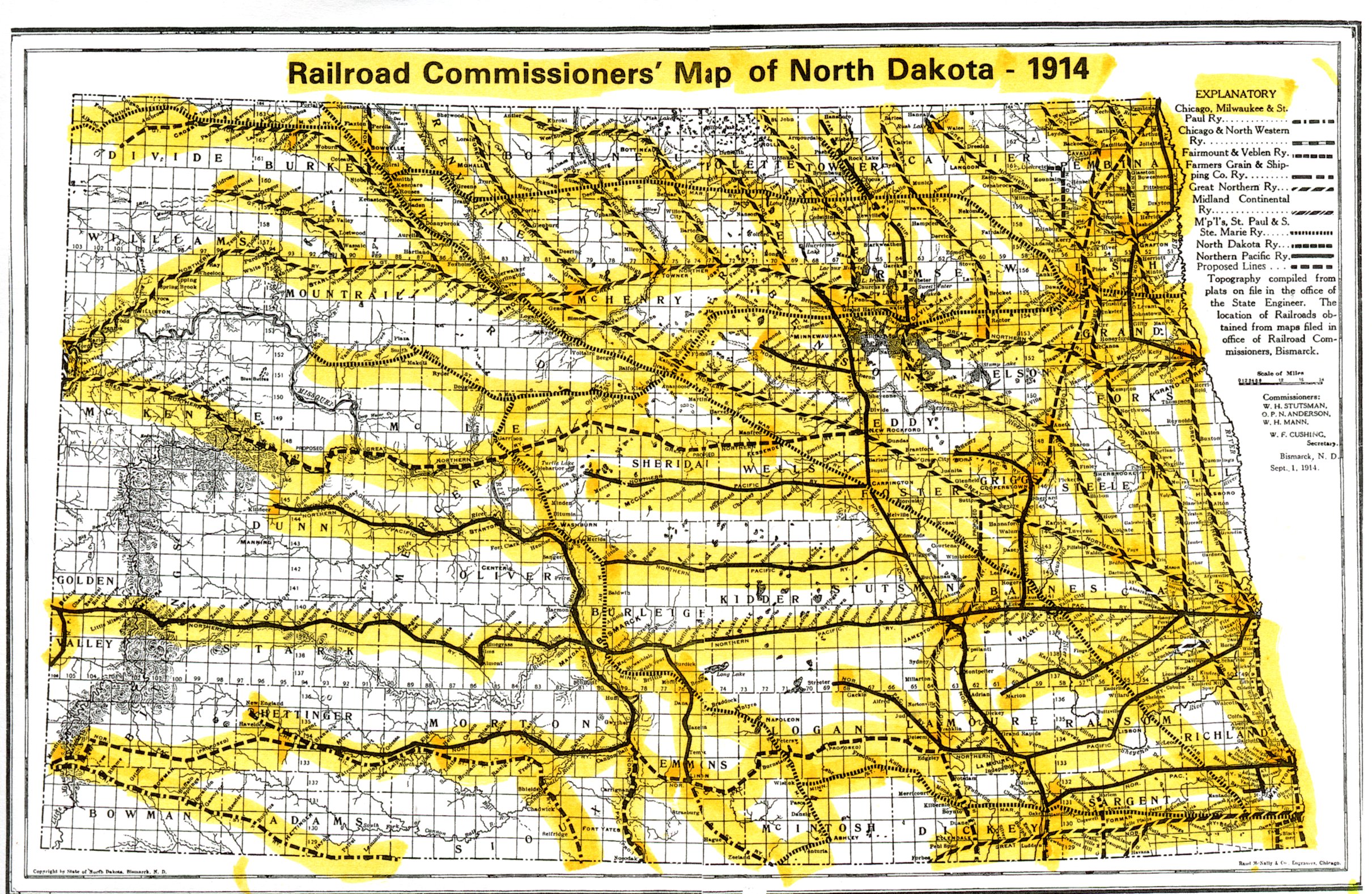
When we travel these days, my route is mostly interstate highway.  But today I’m thinking back to the time in the 1850s when my ancestors began their move from rural Quebec (“A” on the map), ultimately taking, starting 1878, homesteads at Oakwood, near Grafton ND (“P”).  (A pdf version of the map with legend is here: Transportation 1800s.  This is a working draft, your input is invited).

Every family story is different, but what follows might help you in exploring your own family story, regardless of where they came from, or when.  Getting here, for the pioneers, was not easy.

I live in suburban St. Paul MN (“I”), and have traversed the entire Quebec to Twin Cities to Winnipeg route at one time or another.  From my home to Grafton ND is 371 miles; to St. Lambert QC, 1,148.  Thus, the total trip back in those good old days was over 1,500 very difficult miles.

Exactly how one traversed those 1,500 miles depended on circumstances at the time.  These varied greatly, and the travelers rarely kept records.  So, when a Grandpa told his grandkid some generations back that he “ice-skated from Canada” to North Dakota, who’s to know?  (This seemed implausible to me until cousin Remi related that some ancestors near froze and starved  stranded in a frozen Lake Superior bay near Duluth in about 1870.)

The travel was by no means random.  It was based on whatever was known and available at the time.  Every story is unique.

*

Here are some of my picks of crucial mid-19th century locations facilitating or impeding migration from eastern Canada to todays midwest.  See the map.

Take your pick of the stories, means of travel and routes used, if you’re one of the hundreds of thousands of Minnesotans with French-Canadian ancestry, and millions of others, some of whose ancestors might have travelled from the east to the midwest way back when….

C” is Sarnia Ontario and Port Huron Michigan.  The cities are on the opposite sides of the St. Clair River at the mouth of Lake Huron.  Port Huron became a U.S. Port of Entry in 1857.

D” is Sault Ste. Marie where locks made traversing into Lake Superior possible beginning 1855.

K” is Rock Island IL, on the Mississippi, was reached by rail from Chicago in 1854, a truly major event encouraging migration into what is now Minnesota.

In 1867 the railroad reached St. Paul (“I”), and in 1872 it reached Fargo-Moorhead (“M“).

Before that, beginning about 1820, to 1872, oxcarts carried traffic from Red River area to St. Paul.  St. Anthony Falls and other rapids stopped steamboat traffic at St. Paul.   Steamboat travelers arriving at Duluth heading west in the 1870s, had to take a train to St. Paul – there was no direct route from Duluth to Fargo until later.

In 1859 steamboats began to ply the Red River of the North; the coming of the railroad to Fargo increased their impact.  These were not pleasure boats, and the Red River was nowhere near the straight line it appears on a map.  Georgetown MN, just north of Moorhead, benefitted from more water supplied by the Sheyenne River, which entered the Red a short distance upstream.  Of course, the Red flows north, and this is the season of the year when water backs up behind the still frozen river  further north.  Spring is always interesting.

The traverse which seems most daunting, at least to my minds-eye, is the one from present day Thunder Bay (“E“) to Winnipeg (“S“).  It was the Dawson Trail, hacked out of the wilderness about 1868-70.

In summary: back then travel was more than a minor adventure!  There are fascinating histories easily searchable on the net.

*

Following are a couple of stories related about life and travel in those long ago days.

My cousin, Remi Roy, recently wrote about ancestral travel  from the east to Manitoba, via Minnesota and Red River.  Following are three separate snips from Remi’s nearly complete family history.  I present them exactly as written.  I simply take three separate snippets from recent e-mails for this mosaic.

Remi: My great great grandfather Hilaire Roy was born in Beaumont Quebec in 1829. Poverty stricken, he moved with his family including great grandfather Absolom Roy who was sixteen, to Fall River Massachusetts in 1872, where tens of thousands of Canadiens (French Canadians) were already. They all worked in cotton mills, even the younger children aged 12 and 8 (Willamene). in the worst sweatshops and densely populated tenement slum in America. A journalist wrote that “it would be an abuse to house a dog in such a place”

In 1876 the family moved to a Metis village, St Jean Baptiste, Manitoba [on the Red River a few miles north of the U.S.border] to homestead, after a 3-week dangerous journey through the Great Lakes. They were stranded for 8 days on the ice on the narrow Duluth Bay. Starving, they finally walked a great distance to shore.

The Metis helped them through the bitter winter that year in St Jean Baptiste. Willamene later married a Metis boy from the village and changed her name to Mary King (English version of Roy). One of her sons was killed in WW1. Absolom married and moved to Walhalla, North Dakota, once a Metis town, and then with his wife and 12 children, to Lampman [Sask] in 1903. In 1905 Hilaire came to Lampman after the death of Absolom and stayed a few years. He then moved back to Fall River sometime after 1911 to be with his brothers, quite a journey in those days for someone in their 80’s. He died there at the age of 88, in 1917. His family put up a beautiful headstone as Absolom’s family did in Lampman…

*

“It was more a convenient as well as a smoother journey from Eastern Canadian for settlers to take a Great Lakes steamer to the American side of the border, catch a train to St. Paul, proceed north to the railhead at Moorhead and then board a [Red River] steamer bound for Winnipeg”.

“The boat trip from Moorhead to Winnipeg occupied a couple of days and nights.”   [another version, presented below, also from Remi, suggests a five day trip.  Both versions are logical.].

“The nearest railroad (from Winnipeg) was at Moorhead on the Red River, 222 miles away. Its connection with the outer world was one, or possibly two, steamers on the Red River in the summer, and by weekly stage in winter.”

Ham, George H. Reminiscences of a Raconteur: Between the ’40s and the ’20s. The Musson Book Co  Ltd Toronto, 1921 Distributed Proofreaders Canada (online). [Presumption the time period is 1840s to 1920s]

*

It seems that they considered the train trip from Sarnia to St Paul to be more arduous. It was 725 miles from Sarnia to St Paul by train,, It was a little longer from Sarnia to St Paul via the Great Lakes and Duluth. Judging from the fact that the train trip from Worcester, Mass to Sarnia took 4 days, the trip seems to have taken about the same time for both routes from Sarnia to St Paul…

“The boat trip took about five days and cost $19.00 for second class. The first large group to sail down the Red River from Minnesota to new homes in Manitoba was in 1874. “In 1876, with the aid of barges, a steamboat carried 423 Mennonites, 125 French Canadians, and 27 Scandinavians, all on one trip from St Paul to Manitoba”. Parts of the river were muddy, shallow and there were sharp bends. Hilaire and Absolom were on this boat.”

*

Dick: From my own family history which I compiled in 2010, “400 Years”, page 14:  Fr. Joseph Goiffon, the legendary French Priest who nearly froze to death in a Dakota blizzard, and lived in Minnesota for near 60 years, “is said to have arrived in New York City from France October 12, 1857, and arrived in St. Paul November 7, 1857”.  While Fr. Goiffon’s precise schedule for those first 26 days in the U.S. is not known, it is reasonable to assume that there was little time for activities other than traveling the approximately 1200 miles to St. Paul, then only a town in Minnesota Territory.

…The same book [Father Joseph Goiffon A Tale of a French Missionary edited by Duane Thein 2005] “…recounts Fr. Goiffon’s roughly 350 mile trip from St. Paul to the intersection of the Salt (Park) and Red River of the North three years later.  This trip took 24 days, from October 8 to November 1, 1860….”

Rich sent an 1863 letter about a cart train from Sauk Centre going west: Immigration History A Cart Train to Dakota

In my March 31 post about a “Pitcher” (picture) was a photo from the 1880s of homesteaders most likely in Walsh County ND:  There are at least 10 people in the photo, men, women, children: ….

Mid-1880s in Grafton-Oakwood Walsh County ND

SUMMARY COMMENTS: This is only a tiny look at the topic of immigration to the new land of the Midwest.  The reader is invited to learn much more about not only the specific topic addressed as it relates to your own family, but to study also the issues of treaties and the treatment of the native peoples. etc.  This region does not get as much attention as others, so it is generally less talked about.  This is a good opportunity to learn.

POSTNOTES April 28:

Remi Roy discussed alternative routes after 1850s.  Of course, as immigration increased, so did technology and need for new technology increase as well.  There are endless stories.

I have found a possible alternative route for the Collettes to St Anthony. I’ve read that most immigrants to Minnesota from the East at that time preferred the route: Rail from Port Huron to  Detroit to New Haven, Steamer to Milwaukie, Rail to Prairie du Chien, St Paul by Steamer. This was all possible by 1860. It was the shortest, fastest, and cheapest way. As for Samson and Gervais: Steamer from Montreal to  Buffalo, Detroit, Mackinaw Strait, and Milwaukie. This is the route that immigrants from the East took to Milwaukie and Chicago at that time, beginning in 1837. Then there was a road to Dubuque to transport lead from the mines (the cheapest way to move lead to the East). Then the Mississippi to St Paul. At some point, the river was only four feet deep, and there were rapids, but the boats were able to get through..

Dick: Not all took the easiest route.  For instance, my Collettes moved from Minneapolis area to Oakwood beginning 1878-80.  There were about 15 in all, men, women, children.  The consistent story, so far, is that they “walked” rather than taking the available railroad and steamboat, which cost money.

From Remi Roy April 28:

A very interesting trip. I would like to do that someday. I’ve only been to Fargo, Grand Forks and St Boniface. I don’t know if you noticed my section on names. Bernard is the second most common name in France, but 110th in Quebec. Attached is a picture of the Red River at St Jean Baptiste, torturous indeed. I noticed that on the Simon Blondeau naturalization document, it does not mention point of entry like the Collette documents. That would have given me a clue as to Narcisse Samson’s journey, The Blondeaux route was probably similar. The trip on the Great Lakes was dangerous, as you mentioned, lots of shipwrecks and fires. A trip from Montréal to Buffalo in 1847 took 54 hours, but from Buffalo to Milwaukie it took from four to eight days,  a much faster clip sometimes , which I don’t understand. The fare was as little as $4 in steerage, around $150 today, about what the cheapest flight costs today. I perused the book Esquisse de Saint Henri. It is mostly a history since 1900. The older history is borrowed from Edmond Roy’s History, (he was a nephew of Hilaire). One thing I did find out was that Jean Vermet, grandfather of Mathilde was a pioneer, founding colonist of St Henri it seems.  In the 1762 census he had 3 acres of broken land, 2 cows, 2 sheep, one horse and one pig.

“The Steamboat Association was again in control in 1844 with a fixed rate between Buffalo and Chicago of fourteen dollars cabin class and seven dollars steerage, but within a year or so independent operators were cutting that rate to as low as four dollars steerage. The tide of immigration from Europe was now at its height and the Sentinel makes mention of the piers being congested with boxes and bales and newcomers’ belongings after a visit of the Nile and the Empire on the same day.” …

“It was the same month (November, 1847) that the propeller Phoenix, loaded with emigrants from Holland, burned just north of Sheboygan (close to Milwaukie) entailing a loss of one hundred and ninety lives. It was one of the saddest catastrophes of the lake, whole families perishing with all the belongings that they were bringing with them to their new homes.”

This article first appeared in Inland Seas in Summer 1949.  1949 was the only year that Inland Seas published less than four issues; only two were published, Spring and Summer.

I just heard  the craziest expression; « manger un steamer de marde avec une braoule en fer blanc pour pas qu’ça rouille. » To eat steamed shit from a shovel of manure made of tin so it won’t rust –in other words to be insulted.


Upcoming South Washington County School Election

A friend sent me this message on Tuesday Apr. 18.  I send this exactly as received:

“Do you have any interest in writing about 2 votes for 2023 SoWashCo ISD833 Schools a) Buildings Levy? and b) three School Board seats ? 
Not sure of the 2023 dates – (Jun 22 – Aug 7) and or (Oct 22 – Nov 7)
People aren’t expecting an election in 2023. 
81,921 registered voters – in SD47 Woodbury, SD31 Cottage Grove and SD53
Mar 21, 6:30pm Demographics presented.
19,000 students in 25 buildings; 
(4) schools overcrowded now; 
expect (8) overcrowded and Attendance Boundary shift /Redistricting with +10,000 more houses built. 
DRAFT LEVY presented & feedback accepted
Tues Apr 25, 6:30 – 8pm
Oltman Middle School
FINAL PLAN presented 
Tues May 23, 6:30pm – 8pm
East Ridge High School
Can you send friends to go to the meeting/s? “

Of course, March 21 is past, but not the other dates.

I would urge your active participation.  (Personally, I cannot attend April 25 because of a preceding commitment that evening, but I will participate in other ways, including this post.)

This coming referendum follows an unfortunate loss on a prior issue in August 2022.  I wrote about that election then.  You can read it here.

My analysis last time: The 2022 election was one that nobody “won”, most certainly the kids present and future who aren’t old enough to vote.  The ‘victors’ got their base to vote, which was a small minority of the eligible voters in the school district.  The ‘losers’ seemed to have no organization to promote a ‘yes’ vote.  This is not the school districts fault: Except for generating the rationale for a yes vote, the school district seems proscribed legally from lobbying for its own initiative.  The lobbying is up to the voters.  I would suspect that this will be true again, as it has always been.  Active citizens matter.

Fox News

PROGRAM NOTE: This Thursday evening, on Zoom, Coleen Rowley on Leonard Peltier.  Link is here.  Pre-register.

*

Today [April 18] or very shortly thereafter the Fox trial proceeds in Delaware.  There is always the possibility that there will be a pre-trial settlement – very common in matters like this – so anything is possible.  The case will likely not be “front-page news” on Fox News, regardless of outcome.

Fox and the other major issues of the day are endless and extremely important and I follow them daily. But I am likely going to stop  commenting here – I’m just one person with an opinion.

I’ll keep writing, but mostly on other things which interest me.  Check the archives from time to time.

I have mentioned, before, several very credible observers and commentators who I follow on the assorted legal and political issues.  They post frequently on national issues.  I offer these sources again.  Check out their bios.  Access is free, but I would encourage subscription as support to the writers.  My great thanks to Joyce, who has passed these and other sources of informed comment along over the years.

There are others as well, but keep these in mind for consistently valued insights.  As one of the below quartet always closes her posts, “we’re in this together“.

Heather Cox Richardson: Letters from an American

Joyce Vance: Civil Discourse

Jay Kuo: The Status Kuo

Doug Muder: The Weekly Sift

POSTNOTE:  In case you wonder how I see the Fox case:

Fox lied to his audience about the 2020 election, because they decided their audience demanded the story they wanted to hear: that their guy won, and the election was stolen.  False.

Audience numbers drive advertising which in turn drives revenue for Fox.

It will be interesting to see how Fox News plays this story.

And whether the consuming public will continue to demand fake news as opposed to demonstrable facts.

COMMENTS (please note that comments made to the post are not possible due to technical problems):

from Norm:  Fox News has been the outlet for the  MAGA folks for some time including pushing the Big Lie that the little man-child who would be king had win the 2020 election aka it had been stolen from him because they did not want to lose market share even though FN knew that Biden had won the election fair and square.

So, as you noted, profits aka as maintaining or even gaining market share took precedence over being truthful about the election results because doing the right thing would have offenced much of their market.

It sounds like Dominion has made a good case against FN and its efforts to spread lies and untruths regarding that voting machine company.

Hopefully, the truth will prevail and FN will be held liable.

If not, that will signal the end of any obligation of the press to be held accountable if they spread lies such as those sputtered continuously by Donnie.

Disappointing as well as  disillusioning that FN made the decision to put more value on market share over telling the truth so as to protect its profits stream but…

from John: As an ex ex ex journalist…

Any semblance of fairness or balance of any remaining trust in what used to be called “journalist” platforms disappeared when the Fairness Doctrine disappeared in the mid-80s.
All displayed content now is subject to the whims and biases of editors, or (in the case of much smaller organizations) the presenter of the blog, or podcast, or whatever. The only true remaining news source is a live camera or personal eyewitness with no voiceover. And even that is subject to the biases and preconceptions of the viewer.
We regrettably as American still have a throw back mentality to the days when “news” was actually unbiased – whenever that was.
I have my doubts of any meaningful change from this Fox/Dominion lawsuit. The best I can hope for is that Fox is forced to do an on air apology.  My dream is that every one of their telecasts must start with a video of the presenter of that particular segment saying “What follows is opinion only”. And that same clip would need to be replayed throughout that particular segment.


from Dick 3:15 p.m. April 18, 2023:  As this is being typed, the news conference is occurring after the settlement of the litigation.  

Easter

PRENOTE: You may wish to watch this film trailer, in which you’ll see a familiar face – if you know me.  The film will be released in France and the U.S. in the next few months.

There have been three other posts this month: Hoops, Arraignment, Tennessee, access here, if you wish.

*

Thursday morning I watched what appeared to be a full moon as it was setting.  It was a perfectly clear sky, chilly morning.  Indeed it was the “Easter moon” – Christian Easter is always after the first full moon after the Vernal Equinox.

This Easter also coincides, generally, with Ramadan and Passover – I understand that such happens only once each 37 years.  For all of us, this is springtime, and all that means.

In my family collection of old postcards, most Easter cards were secular; here’s one which most speaks to me this year (Lidwina was Grandma Rosa’s youngest sister, probably about 8th grade when this was sent to North Dakota before 1910)

Easter season has its very dismal side.

Last Sunday was the annual reading of the Passion, with the annual “crucify him” from the “crowd”.  Here’s what was read to us (by two women and a man): Passion see p. 3.

Here are the precise words that have fueled hatred for perhaps 100 generations.  “The chief priests and the elders persuaded the crowds to ask for Barabbas but to destroy Jesus…Let him be crucified…Let him be crucified…he handed him over to be crucified…This is Jesus, the King of the Jews”  

The content/context is not optional.  Year to year, event to event, the way the narrative is presented and interpreted might change a bit, but the narrative is consistent and had a major part in fueling the holocaust – demonizing an entire people based on an ancient historical story, generation after generation, as I say, 100 or more..

My particular denomination has tried to soften the text over the years, but nonetheless it remains.  My guess is it will be read again tomorrow night at Basilica at Tenebrae (7 p.m. CDT which you can watch livestream if you like – check Mary.org if interested.  We’ll be there.)

Personally, I think the only antidote to the Passion is to let it be known, as I am doing here.  Eliminating or rewriting this particular Bible story won’t be dealt with in any committee at the Vatican, I’m quite certain.  We collectively need to be the “crowd”, the influencer of change.

A Personal Recollection: 

I’m lifelong Catholic.  I’m also a lifelong citizen of the United States.  Life is an endless series of affiliations: family, groups, nationalities, etc.

We are part of these groups; we are also individuals.  Labels lose something when we become a subordinate part of anything.

I can speak from personal experience about the Passion story, an annual reading during the Easter season, right before Easter, the Resurrection.

The words in the Bible – regardless of which version or edition – are essentially the same.  My Grandma Bernard’s 1911 edition says the same thing as in the Church version from last Sunday, except for slight changes in words – changes which make sense.

At the very end of the Passion, Mt 27-66 in Grandma’s Bible says “And they departing, made the sepulcher sure, sealing the stone, and setting guards.”  In last Sunday’s: “So they went and secured the tomb by fixing a seal to the stone and setting the guard.”  (The King James “Red line” Bible says this: “So they went, and made the sepulcher sure, sealing the stone, and setting a watch.”). And other versions would be similar.

In my growing up years, the scripture readings were always read by the Priest.

In the ecumenical years beginning in the 60s, there were moderate changes in practice by the year.  Typically, as I remember, when the duties came to be shared with Lay people, the Priest would be Jesus.  And there would be one or two lay readers – it is a very long reading.  Once in awhile, not always, but often enough to be remembered, the people in the pews might have a speaking part as part of the crowd calling for Jesus to be crucified.

There is only one specific reference to Jews Ch 27:37 “And they put over his head the written charge against him: This is Jesus, the King of the Jews.

All of us know the potential and the danger of repetition.

Probably about all we can do is to be aware.  the Bible and the Constitution and all similar documents are subject to interpretation and the hands in which their interpretation is vested is important to note carefully.

COMMENTS (comments may not be enabled at end of post – technical issues still being fixed.)

from Joyce: When I studied biblical hermeneutics in college, I learned that, based on linguistic analyses, the Barabas story was inserted after Constantine made Christianity the official religion of the Roman Empire; it was added to make the Jews, rather than the Romans, guilty of crucifying Jesus, even though crucifixion was a Roman practice, not a Jewish one. That insertion was responsible not just for the Holocaust, but also for Jewish massacres for hundreds of years before that. Easter was always a particularly dangerous time for the Jews of Europe, when priests would order their flocks to murder Jews not only because of the Barabas story, but also because of the so-called blood libel, the claim that Jews used the blood of Christian children to make matzoh.

from Kathy: Thoughtful review of the Passion narrative…I never have liked reading “Crucify Him!” I am on the search for my Iberian Sephardim ancestors. Did any Iberian show up in your DNA? If so, quite possibly you have Jewish ancestry. That’s another story 🙂

Blessings at Easter!

response from Dick: Kathy is French-Canadian and Irish ancestry.  I am 100% French-Canadian and German, no indication of Sephardic Ancestry, but we are all “coats of many colors” in my opinion.  Here’s a short article which may help understand.

from Jeff: funny, your website IP blocked my comment [see my response, below]…here it is:

I attended a bar mitzvah for a nephew at an orthodox temple in Chicago 2 weeks ago.  The passage from Torah that was read and the bar mitzvah lad read was the opening of Leviticus.  Essentially lots about blood sacrifice, the rituals and rules of sacrifice, and the sins or forgivenesses revolving around sacrifices.  Karen Armstrong’s work on religious history has pointed to prehistory and the ritual of sacrifice/blood as universal across many cultures, it stems from the hunter gatherers being nourished by the “gift” of food from a large animal in a time of scarcity and limited technology.  Certainly nothing exists in a vacuum. Happy Easter and a blessed Passover.

I also wonder if you have seen the documentary of John Paul II currently a hot topic politically in Poland where the right wing authoritarian ruling Law and Order party is cleaving to John Paul to maintain its electoral advantage in the upcoming election.  Apparently a new one, which looks into the good Polish cardiinal’s sweeping pedophilia under the rug in Poland before he become pontiff.

from Dick: re “blocked comment” – technical issue with the IP provider.  Hopefully soon corrected.

Last night we attended Tenebrae at Basilica.  The church was pretty well packed.. It was a long service.  The only speaker was Rabbi Marcia Zimmerman, long-time senior Rabbi at Temple Israel down the street (35 years at Temple Israel, the last 22 senior Rabbi, highly respected).  Her remarks were very honest about the history, and very well received – a sustained and vigorous applause from those of us in the pews.  This practice is a long time tradition at Basilica.  First time I can remember it was in 2000.  Here’s how the 2023 program introduced Rabbi Zimmerman: “It has been our custom for many years to invite one of the Rabbis from Temple Israel to preach on this most holy night.  For many years, they have graciously accepted our invitation and have moved our congregation with their words of wisdom and healing. Tonight, we welcome Rabbi Marcy Zimmerman, Senior Rabbi at Temple Israel to speak to us.

Earlier in the program was a choral rendition of a poem found by Allied Troops, a vestige of the Night of Broken Glass in November, 1938, titled “Even When God is Silent”: “I believe in the sun, even when it’s not shining.  I believe in love, even when I feel it not.  I believe in God, even when God is silent.  I believe.”  Per the program, the poem was  “written on the walls of a basement in Cologne, Germany.  It had been written by someone hiding from the Gestapo.  It is one of the most poignant poems and extraordinary testimonies to faith under horrible circumstances.”

We, the people, need to face the facts: the only solution is each one of us.  Period.


from Jeff: Cologne is a good Catholic town…been there many times on business…different vibe in the Rhineland than in other parts of Germany, especially the north and east

and central where its very Protestant. Well nowadays mostly secular.

Tennessee

This afternoon I turned on the television about the time the Tennessee legislature was about to expel one of its members, Justin Jones.  The details will be all over the news, including the fates of two colleagues, Gloria Johnson and Justin Pearson.  There will be more than enough detail on the regular news, so I’ll not rehash.  I was only somewhat aware of the situation that I was witnessing on TV.

After Mr. Jones was expelled, I needed thought time.  I went for one of the “covid drives”,  I used to take during the pandemic.  This day it was the drive on Grey Cloud Island, more or less 10 miles, enough time to reflect on what I was witnessing in that State Capitol building in Nashville, Tennessee.  (As I wrote, the floor deliberations continued.  One young legislator (African-American male) was expelled; the 60+ year old white woman legislator, a former teacher,  has survived by a single vote, the third black man legislator had not yet been decided, but he was later expelled as well.)

As I drove a short while ago my thoughts went back to the Edmund Pettus Bridge in Selma Alabama March 7, 1965.

2023 is not 1965.

April 6, 2023, in Nashville TN can possibly be one of the important Edmund Pettus Bridge moments in todays Civil Rights movement.

*

We tend to forget that the 1960s were young people’s movements.

In 1965, Martin Luther King, Jr. was a young man of 36, he was elder among most of the protestors, people like John Lewis, 25, nearly killed that day. (King didn’t live to age 40; Lewis died at 80, after years as a Congressman.)

In the Tennessee State Capitol today the two young men were in their 20s, I think, and were they incredible.

They each had been elected to represent about 70,000 citizens.  That is about the population of my own Senate District here in Minnesota

This time in history the young folks have advantages they could not have had 58 years ago.  There is a different dynamic.  In 1965 there was no potential of parity for the folks on the bridge against the Bull Conner types on the other side.

The then-generation were pioneers; teachers for the future.

2023 is not 1965.

In 1965 power to the people was just beginning.  Those old enough to remember the 60s know it was a somewhat messy route to major and positive changes (some of which are again at risk).

The 60s were nothing at all like today in the ways people could communicate, instantly, internationally.  On and on and on….  Ask any old-timer.

1965 and the other years were foundation years.  A foundation is necessary to build towards the future.  Hopefully building up, rather than tearing down.

The critical ingredients for change, then and now, are courage and determination.  Power has rarely been given up graciously by its possessor.

*

A few weeks ago I was sitting in a synagogue meeting room talking to some folks at a table after we’d listened to some clergy who’d visited Civil Rights places like Selma back in January.

I wrote about the experience here.  It’s title: Activism.

At the table, when it came my time to comment I told the folks what I had written on my comment card:

I truly believe what I said to my table mates that day: “Evidence of Progress is Pushback”.  “Pushback” is what happened at the Tennessee State Capitol today.  Yesterday may have been a setback, but don’t forget that it is “evidence of progress”. Those who expelled the two young black legislators are on the losing side of history, and are terrified.

Wherever you are, keep on, keeping on.

POSTNOTE:  In the end, the white lady missed being expelled by one vote.  She was asked why.  Color of her skin….  She’s a hero too, and we’ll hear more from and about her in coming days.

As I finished the postnote, this commentary came into my e-box.  It’s title was exactly the same as mine.  Great minds…?

Here’s another from Jay Kuo on Friday.

Arraignment

I asked my search engine just now “how many people are arraigned in a year in the U.S.?“.  Of course, the answer was almost instantaneous: “There were over 4.53 million arrests for all offenses in the United States in 2021.

Sometime later today one of those arraignments will happen on Manhattan, and sometime after that the indictment will be unsealed, and we will all have an opportunity to know what the charges are.

Virtually everyone knows who Arraignee #1 will be later today, and that person is not someone being arrested for possession of drugs or such.  Nuff said on that.

For weeks now there has been speculation filled with certainty fueling passionate opinions about what an unsealed indictment will say later today.  I know as much as anyone else, which is nothing.

To this point, I’m most intrigued by the fundraising by the victim-in-chief, claimed to be $7 million so far, but impossible to know for sure.

How much is $7 million, really???

Assuming it’s really 7 million, and that a reasonable average donation is $100, this money comes from about 70,000 people among the 330,000,000 of us in the United States, a minute fraction of the total.

My state of Minnesota with 5.7 million population has roughly 2% of the population of the U.S. which comes out to about 2,400 Minnesotans tossing coins in the kettle, perhaps 30 in my town of 70,000.

$7 million is not small change, granted.  A good share of those arrested today would not have a nickel of that for their own defense.  But it is important to keep such numbers in perspective.

There will be endless news once the indictment is unsealed, probably later today.

Joyce Vance gives a good preview with her overnight column, here.

Have a great day.

POSTNOTE 8:15 P.M.  I watched part of the events in the afternoon, and some of the commentary later.  I did not watch any of the talk at Mara Lago.

A commentary came this evening that describes the situation well: we are contending with a pretend Jesus among us who may as well be a divinity.  His base seems disproportionately populated with evangelical Christians.

This is not the first such aberration of the divine.  Back in 1993 David Koresh of the Branch Davidian at Waco, fancied himself, and was fancied as, a latter day Christ on earth.  The destination was catastrophic for Koresh and most of the followers and their children.  From the ashes came acolytes, like Timothy McVeigh, who two years later blew up the Murrah Building in Oklahoma City.

Jimmy Jones and Jonestown comes to mind, and endless others.

The legal issues will take years to sort out.  The next hearing on the NY case will probably not be till the end of the year.  Quite certainly there are other indictments ahead.  Will they make a difference?  Basically, I think it will be up to all of us who believe in democracy to stand up and be counted in all of the assorted ways we will be needed.

*

Thursday Apr. 5 after the arraignment:  Civil Discourse; and Letters from an American.

Hoops

Tonight is the NCAA Men’s Final, the premiere college basketball title in the U.S.

Strictly coincidental, my 8th grade friend raised a question about what we remembered about the old school in tiny Ross ND in 1953-54.  My brother, John, sent along photos he took in 2014, traveling through Ross, and finding the old school being demolished.  We lived in the town and our parents taught in the school for that single year of 1953-54.  We lived in a tiny “teacherage” next to the school itself.

One of the photos was this one of the old gym in the school:

Remnants of Ross Gym, Oct 16, 2014

Certainly the subject of the photo leaves something to be desired – it was wreckage, after all.  The school was being demolished.  But the photo, especially the backboard, brought back a flood of memories to me.

In 7th grade, 1952-53, in another town I got interested in basketball.  But I broke my leg ice-skating.  So, after only two games my first season was over….

8th grade we were in Ross, living right next to the school, and since Dad was administrator I could spend lots of time in the gym, and did.

The season started with a bang. The first two games in this little gym I scored over 20 points – pretty unconscious for an 8th grader:  24 and 22 points if I recall correctly.  It seemed that if I threw the ball up, it went in the basket.

As the season went on, I actually did pretty good, but never reached 20 points again.  But it was my most memorable season.

Here I am in that season.  Look for #5:  This was the high school team.  In the little towns most every boy was enlisted to play.  We weren’t NBA or NCAA calibre like UConn or San Diego State; nonetheless, we could play.

Ross basketball team 1953-54 Dick B #5 front row second from right.  Others, front row from left Joe Omar Donnie Wamre, Dennis Stahlberg, me, Larry Vachal.  Back row from left: Terry Christenson, Richard Rehab, Dean Rehab, Jerry Olson, Vic Cvancara.   Don’t remember coaches name.

Highlight of my year that year, in addition to the first two games, was going to the County tournament in Williston ND.  We were a tiny school, so those in our league would be similar: places, like Epping, Wheelock, Ray, White Earth, McGregor, Alamo, Wild Rose, Alkabo and similar that others may be able to name.

Best I recall, we may have been the first team to go on the floor for the first game in that brand new field house which was, to us, immense.

It was time to go on the floor, and no one wanted to be first, so I took the ball and dribbled out.  To my recollection, there were no fans in the stands, and the scale of the place took some getting used to.  The field house seemed to be (and probably was) enormous.  I don’t know who we played or if we won or lost.  It was just memorable.

A few years later a Williston kid started to build a reputation in that same building.  His name was Phil Jackson, and he went on to many stellar accomplishments ending as head coach of the LA Lakers.

But I beat him to the court back in 1954!

Now it’s near 70 years later, the field house has long been history, but still there are kids dreaming, and that’s a good thing.

Way to go, out there on the driveway, or anywhere you might be.  Keep on, keeping on.

Sunset for the Ross School, October 2014. Photos John Bernard, taken from the footprint of the house we lived in that year.

Ross high school band Williston ND 1954

Esther and Henry Bernard at the Ross School 1953-54.  Dad would have been 47 at the time, Mom 45.

The “Pitcher”, the “Taker”, and some ND History

Spring is almost here.  We expect perhaps 5″ of snow tonight and tomorrow – but next week perhaps to the 50s.  This weekend, a trip back to the 1880s.

Within this week, I shared the below photo with my siblings, and with my French-Canadian colleagues in the French-American Heritage Foundation.  This is a reminder about  the “old days”, specifically around Grafton-Oakwood ND, very likely pre-North Dakota statehood (1889).  The pdf has a larger scale version of the photo.  The specifics about the photo itself are unknowable, but this doesn’t mean the photo is unknowable…a bit of history of a historical area in the midwest.

Mid-1880s in Grafton-Oakwood Walsh County ND

The likely history of the photo is included in my family history, “400 Years, remembering the Cote, Blondeau, Bernard and Collette families”, compiled by myself in 2010: pdf enhanced by my brother : Collette Walsh Co Homesteads 1880s0001.

The fascinating bio of the likely photographer, Henry A. Ball, is found in the Centennial History of Grafton ND, 1982: Grafton ND Henry Ball.

Grafton, in northeast North Dakota has a present population of about 4,000.  Oakwood, a township four miles east of Grafton, is now primarily a farm township with about 250 people.  These are the communities where my French-Canadian grandparents lived their lives.  Grandma was born there; Grandpa came from Quebec when in his 20s.

*

“Pitchers” (photos) were infrequent back in the 1800s, but always significant, including the one above, which I’d guess fairly represents the usual rural scene in the early days of settlement of the midwest.  These were not easy times, impossible for us to imagine in these days.

The photographer, Civil War Veteran Henry Ball, came to Grafton in 1883, the year after the town was founded in 1882, the year the railroad came to the area.  His home town was Berne NY, 25 miles west of Albany.  Some years later he took on a partner, and became a fixture in Grafton area for many years.  No doubt my grandparents and my Dad knew him.

Most any community of any size had somebody like Ball, a “pitcher taker”, as my homies in N. Dakota might say.

*

My ancestors, Collette by name, took up homesteads just to the east of Grafton, in the town of Oakwood.  Their home country was rural Quebec. In between, for about 14 years 1864-78, they lived in what is now the Minneapolis-St. Paul area.

My Grandma, Josephine Collette, was born in the summer of 1881, at St. Andrews, a landing where the Park and Red Rivers intersected.  Her parents had arrived in 1878, among a large community of French-Canadians.  Their Oakwood home was at the Park River, perhaps a half mile from the St. John’s church, still an Oakwood landmark and the place where she and grandpa married in 1901.

*

The above photo is best studied by printing out the pdf and looking carefully at it with a magnifying glass.  Only one person is immediately obvious, but a closer look reveals up to 13 persons in the photo, of which several are children.  There are also two buggies, cattle and horses.

Quite obviously, the trees in the background indicate a river, which quite likely could have been the Park River, but could have been any river in the area.  French-Canadian settlers preferred river locations and long, narrow farms than  the later more common square quarter-sections.  There are, here, two apparently separate households next to each other.

I would guess that the photo was closer to 1883, than to 1890.

There are rich stories in the photo.

*

In my treasure of photos are the below.  The first shows all of the Collette men, from January of 1887.  This was likely on the occasion of the death of their mother, Mathilde (Vermette).  In the photo is their father, Octave, and the Priest.  (There were Collette women too, at least two of them living in the area – apparently this was a specific photo of the men, and more than likely it was taken at the Ball studio in Grafton.). Almost without question, Henry Ball did the portrait.

Collette men January 1887 ND.  My great grandfather Octave is in back row, third from left.  He would have been about 39 years.

*

Three more historical photos are below.  This column started with one old photo.  Similar stories can be found in every single family, everywhere.  What are some of yours?

My grandmother Josephine Collette with her brother Arcidas in 1898 Minneapolis MN.  They were there for the funeral of their grandmother Adelaide Blondeau, who settled in the 1850s at Dayton MN.

A tintype.  Octave Collette and Clothilde Blondeau, my great grandparents at their wedding in St. Anthony (later Minneapolis) in July 1869.  She died in 1916, he in 1925.

POSTNOTE:

After completing the above, I was in the local drug store to pick up some photos.  At the counter ahead of me was an older lady with her granddaughter.  The lady was deaf and having trouble communicating with the counter person.  A manager came to assist, and handwritten notes solved the problem.  Afterwards he and I chatted a bit about what had happened.  He regretted he didn’t have basic skills for such communications.  It was very positive.

The difficult exchange caused me to remember my Aunt Josie, Dad’s sister, born in 1903, who was deaf from early childhood – they believe from some childhood disease.

I seldom saw Josie – she spent most of her school years at the North Dakota School for the Deaf at Devils Lake, and all of her adult years in the deaf community in Los Angeles.  She worked as a seamstress in a factory making clothing – a place where deafness was in some ways a blessing.

When we saw her, we could cobble together understanding.  She could make understandable words.  But I’m sure the disability restricted her associations and opportunities considerably.

She was a neat lady.  She was fortunate in that she did have the deaf school.

She died in 1984.

Josie Bernard at right, next to my Dad, Henry. Their parents Josephine and Henry behind them.  By the time of the photo, Josie would have been deaf for several. years.  Very likely a Henry Ball or colleague photo.

COMMENTS: (WordPress comment section temporarily disabled due to technical issue.)

from Norm: I noted several similarities to what I remember from growing up in north central Minnesota including many similar old photos where people had obviously put on the infrequently sued Sunday best clothes to sit for the photographer

I remember an old log barn on my grandmother’s place that was used to house the two work horses that my bachelor uncles used for farming before they bought their first John Deer M tractor.

I understood that the “horse barn” had been the original house as well.

The wooden fences were still around during  my early years as were several long rows of fieldstone that had been picked off of the fields.  Lots of back breaking labor picking the rocks, setting them on the stone pony (sledge) and hauling them off to the edges of the fields.  A never ending task, of course, as the rocks kept surfacing and no doubt breaking some equipment from time to time as well.

On the other hand, wood was generally readily available and cheaper than barbed wire so with the presence of a strong back and good axe skills, they could be set in place at little expense.

response from Dick:  There is a tendency to romanticize those ‘good old days’. It was tough sledding even in the best of times, and they couldn’t take the first flight out, or even catch the train if things went south.  On and on.  My cousin remembered our Grandma (Mom’s mom) saying that early on there was an occasion where “if Grandpa had had a nickel in his pocket, we’d have left”.  Some struck it rich, but most probably left the dreams behind and moved somewhere to at least make a life.

from Jeff: good post, very much enjoyed reading it…great to have access to the photos.   8 inches here in Burnsville. yuk

Happy April Fools Day


from Carol:  in same suburb: This is the view out an upstairs window – and no, there isn’t normally a tree lying on our roof…  It’s not even broken off, just totally bent over from the weight.  When I saw that (and yes, it was windy here…) I decided to sleep downstairs.  So then was treated to the second power transformer in the area blowing – with two huge explosions each, and the whole outside area turned bluish and sizzled.  We did have power for like 15 minutes between the two outages.  And it’s back on now.  I haven’t felt so vulnerable in awhile.

Woodbury April 1, 2023. We apparently had 11 inches, and I can attest it was heavy, wet snow, that is even now beginning to melt.


Tips

Elba encounters a Tarantula, here.

*

Tuesday Netflix gave a viewing tip:  Waco: American Apocalypse. a three part series which opened March 22.  [See Postnote 2] It’s now 30 years after.  Has anyone learned anything?  Joyce Vance has an very informative commentary on the 1993 tragedy.  (Vance places the Branch Davidian compound 20+ miles northeast of Waco near Axtell TX.  Another well known place in the area, later, was George W. Bush’s “ranch” outside Crawford TX, roughly the same distance northwest of Waco.  Map here. We’ve been to Crawford, in 2007.  Just a tiny Texas town.  We were enroute to Houston, and I specifically wanted to see the sort of ‘shrine’ Crawford had become for the anti-Iraq War folks.  I supported and support their cause.  I wonder if Camp Casey still exists there.)

Fence Crawford Texas June, 2006 (photos by Dick Bernard)

Camp Casey, Crawford TX, June 2006

Also on Tuesday, I watched a great special on Dr. Tony Fauci on American Masters on public television.  It is a superb treatment of an American hero and covers the waterfront.  Information Here.   It is really worth your time.

Sunday afternoon in downtown Minneapolis will be the third and final segment of the recent Pilgrimage of downtown Minneapolis clergy to Georgia and Alabama.  I have been to the first two, and will be at this one as well.  Each program is unique and have been well attended and very excellent, each about 1 1/2 hours beginning at 4 p.m.  More detail here: Civil Rights Pilgrimage 2023.  My on-going thoughts on the reports about this Pilgrimage can be seen here.  I will be adding to it after the last program this Sunday.

Also, Sunday evening on MSNBC, the documentary on Lowndes County and the Road to Black Power,  will air 9 p.m. CDT.

POSTNOTE: Check back later if you wish.  I have some personal comments on the general issue of symbols and violence.

Briefly, on Shrines….

One of my abundant quirks is a fascination with assorted shrines and monuments.  If I see evidence of a roadside placard, I’m inclined to stop and check it out.

Such as well at the Branch Davidian site outside Waco (photo in Joyce Vance commentary).

I have seen probably thousands of such places over the years, remembering all sorts of happenings (probably the most unique was in the early 1990s, with my Dad at tiny Rutland ND where he once had been a school teacher.  At the entrance to the town was a gigantic griddle, to remind visitors of the “world’s largest hamburger” cooked there at an recent event.)

For good or ill, shrines of all sorts attract followers, no less than rural Waco.  So be it.

Two years after the Branch Davidian compound burned, another zealot bombed the Murrah Building in Oklahoma City, killing hundreds.  We’re been there, too.

Good and Evil is a qualitative judgement.  We enshrine both, and narratives live on in hearts and minds of some.

On this day I prefer to think of the ordinary every day people I will see this weekend in this suburban community and in slightly more distant St. Paul and Minneapolis.  Odds are that today will be like all days, where the only people I’ll see are among the daily business of living their lives.  Possibly there will be an emergency vehicle enroute to some 9-11 call, but that’s about it.

The news, of course, will always lead with the incident, of whatever, giving credence to the saying “if it bleeds, it leads”.

But keep the reality in context.  Most of us, most everywhere, rich and poor, are about doing our best; in one way or another trying to make our little piece of turf a little better….

Have a great day.

Postnote 2: After publishing the above post, I spent part of my Saturday afternoon watching all three episodes about Waco on Netflix.  The documentary is very much worth your time.  It closes with the Murrah Building bombing.

COMMENTS:

from Chuck: Thank you!
I wonder if it will mention that Timothy McVeigh was there watching this all unfold…and because of his experience in Gulf War 1, then Ruby Ridge incident he was convinced the federal government was getting to abusive of people’s fundamental rights…and then used his bombing of the Oklahoma Federal building to make a patriotic statement!   He killed over 160 people and a classroom full of children in the day care center with that truck bomb.  He said he felt bad about that …but in his war against the Federal aggressor…they were unfortunately collateral damage.

from Dick: Re “I wonder” – no, Okla City was just a short segment at the end.  I’ve twice been to the park that is the footprint of the former Murrah Building.  It is a contemplative place for sure.  We all have opinions and our own connections with these and other situations.  I wish we would learn from the past.  Perhaps most of us do, but some will never, and the beat goes on.


Tarantula

Advisory: if you’re squeamish about, or have a special affection of, arachnids, perhaps pass this one by.  Here’s a primer from National Geographic.  It’s only a minute or so.

I was browsing a book about King Ranch in Texas, and inside was a sheet of paper, a story, by Elba Gobar, a neighbor and friend of my parents when they lived in San Benito TX from about 1976-87 (Mom died in 1981).  Elba, who died in 2005 at 85, was a hobby writer, like me.  Her writing speaks for itself.  San Benito is a half dozen miles or so from the Rio Grande, about 20 miles from Brownsville TX.  I’m guess this was written sometime in the 1980s, but it’s pretty timeless!

Elba:

“Holy Sh..!”  “Holy Sh..!”  Later I could not believe this came out of the same mouth that for the last ten days had been begging God to help me to handle anything that might happen.

This was my first night alone since Bernard had emergency surgery.  To stay alone is something in which I am totally inexperienced.  Five nights spread out over a period of forty-two years can hardly be passed as experience.  And no, in front of the stove, staring me in the face, was a tarantula legs and all the size of a coffee mug – a big coffee mug.  

Now just what in hell does one to at 11:00 pm with all the neighbors sound asleep?  I tiptoed behind it, got the Decon from under the sink and began “squeezing off”.  At the first spray, off it scurried under the stove.  I sprayed and sprayed.  Boy, did I spray! – under the stove, under the refrigerator, the door sill, a path to the bedroom, under the door and around the bed.  I locked the door and asked God to please leave the Persian Gulf long enough to give me paralysis of the bladder, at least until daylight.

The next day I brought Bernard home so I was much braver.  Besides having told Debbie of my “hairy” experience, I was ready to try her procedure for getting rid of tarantulas, lizards, crickets, frogs and roaches.

Take one big bowl

Plop down over critter

Weight down with a heavy iron skillet

Call someone braver than you in the morning

That night I was ready for that sucker.  I put out my ammunition and checked every half hour to see if he had returned.  I did not warn him as I do the roaches by saying, “I’m coming.”  Stomp!  Stomp!  “This is your last chance to hide.  I’m turning on the light.”  Stomp!  Stomp!   Not this time – I was out for revenge.  A flick of the switch – A flash of light! – there he was dining on a dead roach.

This time I figured I’d move him out in the open so I would have plenty of room for action. I took one swing with the fly swatter and damn’t wouldn’t you know, I missed.  Zip – under the refrigerator.  Again I sprayed in, out, and around everything.

I still checked every night and sprayed.  By this time I had enough dead roaches laying around to coax anything out of hiding.  No tarantula!  Several days later, in the middle of the day, I walked in the kitchen.  There it was dead in the middle of the floor.

Had it taken one daring chance to escape me, or had it wanted me to know the “Joy of victory”?

Bernard figures I got three roaches and one tarantula per two cans of Decon.

POSTNOTE: Elba reminds me of a close encounter with a gigantic centipede in a house on the Big Island of Hawaii seven years ago.  The centipede was just minding its own business in a shelf outside the house, and I was just taking something off the shelf.  You know the rest of the story….  Thanks, Elba.