POSTNOTE, Wed August 12, 2026: Early this morning I looked up the Minnesota vote in the Primary Election. Source of data is the Minnesota Secretary of State weblink here. At the link choose the tab Election Results, on that page choose 2026 State Primary. All the rest is editorial. In the Flanagan/Craig race, my candidate won. I was surprised by the margin. Of course, this is preliminary to November 3. I had/have no issues with Craig. I felt/feel that Flanagan was the better choice.
Previous related post here (August 2). I have more observations, but let this suffice for now. New comments below beginning with “more from SAK”.
*
Today (Aug 11, 2026( is Primary Election Day in Minnesota. First reports are of an unusually heavy primary turnout.
Per my personal tradition, I do my post before particular events end, and do not make any predictions. Who the public votes for today, remains to be seen. Personally, I voted last week at the government center. As usual, it was a simple, orderly, uncrowded process, staffed by friendly citizens.
The Minnesota primary ballot is basically partisan – you vote the Democrat or the Republican column, no crossover allowed. There were a couple of non-partisan positions on my ballot with more than one candidate. They were the only exception. (Minnesota Democrats: on the partisan side, I voted for Peggy Flanagan.) Results and more comments as a postnote at this space perhaps Thursday Aug 13.
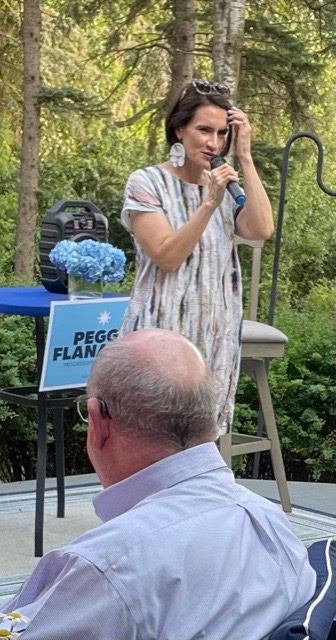
Peggy Flanagan July 30, 2026, Woodbury
Why title this post, “Forrest Gump”?
Saturday evening, on a whim, I decided to watch the 1994 film, Forrest Gump, which I had seen at the time, and liked a great deal, then, over 30 years ago. You have probably seen the film. If not, its theme is basically the 1960s era.
Personally, I found the re-view very powerful, second time around. I saw many parallels to the present time we are living within in 2026.
I would highly recommend taking the time to watch the film before you look at other reviews or the description, and that you watch the film, in context with the present day. It is likely easily accessible on line at low cost.
Your choice, of course.
*
Other thoughts:
A Peace Of My Mind: I first met John Noltner about 2010 at a meeting of the Minnesota Alliance of Peacemakers. He is doing great work in the peace-making universe and most recently shared his recent talk on TedX. Here is the YouTube link to the 10 minute talk. This is well worth your time, and certainly he’d like to see it shared.
Artificial Intelligence (AI): In my most recent post, From A Distance, list member Larry posted his impressions of AI from a personal use perspective (following). This prompted a response from SAK.
Larry: .”just posted my lastest YouTube essay. This is on Artificial Intelligence, today’s big buzz term. I tell in three minutes 39 seconds how I use Gemini. Of special note – you may find the opening graphic interesting. Totally created in about two minutes by Gemini A-I. I just typed in a few thoughts about what I wanted. I plan to make more use of that free service. Here’s the link.”
Today’s Robert Reich commentary was on AI.
SAK:
Interesting Mr Bernard, thanks: the memories, space, AI & all!
To start from the end, your good friend Larry Gauper has a point: if one just uses AI, as you also recommend, to find or make sure of facts, help write & correct, or improve sketches or photographs etc then all is well. It must be pointed out, however, that a search engine uses only 5% of the energy that AI employs to answer the same question – that is when both are capable of answering.
Still it is alarming that a group of top staff at AI firms have recommended that AI be regulated. 100s of staff have asked for a halt to AI development worldwide because of the dangers. Recent hackings by at least 3 AI engines that I learned about make regulation highly advisable – no matter what president Trump says, many are only focused on the stock market & AI is currently one of its main engines, possibly the top one. AI might be “thinking” that it is important to hack to achieve the set goal. For example I used AI to review an article and it felt it quite appropriate to look at the other pages etc open in my browser without my specific instruction or permission!
This ties up neatly with youthful memories & space: I watched 2001: A Space Odyssey many years ago & aside from the music by Richard Strauss (Also sprach Zarathustra which opens the film: https://www.youtube.com/watch?v=5NShEY1ScSY), it imagines a future world where the computer HAL (note each letter is 1 step down from those of IBM!) tries to take over completely thinking it is better equipped at accomplishing the mission than the human crew. The film also starts with scenes of violence & brutality between our ancestral apes – one group discovers that using large bones to hammer the other is effective & bashes them. Sadly many discoveries & applications are devised by the military or soon adapted to serve military ends. Already the space race and the AI race are being funded & justified in the name of national security – at the expense of so many other more useful purposes, some quite urgent like global warming or health services.
Around 2000 years ago, Seneca, a Stoic Roman philosopher, warned about distraction because of mounting papyrus usage and people were hopping from scroll to scroll: these had become cheap & people could afford to buy lots of them! Nowadays people are scrolling & swiping on social media, smart phones & soon, I heard yesterday, a $300 AI gadget. Once one pays for an internet connection, the world wide web is his or her oyster & even basic AI engines are free as Mr Gauper mentioned. If Seneca lamented the little amount of attention given to writings or thinking, he would be shocked to learn how things have deteriorated since. 25 years ago a page or screen item could hold our attention on average for 2.5 minutes. That has dropped to less than 50 seconds now. Compare that to Seneca’s advice to focus on one thought during a day! Teachers complain that students are unable to finish books – often not even a documentary. Such a mind, Seneca wrote is unable to “stay in one place and spend time with itself.”
Another translation I found of the bit from Seneca’s Moral Letters to Lucilius:“the primary indication of a well-ordered mind is a man’s ability to remain in one place and linger in his own company”.
Happy lingering.
[SAK shared a link on Seneca (below) to a very interesting commentary in a recent New York Times. I’m a subscriber to the Times and below is the shared commentary.]
[from New York Times Seneca
Explore this gift article from The New York Times. You can read it here for free without a subscription.
There’s an Ancient Solution to Our Modern Crisis of Attention
Devote your attention to one idea a day.]
More from SAK August 12:
Thanks Mr Bernard,
Congratulations, your Minnesota candidate of choice won & by quite a margin.
I read Robert Reich’s take on AI & its threats – pretty convincing, maybe the link should be even more prominently displayed or moved up on the page 😊?
Is it the case that when left of centre (center chez vous) politicians or liberals are elected they move towards the centre once in power while right wingers become even more right wing when elected? I think of Blair’s Labour party in the UK or Social Democrats in Scandinavia . . . I suppose we should be pragmatic and choose candidates more likely to win elections but:
- Should we also make sure these candidates have values & positions we approve of
- Is there a trend towards more leftist/liberal positions among US Democrats
- Are we quite sure about who is more electable these days
I ask these questions after reading an article in the British Guardian & I would like your take, if you have the time & inclination:
Centrist Democrats dismiss Abdul El-Sayed as a freak radical. Do they want to win in 2028 or not?
https://www.theguardian.com/commentisfree/2026/aug/10/centrist-democrats-abdul-el-sayed-michigan-2028-zohran-mamdani
I am attaching the article in case it’s not available where you are.
I think we should keep in mind an important distinction: there are leftists & leftists! For example Francesca Hong in Wisconsin was seen as too far on the left & lost to David Crowley 39.4% to 39.8%.
The litmus test seems to be whom Senator Bernie Sanders and New York Congresswoman Alexandria Ocasio-Cortez support, they did notsupport Hong.
They did support Abdul El-Sayed though. Sanders supported Rebecca Cooke in Wisconsin against the further left candidate Emily Berge and again Cooke won by a margin.
It is not very different in the UK where the Labour party has recently shifted leftwards but there remains a further left flank that, although it is gaining in popularity, is still not seen as electable.
Since I certainly do not follow US politics as closely as you do, I am very interested in your views & analysis.
Many thanks & best regards
from Peter, longtime friend in New Hampshire: Barus Nuclear AI Aug 2026. He attaches this to the Nuclear conversation as well, which I also published a piece about, recently:https://thoughtstowardsabetterworld.org/nuclear/
SAK responding to Peter:
Many thanks Mr Bernard, I found Mr Barus’ piece very interesting indeed & quite informative. People need to wake up & before it’s too late – perhaps it is!?
So there is AI, there is the nuclear radiation, there is the snooping & lack of privacy & there is the corruption . . . What a toxic mix.
From the good old BBC, yesterday:
The Department of Homeland Security (DHS) spent $464m on 10 used airplanes, but has seldom flown the jets, according to a report by the New York Times.
Citing internal documents and people with knowledge of the no-bid contract, the Times reports that the DHS said it had no time to consider other offers for the plans, and they were needed “urgently” for deportation flights.
In their reporting, the Times notes that three of the aircraft are luxury business jets, which were loaned to two other agencies – including the FBI. While seven other Boeing 737s have been parked in Louisiana, because the department did not have the necessary staffavailable to operate the planes.
The company that received this contract for the used jets, Daedalus Aviation Corporation, has ties to the Trump administration. Its chairman has donated to a Pac supporting the former homeland security secretary Krisit Noem.
& the Guardian had an editorial that details what Mr Barus – and all the “regular” people – are up against. By the way Brockman, mentioned in the article, was in the news before:
“Early this year, the news broke that OpenAI’s president, Greg Brockman, donated $25m to Maga Inc, Donald Trump’s biggest Super Pac. This made him Trump’s largest donor of the last cycle.”
The Guardian view on AI money in US politics: not the way to hold an urgent democratic debate
Editorial Tue 11 Aug 2026
Amid public concern over the impact of new technology, Silicon Valley’s use of its wealth to influence specific election races is an unwelcome development
As the huge societal ramifications of artificial intelligence have become clear, some of the tech industry’s most senior figures have taken to writing thinkpieces on what comes next. The latest to do so is Mark Zuckerberg, who this week published 6,500 words making the case for a laissez-faire approach to AI development. Worrying too much about regulation, Meta’s CEO unsurprisingly opines, could lead to the United States falling behind in the race to own the future.
Mr Zuckerberg’s plea for maximum autonomy is, of course, self-serving. Much of his essay – which airily envisions “invention superpowers” for every entrepreneur and “an abundance of jobs in the future” – reads like unadulterated tech-utopianism. But the lobbying at least has the merit of being out there in the open. As midterm elections loom in the US, darker arts are also being used to counter popular concern about what AI will mean for a host of topics, from the labour market to child safety, the environment and cybersecurity.
Replicating a strategy deployed by cryptocurrency backers in the 2024 election cycle, Silicon Valley is pouring hundreds of millions of dollars into Super Pacs – groups unaffiliated to political parties or campaigns – to ensure that voices sympathetic to its deregulatory AI agenda get elected. OpenAI’s co-founder and president, Greg Brockman, and Palantir’s co-founder, Jo Lonsdale, have given large sums to Leading the Future, an organisation dedicated to “identifying, maintaining, and growing pro-AI candidates”. Vast amounts are being spent to try to tilt the balance in individual contests, sometimes through disingenuous means.
” src=”blob:https://thoughtstowardsabetterworld.org/ef580fc6-b02d-45ea-896a-92ee33fcea81″ alt=”Greg Brockman, president of OpenAI.” border=”0″ class=”Apple-web-attachment” style=”width: 1.25in; height: 1.0729in; opacity: 1;”>
Greg Brockman, president of OpenAI. Photograph: Manuel Orbegozo/Reuters
Earlier this summer, Leading the Future spent $6m on ads attacking Alex Bores, a New York state assemblyman and pioneer of AI regulation at state level. Rather than focus on his AI campaigning, the ads attacked Mr Bores’s progressive credentials, alleging that he had carried out tech work in the past for US Immigration and Customs Enforcement, which he denies. Running for Congress in a Democratic stronghold, he lost a tight primary race after battling what was in essence a smear campaign.
Countervailing forces are emerging. Guardrails Alliance, a union-backed Super Pac, is attempting to combat Leading the Future’s influence, while a bipartisan groundswell of opposition to datacentres is generating serious electoral clout. But as tech companies and their billionaire owners seek to shape and above all limit the scope of AI regulation, their influence is distorting debate in a political culture where the power of money already holds far too much sway.
In his essay, Mr Zuckerberg urges that AI’s democratising potential be protected from those who believe “a small set of experts … should decide what is best for humanity”. He appears to miss the irony that an unelected tech oligarchy, to which he belongs, is already performing that function by default. Its pressure has been instrumental in persuading Donald Trump to cancel the signing of an executive order which would have given the government the right to review new AI models. Its wealth is now being used to attack and undermine dissenting voices in the public square.
If a democratic debate about the benefits and dangers of AI is to take place, such presumption must be fiercely resisted in the US and elsewhere. The semi-covert manipulation of political discussion is no way to map out an inclusive future in challenging times.


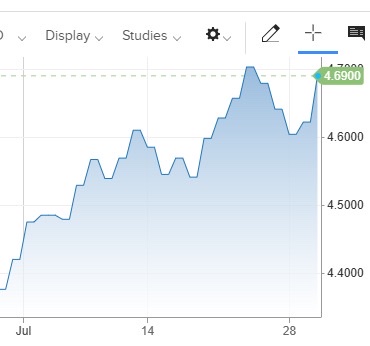 This is pretty unusual!