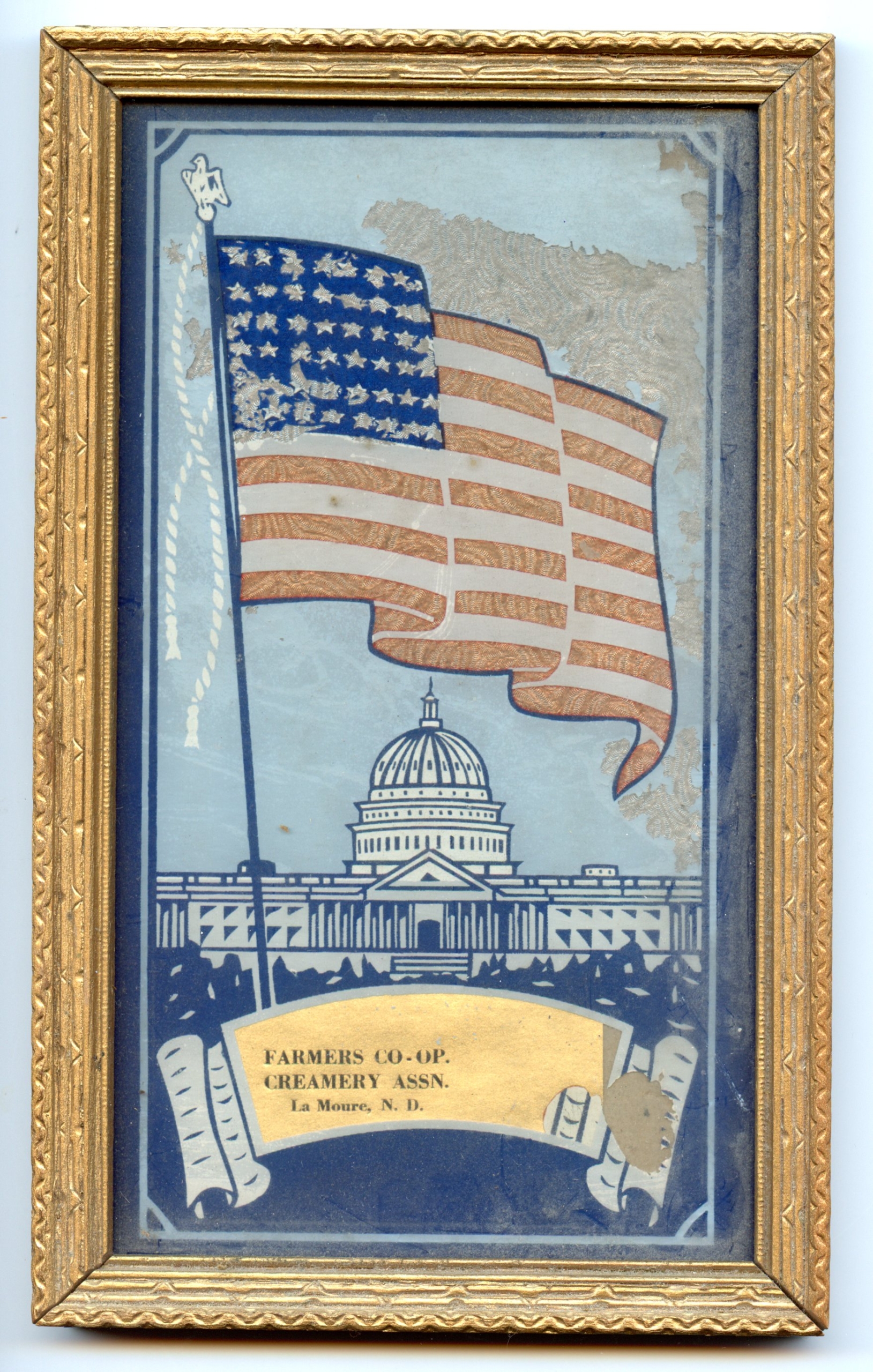
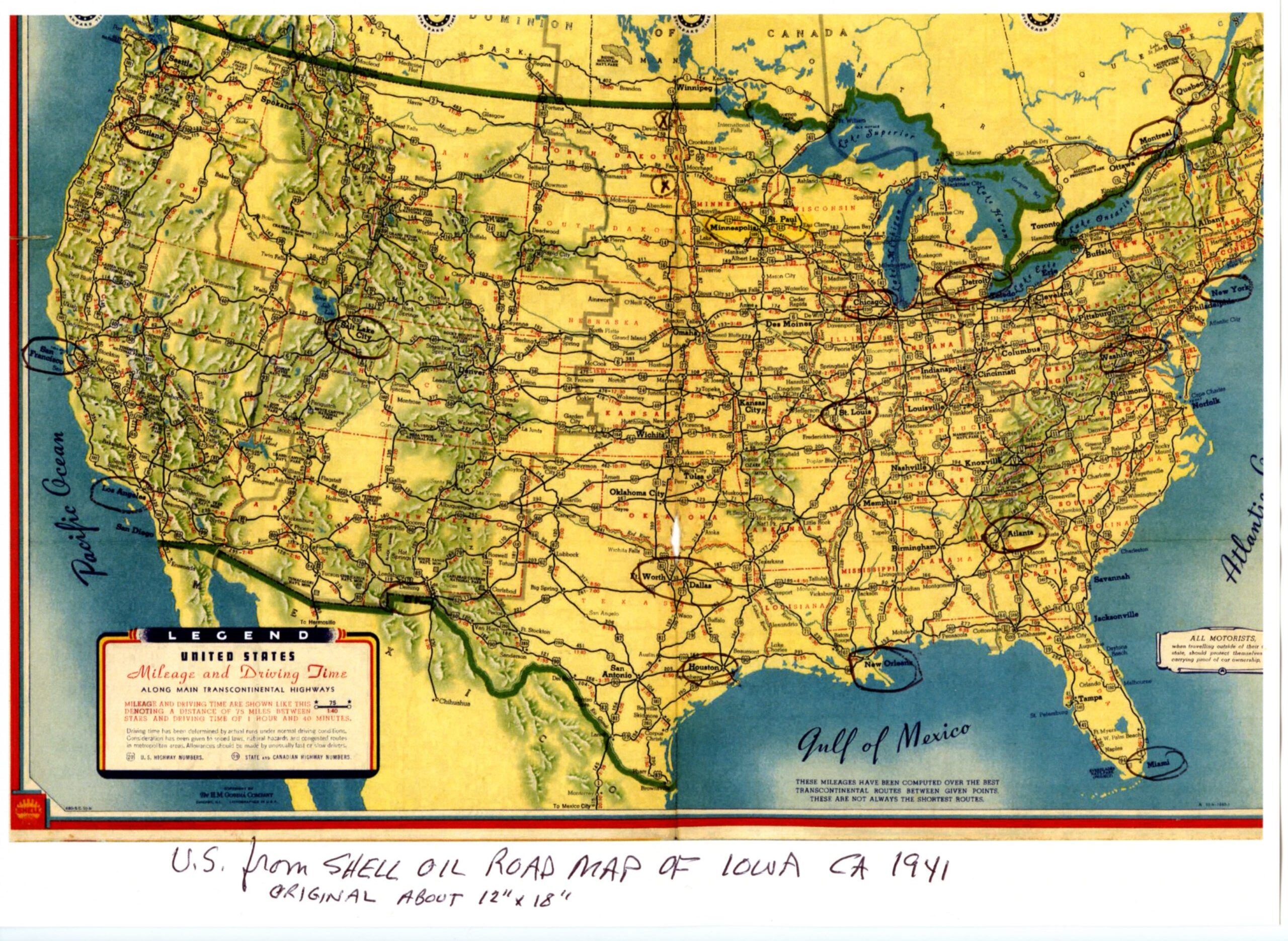
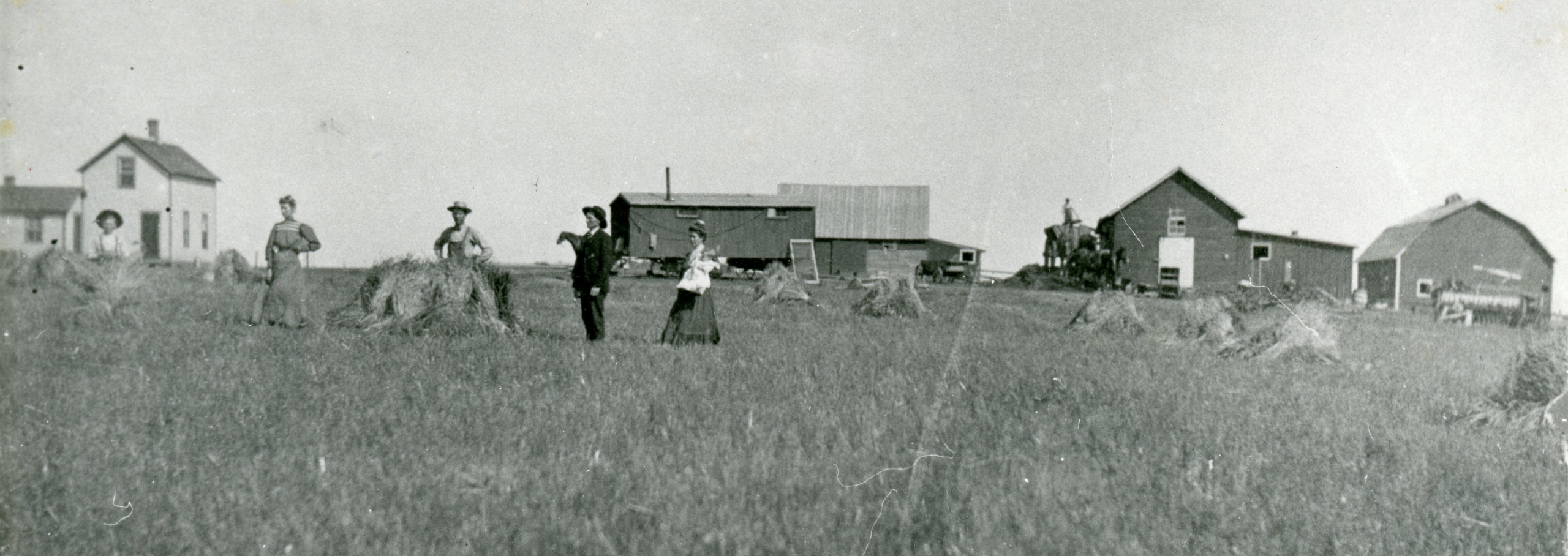
SAK and Jeff on the Past and Present.

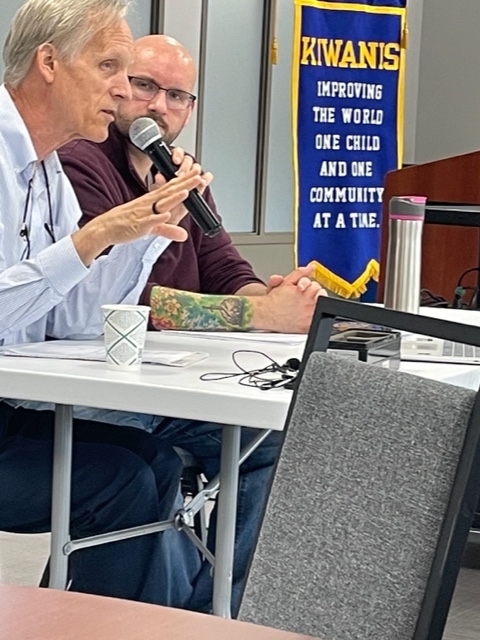
SAK and Jeff are long-time friends of mine who have never met each other.  In fact, I have never personally met SAK, who lives in England.  Both recently filed opinions, and I asked and received permission to share their thoughts.  Their thoughts are well worth your time.


from SAK, May 1, 2026:

Congratulations on the 250th birthday! May the next 250 years be happier and even more prosperous for the United States, and if I may script a variation on a J. F. Kennedy formula, may the United States think not what the world can do for it but, as in times past, think what it can do for the world.

Looking back in order to help with the future, I thought two books by US authors would focus minds on a couple of issues that have not ceased to cause division & worse.

The first is The Virginian by Owen Wister. I came across it in the TV adaptation. That was many years ago & most probably in black & white. The whole book is available as part of the Gutenberg Project.

How could a young man resist when it tells of a “world where justice comes not so much from courts as the barrel of a gun.” Did the book start the “western” theme & craze, I don’t know? Even the western film genre progressed from black (“Indian”) & white (cowboys) to seriously dealing with issues of colonialism & racism, e.g. as in many of the films by John Ford – born to Irish parents which probably had something to do with his outlook.

A particular theme of The Virginian could be that the corrupting forces of the civilised east have diminished man, fulfilment will only come from heading west & embracing the freedom that the frontier provides. That is a bit the story of the hero as well as the eastern author who, after a nervous breakdown & being sent west by his doctor, was charmed by the land & the characters enjoying more freedom, and nobility, than the people he left back east.

In one episode, The Virginian, played by James Drury (in the TV  adaptation) is “forced” to take part in the hanging of a friend who was a cattle rustler, a grave crime at the time, which saddens him tremendously but which he says he would do again as it is the right thing to do. Compare that with the thousands of pardons to friends & supporters by you know who: another case of what the author of The Virginian points to as the corrupting influence of the civilised east, New York in this case, leading to diminished man 😉!?

Wister values the frontier spirit but at the same time laments that it is slipping away. The book & its many adaptations kept the myth nostalgically alive along with a dislike for what was replacing it. “The feel of it struck cold upon the free spirits of the cow-punchers, and they told each other that, what with women and children and wire fences, this country would not long be a country for men.” Think J D Vance & Pete Hegseth perhaps?

The author’s views on equality are readily available in The Virginian as well as in other writings of his. One chapter of The Virginian is titled Quality and Equality.

Wister: “There can be no doubt of this: All America is divided into two classes, the quality and the equality.

The latter will always recognize the former when mistaken for it. Both will be with us until our women bear nothing but kings.”

He writes:

‘It was through the Declaration of Independence that we Americans acknowledged the ETERNAL INEQUALITY of man. For by it we abolished a cut-and-dried aristocracy. We had seen little men artificially held up in high places, and great men artificially held down in low places, and our own justice-loving hearts abhorred this violence to human nature. Therefore, we decreed that every man should thenceforth have equal liberty to find his own level. By this very decree we acknowledged and gave freedom to true aristocracy, saying, “Let the best man win, whoever he is.” Let the best man win! That is America’s word. That is true democracy. And true democracy and true aristocracy are one and the same thing. If anybody cannot see this, so much the worse for his eyesight.”

According to Wister some men are born superior & democracy should allow them to rise & not enforce some sort of social equality. He thought the ways of the west – at the time – were what made America great & these ways were being betrayed. Sadly, as is often the case, this yearning for a mythological past comes accompanied with a distaste for the present along with all its diversity which Wister, along with many, consider as impurity. Thus from an essay he wrote in 1895, The Evolution of the Cow-Puncher, one can read: “No rood of modern ground is more debased and mongrel with its hordes of encroaching alien vermin, that turn our cities to Babels and our citizenship to a hybrid farce, who degrade our commonwealth from a nation into something half pawn-shop, half broker’s office. But to survive in the clean cattle country requires spirit of adventure, courage, and self-sufficiency; you will not find many Poles or Huns or Russian Jews in that district; it stands as yet untainted by the benevolence of Baron Hirsch.”’ Lament amplified by irony.

Few are spared the slurs & similarly nowadays insults of whole groups are dispensed willy-nilly by people in high, or the highest, places. Wister thus continues:

“Even in the cattle country the respectable Swedes settle chiefly to farming, and are seldom horsemen. The community of which the aristocrat appropriately made one speaks English. The Frenchman to-day is seen at his best inside a house; he can paint and he can play comedy, but he seldom climbs a new mountain. The Italian has forgotten Columbus, and sells fruit. Among the Spaniards and the Portuguese no Cortez or Magellan is found to-day. Except in Prussia, the Teuton is too often a tame, slippered animal, with his pedantic mind swaddled in a dressing-gown. But the Anglo-Saxon is still forever homesick for out-of-doors.”

The second book is Margaret Mitchell’s Gone with the Wind.

The book & film capture America’s myth of its own innocence, capture the origin of white grievance, basically that whites are the victims of black equality and victims of racial justice.

Sarah Churchwell’s book, The Wrath to Come: Gone with the Wind and the Lies America Tells, tells of how parts of America refuse to accept that it has done anything wrong. Many of the ideas below, the better ones,  are Churchwell’s.

Gone with the Wind is a big impressive lie but it doesn’t follow that it should be banned: it is literature dealing with complex issues & human dilemmas. I also wonder if any books should be banned at all?

What happens when 2 ideologies come into conflict & one wins over the other? What does the defeated ideology then do? Does it go away or does it go somewhere unnoticed & continues to develop and/or fester. I notice in the Middle East for example the Sunnis vanquished the Shi’ites way back in the 7th Century A.D. The effects of that battle are still with us!

Someone has pointed out the difference between mourning & melancholia. Mourning is linear, with time it ebbs & gives way. Melancholia persists. He pointed to something that afflicts empires etc like the British Empire & referred to it as “post-colonial melancholia”. Empires have to overcome it in order to become a normal state focused on the present & the welfare of its present citizens. The Austro-Hungarian empire seems to have done that admirably & Austria is now a happy place that knows its limitations. The British empire is less successful.  The Russian & Ottoman empires are still suffering from acute nostalgia. The US is facing a slightly different melancholia: post-slavery & perhaps even post-hegemony melancholia.

The author, Margaret Mitchell, grew up with stories of the civil war. She said that she had “heard everything in the world except that the confederates had lost the war. When I was 10 years old it was a violent shock to learn that General Lee had been defeated.” Talking of The Virginian, President Trump renamed Fort Gregg-Adams in Virginia back to its Fort Lee name. I wish he were at least honest about things but no, this is his justification: “We won a lot of battles out of those forts. It’s no time to change. And I’m superstitious. I like to keep it going, right? I’m very superstitious. We want to keep it going.” No mention of dog whistles, it just so happens that the at least seven military bases, one of which is possibly the largest in the world,  were renamed after Confederate officers.

All this propagates the myth of the “lost cause” which was developed to conquer the shame of the Confederacy losing the civil war. A bit like the “stolen election” which the President continuously hammers, facts or no facts.

Mitchell saw herself as a friend of black people & the plantation owners as doomed chivalrous romantics – not as slave owners. The black slaves in the book are not full-fledged characters but are there supporting the main heroes of the novel like Scarlet whose lives are disturbed by the civil war.

According to Sarah Churchwell, “racism is the operating system of the story, it is what it’s about. The narrator never refers to black people as people, not a single time over the course of a thousand pages. They are either called a racial category so she will use either racialised words or she will compare them to animals. So they are literally described as different kinds of dogs or many different kinds of apes, monkeys, gorillas, hounds but literally never as a human being. I went into every single depiction in the book. So it is a textbook instance of dehumanisation. They are systematically dehumanised. The sympathetic black people who are depicted positively are the ones who choose slavery. They like being enslaved. They choose to stay with their enslavers after the war. They resent the Yankees for coming & trying to liberate them and the bad black people in the story, the unsympathetic black people are the ones who assert their own freedom and who assert equality.”

Still it is a compelling novel although it is a misrepresentation. The film played in London’s Leicester Square for 4 years including during the WWII Blitz. Churchwell writes that one of the first acts of Hitler on entering Paris was to ask to see Gone with the Wind. The issue of slavery & how it was handled reflects badly on many countries aside from the US of course. Britain was complicit in the trade & it compensated slave owners for the loss of their “property”.

For a good while during our lifetimes the pendulum swung in the direction of justice and tolerance away from insistence on social purity & the superiority of certain groups. Now it seems to be swinging in the wrong direction. Let us see what the near future brings . . .

Happy birthday!

General Pershing at the Arch of Victory (Arc de Triomphe) Paris, at the end of WWI.  Cover of book found in farm junk in North Dakota.


From Jeff May 2, 2026:  

Its possible that I am reacting to the finishing of reading the book on the demise of the Weimar Republic just today, where there were so many possible off ramps that could have been taken by many groups and individuals to upend the rise and takeover of Hitler and the Nazis…ugh.
The book I read was “Fateful Hours: the collapse of the Weimar Republic” by Volker Ullrich.   Ullrich  is a German historian, this is a translation of his latest work into English.  Ullrich’s thesis is that from 1919-1933 nearly every step of the way things could have been done to stop Hitler and the Nazis. He points to critical moments where parties failed , individuals failed to do what was necessary. Parties and factions within failed to come together to unite and fell into disunity.

Sure, a historian has the benefit of hindsight, but he quotes journalists and others at the time who understood the gravity of several missed opportunities. 

Germany’s unique history leading up to WW1 and its aftermath greatly played into the shifting situation.  There remained a strong anti-republican group based in different regions, the  Bolshevik revolution in Russia gained strength for the Communists and labor unions were already strong, the Center was declining, much of the Lutheran and especially Catholic establishment tended toward the right wing, if not the authoritarian wing, the Social Democrats, as I said, while comprising a plurality missed the urgency of certain moments and like most liberals held faith in the “law” and the “Constitution” and the better angels!
Meanwhile Britain and especially France demanded outrageous reparations and requirements on Germany. The economy jerked around with hyperinflation then a liquidity drain after 1929 and finally huge unemployment and a government from 1930 to 1932 that was sure that austerity and cutting budgets and raising taxes was the cure (John Maynard Keynes and FDR proved them wrong of course)
Interestingly though, the book enlightened me on the German public,  they were not disengaged! Voting rates were from 75 to nearly 90 pct in national and regional elections (no tv, mobile phones or social media to distract them?)  By summer 1932 when the Nazis reached their peak in the elections, the Center Right government was not solving the economic pain, the Center Left was fractured and the Communists were not a solution as they were under the control of the Comintern and Joseph Stalin by then. 

The Nazis were able to become the party of “change”, upending the status quo, and offered a dynamic leader and understood the power of propaganda and new technologies to disseminate much more than the traditional parties.   (sound familiar?)
There was one quote that stood out to me in the book, a Social Democrat member of parliament and wounded WW1 vet named Kurt Schumacher said in 1928: “If we know anything about National Socialism, it’s that for the first time in German politics human stupidity has been successfully and completely mobilized.”
Take out the words National Socialsm and put in MAGA and its pretty much where we are today

Another parallel in the book, is that in one election where 84% turnout happened, news articles suggest there were alot of first time voters, and uninformed voters,  Ullrich uses this inference to suggest the increase in votes for the Nazis in that election…again, sound familiar?

I am far from being calm, or maybe I have finally reached that state, day after day of screaming and banging fists against a wall finally you end up with no voice and bruised and broken hands. Calmness due to inability.
I have been reading alot. Also I recommend watching light stuff on tv to relieve the mind (though since my good wife was gone in Wisc for 2 days and she cannot tolerate any serious movies {enough terrible seriousness in the news and daily life} I watched “The Secret Agent”  the Brazilian movie that won the best foreign film..its a trip and unique)  I recommend the Netflix series “Running Point” with Kate Hudson, its about a comically dysfunctional family of sibs who own what is supposed to be the Los Angeles Lakers in the NBA (fictionalized of course)….2 seasons, quick dialogue, topical, yet mostly traditional.  show writer is Mindy Kaling

Law Day 2026

Today is Law Day in the United States.

For a lot of years after I retired, I was active in an organization who was very active advocate for the rule of law.  Before that, though not a lawyer, most of my work time was spent dealing in one way or another with legal matters such as contracts, etc.

A few years ago, while going through the papers of my friend Lynn Elling, I discovered a 52 page booklet produced for Law Day from 1959, produced by the American Bar Association.  The four links are the entirety of that first booklet, now 67 years old, but more current now than ever.  (The note on the cover was by a prominent twin cities lawyer who was president of the local group.)

If nothing else, read the first two or three pages of the first link.  The booklet is the post.  Certainly share with friends you know who are in the profession of Law.

Law Day Am Bar Assoc 1959

Law Day (2) Am Bar Assoc 1959

Law Day (3) Am Bar Assoc 1959

Law Day (4) Am Bar Assoc 1959


Reflecting at 250 Years

In about two months our country has its 250th birthday.  What is your role in the future or our nation and our world?

I’ve been reflecting on how I, as an individual, fit into the 250 years of the United States of America.  I am, as we all are, individual members of this union.  Everyone has their own story.  Monday I shared a single page thought starter with a small conversation group I’m part of.  And here I share it with you: Reflection at 250 years.  It speaks for itself.   Interpret as you wish.  I’ll share my personal thoughts on May 4.  I’ll welcome yours, if/as you wish, any time.

*

Sunday, April 26, I shared first thoughts in the wake of the White House Correspondents Dinner at the Capitol Hilton in Washington.  The next two days, ending this evening (Wednesday) have been highly publicized and puzzling.

I watched King Charles III speak at the Congress, and I was very impressed with how he approached the topic generally,  YouTube has numerous recordings of the speech, and I recommend that you watch and listen.

Post Saturday night at the Capitol Hilton the President seemed to use the near tragedy as a selling opportunity for his dream of a regal ballroom next to the White House, where the East Wing used to be, and intensified his campaign of retribution..

Here is another old postcard from the ND farm, from 1904, showing the White House from where the future east wing would be constructed the following year (1905), in Teddy Roosevelts term.  I think the proposed new ballroom is an outrageous decision to waste money we don’t have on this kind of frill, but who am I?

White House Postcard 1904

POSTNOTE April 30, 2026: Heather Cox Richardson on the speeches of King Charles III and DJT, here.

*

Finally, I want to share a couple of individual comments generally relating to Iran.  They are opinions written at a certain point in time.  I appreciate their thoughts.  First, from Jim Klein April 9, 2026: the second, on April 20, from Jim Christie.  I’ve known both Jim’s for a lot of years.

I’d invite more such expressions of opinion, especially in the next two months as the 250th birthday approaches.

Chaos

POSTNOTE April 27: A week ago today I learned of the death of a colleague staff member at Education Minnesota, Angel Morales.  Here is the obit.  I really hardly knew Angel – he came on staff a year or two before I retired (2000) and his assignment was to the Rochester local, outside the Twin Cities.  But I did know him.  I would really encourage your reading the obit, especially his request at the end.  I didn’t ‘connect the dots until this morning, when local police officers descended on my walking area for some area training.  They were all wearing black.  The obit and the training brought into focus another reality.  Your choice to read or not.  I hope you do.

5:34 a.m. Sunday April 26, 2026

I wasn’t especially interested, but we were going to watch the White House Correspondents Dinner last night starting at 7 p.m. CDT.

Apparently it had very limited play on TV.  I know it was being carried live on CNN and MS Now.

I watched for about the first hour, then went to bed.  Life is too short to spend the night with speculation about who, what, when, where, why, how the drama unfolded, though the issue in the broadest sense is certainly important.

Stay tuned.

8:06 a.m. April 26: I printed out and read at coffee this overnight post from Heather Cox Richardson, received in my inbox at 12:09 a.m.  It speaks for itself.  This story is just beginning.

4:50 p.m. April 26: Here are two brief comments from folks I consider to be very reliable and well informed sources of information, far above my pay grade:  Joyce Vance, this morning, and Robert Reich, this afternoon.  I expect this story will have legs.  Stay tuned.

8:00 p.m., April 26: 24 hours ago we were watching the beginning of the Correspondents Dinner program.  Joyce Vance filed her update at 6:30 p.m.  At 6 p.m.  CBS 60 Minutes opened with Norah O’Donnell interviewing the President.  The segment is worth watching.  The following segment, an interview with former Nebraska U.S. Senator Ben Sass is also worthwhile.  He is a young – 54 years – man with terminal cancer; a conservative with a message to everyone regardless of party.

2:14 a.m., April 27, 2026: Heather Cox Richardson April 26.

I basically note that President 47 has a single default position: the opposition is enemy, to take no prisoners.  Bad news is always their fault,  This might seem to work in cutthroat business, but it is destructive to a society where people of differing points of view need to live together.  It is destructive for him to blame people like myself – Democrats, liberals, progressives – for all his problems, when he is the one who acts as a dictator, incites division, and complains when his opponents fight back.  His is not a recipe for a healthy community – country, state, town.  But he is not inclined to learn.  There is much more to say, but let this suffice.

*

I invited a few folks from outside the U.S. to comment if they wished.

from Remi in Canada (see also comment at end of post):

Comparison of Firearm Deaths (Recent Annual Data)

The following table summarizes the most recent available annual statistics for total gun-related deaths and specific homicide counts for 2024.

Country Year Total Gun Deaths Gun Homicides Death Rate (per 100k)
United States 2024 44,447 15,364 12.8
Canada 2024 ~800 286 0.69
United Kingdom 2024 ~130–160 ~30 0.25


from Chris in France:

Basically, nobody is impressed by the security that Trump was looking so proud about. How could this happen without a break in security process???
Same with the guy found in the bushes around his property in Mar a Lago a few years ago.
Is he organizing those things to make him looking so strong that nobody can destroy him???
Still, the French think that Trump is enhancing agressivity and violence.
Images provided by him went on TV.
We are tired of seeing him everyday of every month with some more speech or declaration or comment… contradicting the one of the day before….
Well, that’s what I can tell so far.


from SAK in British Isles:

As all leaders & politicians have said: happy nobody was injured or killed.

In the UK there are questions being asked as to whether King Charles III should be around President Trump – safety concerns regarding the coming visit.

Trump accused Europe of being “weak” and in “decay” because countries are too focused on being “politically correct”.

Trump: “If you look at Sweden, Sweden was known as the safest country in Europe, one of the safest countries in the world,” Trump said. “Now it’s known as a very unsafe, well, quite unsafe country. It’s hard to believe that’s true; it’s a completely different country.”

According to recent statistics, Sweden has 1.15 murders annually per 100,000 citizens which is less than the safest state in the US (New Hampshire: 1.9).

District of Columbia, where the White House & the Washington Hilton are, has 33.1 murders per 100,000 annually.

Yesterday at the Washington Hilton, District of Columbia, happily nobody was injured . . .

House speaker Mike Johnson said on X that he and his wife were at the gala and were “thankful no innocent people were harmed and everyone is now safe”.

“We’re grateful as always for the law enforcement and first responders who acted so quickly to bring the situation under control. Praying for our country tonight,” Johnson said.

There will come a time when gun laws will change in the US. A question of when.

Same applies to the current US administration: will President Trump last the term & will Republicans lose control  . . . a question of when.


Jim Christie: Thoughts on Iran

On April 8,  I sent the following to a group of people I thought might have a particular interest in the Iran situation:

“I’m sending this to only a few of you.

I’d appreciate your taking a look at, and perhaps commenting on, https://thoughtstowardsabetterworld.org/war-on-iran/, especially the postnotes for April 6 and 8 at the beginning and end.  
I am no more an expert on Iran or anywhere than any other Americans, but I think there is a lot at stake at how this issue is approached in coming months.
Of course, feel free to share.

April 20, Jim Christie in Winnipeg ‘took the bait’.  Here, with his permission, is his response. 

“You are free to use whatever these few comments are worth wherever you wish, quoting me directly.

First, thanks again for circulating these thoughtful remarks. Making connections with past horrors like 9/11 is instructive for anyone of good will.
Second, the critiques of Christianity and the bellicosity of the Tenakh [the holy books of Judaism, one of which is the Torah] are warranted. Of course the Qu’ran has enormous violence imbedded in its pages, too. The sad reality is that all religious traditions are tainted in this respect. However, surely the pervasive problem is the determination by far too many in every generation to weaponize religion. And one can hardly gainsay the vast positive impact of religion in the lives of so many individuals and cultures. Religion has a place in the public square, but not in the political process.
Third, 9/11 and the current debacle; No two conflicts, despite congruencies, are ever identical. As Twain, I believe, said, “History does not repeat itself, but it does rhyme.”
The horror of 9/11 and the cowboy posse response of Mr. Bush does not compare with the ongoing campaign of the Islamic Republic of Iran to destroy Israel, murder Jews everywhere, and undermine even the best elements of the West, including the ongoing attempt at preserving the integrity and security of persons under law. Leave us not only be cautious of implicitly lauding the October 7 perpetrators, but also of a regime that routinely and profligately murders its own people, from the Baha’i to the January protestors.
As to Israel and Hamas and other Iranian proxies, the Israeli’s exist year over year amidst perpetual existential threats. Those threats are not only external. The extreme Haredim and the unholy Netanyahu cabal are also deadly to Israel. Benjamin Netanyahu is an abomination. But then, forgive me, so is your current President, tragically so during the 250th. Anniversary of your already great Republic.
It’s a mess, Dick. And like so many of our aging generation, beyond raising my voice where possible and welcome, I have reached the stage of life where I mainly observe.
Still, I find it impossible to give way to despair. For me, Easter is.
I find I reflect a great deal on Tennyson. “‘Tis not too late to build a better world.” But our tools are worn, our energy low.
Blessings on your continued thought and voice,
Jim

 James Taylor Christie

Professor Emeritus
University of Winnipeg
Co-Editor/Author, Moral Pressure for Responsible Globalization, Vol. 2
DeGruyter-Brill, 2025

Four Presidents

Kathy alerted me to a 18 minute piece on NBC April 21.  It features brief comments made very recently and personally by Presidents Bill Clinton, George W. Bush, Barack Obama and Joseph Biden.  It is well worth your time.   Link is here.  “Cost of admission” is a 25 second ad.

Here is a chronological list and brief bio of all of the U.S. Presidents.  The list is compiled by the White House Historical Association.

The U.S. presidents and the U.S. Capitol, 1905. All Presidents shown up to and including Theodore Roosevelt (front row far right). Found in the basement of the North Dakota farmhouse of my grandparents, who came to North Dakota in 1905.

The above photo in pdf: Presidents through TR

How do you see our past and present, and your personal role in the future of our country and the planet on which we live?

POSTNOTES:

Wednesday April 22 is Earth Day.  Many local events were held beginning on Saturday April 18, but this site provides information for followup.  Earth Day is every day, and we, not they, are the crucial link.

Other recent posts (click the date for each on calendar at right):  April 11, Jim Klein; April 14, Space Shot; April 17, Tax Day.

It is about two months to the 250th birthday of the U.S.  I would solicit personal perspectives on past, present and future from anyone as standalone opinions.  Your choice.

COMMENTS also below:

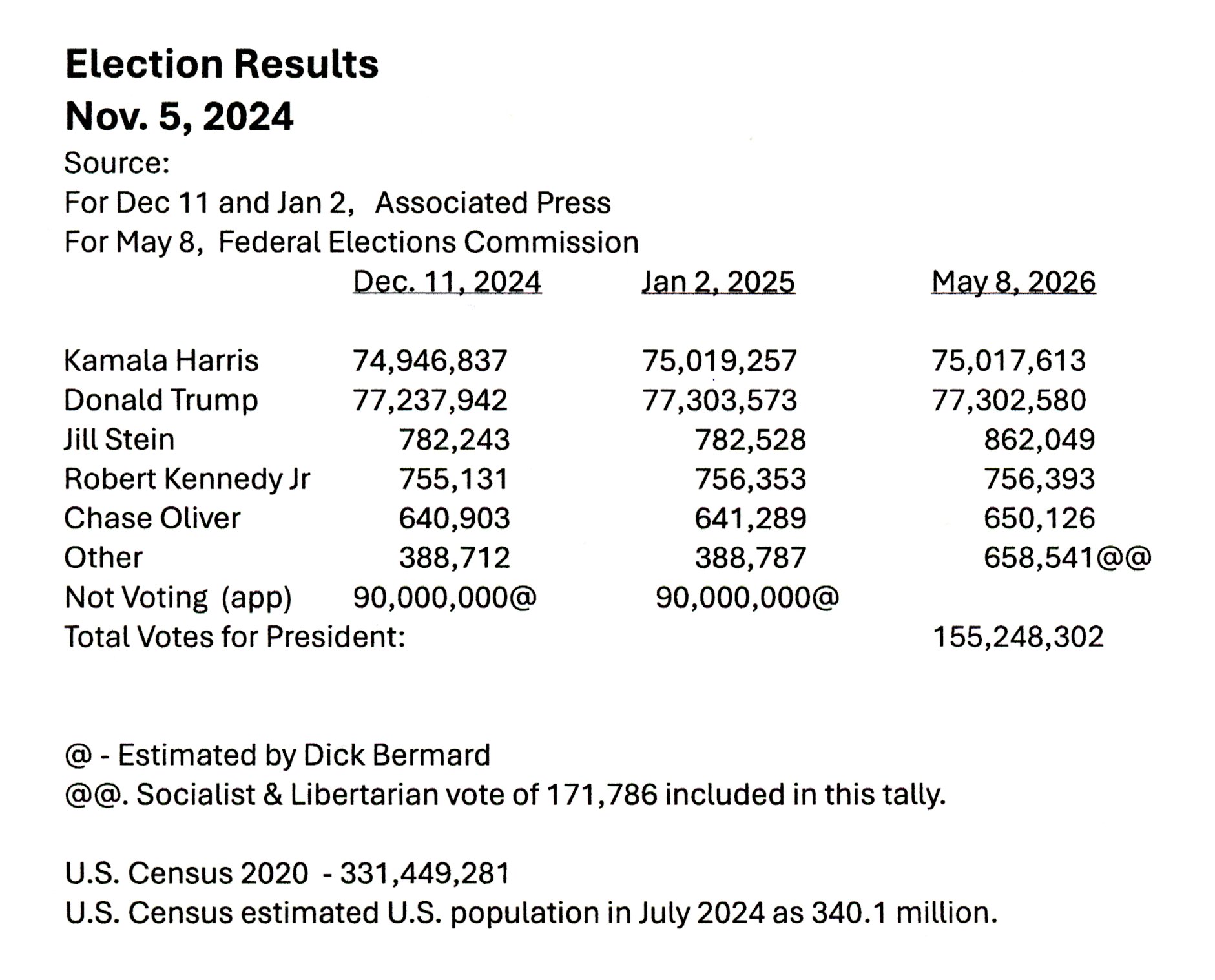
from Jeff:  The fact that a majority of people elected the current occupant 2 times is a sad comment on the state of the USA. He is a depraved narcissist.  as you have often said, it is more the folks who don’t vote who are much to blame

from Brian: Oh Dick, this was so great, it made my night so much happier.   Thanks!

from Joann: Thanks for sharing! I hope their optimism is warranted.

from Jay: Thanks, Dick. Just watched itvery good!


Cuba on my mind.

A year ago today we were about half way through the first 100 days of DJT’s second term.  Speaking only for myself, back then I was suspecting the worst, but in retrospect I was grossly underestimating the reality to come, and we’re only in the second year.

Cuba is on the plate, and I think this is a good time to revisit a bit of our long history with our island neighbor near Florida – a world community which  has about 10 million people, and is about the size of Tennessee.

from A History of Latin America 2d Edition by Hubert Herring 1963 p 405

For me, and perhaps for most, Cuba’s history as a known place began with Fidel Castro in 1959.  There was no particular reason for a common individual to pay much attention to the Caribbean nation.

Years ago I found a 1963 college textbook, “A History of Latin America 2d Edition” by Hubert Herring (see note at end of post).  The topic of chapter 26 was Cuba;  22 most interesting pages.  The books publication was about the time of the Revolution that brought Fidel Castro.

Here is Chapter 26 of the over 800 page book: Cuba H Herring 1963.

If nothing else, read the last sentence of the chapter.  (Also, see NOTE at end of this post).

*

1898  was an important year in this history, at least insofar as Cuba is concerned: “Remember the Maine” the slogan.  Guantanamo Bay became a U.S. presence in the early 1900s, and has its own history.

Personally, I have never been to Cuba,  but I have always had curiosity about it.  Among my friends is a person who as a teenager was part of the Mariel boat lift, and has no fond feelings for Fidel Castro.

In January 1959, the year of the coup, I was a Freshman in College, and have no memories of, nor discussion about, the Cuban revolution.  Our small North Dakota college did have an “Afro-Cuban Review” lyceum program in about 1960 – Cuban dance and music performed by Cubans.  In 1961 came the Bay of Pigs debacle.  I didn’t much connect with that event either,  I likely attended the program, and the name of the Bay attracted the attention of a rural kid, but that’s about all.  I’d had no class on the subject, and thus no test to recall facts.

In 1962, my first stop after college was doing my time in the U.S. Army.  In October, 1962,  came the Cuban Missile Crisis which got everyone’s attention.  Russian missiles were set to arrive in Cuba, a short distance from our shores.  Fort Carson, where I served in Colorado. was a potential and reachable target for the missiles from Cuba.

The crisis was a major story in the Rocky Mountain News Oct 22, 1962: Cuba002.  

I was in an infantry company.  Along with a few other GI’s, I watched President Kennedy address the nation on the Mess Sergeants tiny TV.  It was a somber time.

The conflict was settled in the same week it became public knowledge in the U.S.  It was a very serious threat.  I think we soldiers mostly viewed it as a temporary inconvenience.  I was there, living in the same barracks with the others.  All we knew was that it was settled.

Then, for all the over 60 years since, Cuba has been the enemy, to be punished.

Many years after 1959, a relative of mine, a very prominent citizen of a Minnesota city, recalled the time of the revolution in a conversation.  He had made a bet with a friend at the time that the revolution would last less than six months.  “Lost that one” he said.

Let the conversation begin.

Personal Opinion: We have no reason to feel covered with glory by continuing the punishment of Cuba all these years.  We won’t by piling on again.  We should have normalized relations years ago.  Of course, we didn’t.

ENDNOTE:  The Herring volume (referenced above) is one of three I have that help illuminate Cuba before Castro.  It is available as a used book.

I also have “A Diplomatic History of the American People” 7th Edition by Thomas A. Bailey   This volume, also from the 1960s, has a number of references to earlier pre-revolution American dealings with the Spaniards and Cuba.  The inference I take from its references to Cuba is that the U.S. had an interest in Cuba, even as a potential state, but essentially as a slave state, about the time of our Civil War.

Perhaps some of the tension related to next door Haiti, whose slaves had overthrown the French in 1804, and our own slave-holding nation was not about to encourage another nation of freed slaves in North America.   Haitians have feelings, and have paid a heavy price, for their freedom in their long history, a few miles east of Cuba.

I also have the over 500 page “America’s War for Humanity” (cover photo below), about the Spanish-American War in Cuba in 1898.  The edition I have, apparently no longer available, is the original and focuses entirely on the Cuba campaign of 1898, with only a few pages at the very end about the Philippines and Porto [sic] Rico.  I would most like to learn of its history within my farm family, since my grandparents came to North Dakota in 1905, not long after the Spanish-American War.  And my Dad’s Dad – Grandpa Bernard – was in Manila in 1898 when the Spaniards surrendered.  He was an American soldier.

Of course, it would be interesting to learn even more, but these three books provide a lot of grist for further research.

COMMENTS (more below):

from Peter: Glancing at the first page [of the Harring chapter], I notice something that I think has remained unchanged: the notion that the original inhabitants “disappeared.”

Aside from the obvious, that they were all killed and stacked like cordwood wherever Columbus touched down, I know that the Taino people did not disappear, and remain among us. But Academe will insist that they are practically extinct.

A friend of mine from the pandemic years was an anthropologist who tracked the DNA of Caribbean peoples and verified this. However, when she attempted to report on this to universities, she was rebuffed rather disdainfully by the “experts”.

This book is no doubt a monument to such myths (not in the important sense of “myth” as a transmission of principles of life, but in the sense of a persistent lie embedded at the level of culture, which is now the primary selective process, having superseded natural selection after the last Ice Age.

As such it is extremely valuable, and thanks for sharing it!

from Brian:  I love your post.

Yes, Cuba.  A  few years ago I wanted to go there and had to fly to Mexico to get there since it’s not allowed just for us normal Americans to go there directly.   And coming back to Mexico the customs guy said if I’d give him a tip ($10 US dollars) he wouldn’t stamp my passport–great!

from Jane:  What is happening in Cuba right now is criminal.  The sanctions, the lock-downs, the threats.  Arrgh!

Tax Day

Wednesday was tax day.  I had our appointment on April 8, and had left the prep materials with our advisor,  One problem: one 1099 had gone missing.  The good news was we would likely be getting a refund on both federal and state.  I had no idea why.  There were some peculiarities in some of our line items this year, and I thought we’d be paying in.

We’re in the class that likes refunds.  So I wonder why the unexpected bonus this year.  Let’s say it’s between $1 and $1,000,000 – take your pick where we are on the continuum!

I think the “bonus” is a one time bump thanks to the “Big Beautiful Bill” passed last year.  The bill gives a one-time bonus, while the tax cuts for the rich are permanent.  In other words, let the schmucks celebrate their present while they have it; the rich derive their far more substantial benefits permanently.  At least that’s the narrative.

Of course, there Is another reality facing all of us who have to live 365 days a year.  It is a death by a thousand cuts, more for groceries, stamps, gasoline, etc., paid for by cutting back on luxuries like vacations or new stuff, or added to already too much credit card debt.  Absorbing the added cost on scads of imported items.  This is a reality we are individually and collectively supposed to ignore.

We happen to be middle class lucky duckies: social security, medicare, pensions, even 401-k.  Yes, we earned it all, but all the same we were lucky duckies: we had the opportunity and our employers gave a damn about the workers when we were employed.

Those days are gone unless there is another uprising of the working class.  It is a stretch to imagine it happening, but not an impossibility.

POSTNOTE April 17: Signed the tax documents on Thursday.  The refunds were perhaps four times what I had anticipated.  I’ve handled the tax end since my first return in about 1964, and over the years I’ve tried to keep a balance between withholding and tax obligation – usually I’m fairly close.  I was way off this year, and I think its the tax policy rather than dementia!

I noted that the President was out and about singing the praises of people who live by tips – there is no taxes on tips, I guess.  The implication is that they should be grateful.  But for every dime they save for this one-time benefit, the Scrooge McDucks of the country, the Uber-wealthy, will get thousands of dollars in permanent tax reductions.  When will we learn?

A Little Ride

We watched the conclusion of the Artemis II mission on April 10, 2026.  In all ways it was impressive – a perfect landing.  Only a few dilemmas.  Here was my view as the spacecraft neared touchdown.  I was most impressed with the diversity of the four person crew: a woman, an African-American, a Canadian, and a white man, all stuffed in a tiny vehicle, all eminently qualified for their duty.

Near touchdown. I like this photo since it shows how tiny the vehicle is compared with the surrounding earth.

As I was watching the conclusion of the mission I jotted down on a sheet of paper my own close calls with the space program, all of them as a spectator, but actually more occasions – 15 in all – than I had expected.

For me, first on my list was Sputnik, which I watched from my grandparents farmyard in rural Berlin North Dakota in October 1957.  There was nothing impressive about Sputnik itself – just a tumbling ball in the sky.  This was in the pre-high tech days…but the Soviet Union had won the race, and apparently we were caught unawares.

That first humble satellite which stayed around for only a short time, was very big news, and local newspapers publicized its route if its travels were in the vicinity.  In my case, it was a map in the Fargo Forum which showed the route and time across the night sky – in my memory from SSE in a completely clear but totally dark sky with stars as background.  We knew where to look, and when. and sure enough on schedule came a twinkle moving across the heavens.  It was Sputnik, and as it tumbled it reflected the sun for just an instant, over and over.  I’ll never forget it.

The next on my very short list was the moon landing of Apollo 11 with Neil Armstrong and Buzz Aldrin July 20, 1969.  I was driving on U.S. Highway 2 near Bagley MN, when Apollo landed.  I pulled over to the shoulder.

Late in the evening came the first footsteps on the moon.  We watched it on TV, such as it was in those days.  Here is my screen shot late in the evening that day.  Yes, we had a color TV.

July 20, 1969, man on the moon ‘screen shot’ off TV in Spring Lake Park MN

That compares with the view on Saturday, also on a TV screen.

In the Pacific off San Diego April 10, 2026

I said I had 15 specific contacts with the space program.  Perhaps you’ll see these below, perhaps not.

Everyone has their own opinion about the short and long term value of these programs and their role in the competition to be first.  Personally, I feel that they do add to the considerable advances that have been made in science, but those same advances could be made without going into space.  On the other hand, satellites are helpful to us every day in many ways, such as GPS for road travel maps.

I highly doubt the utility of proposed permanent occupation and settlement of places like the moon and Mars, for just two examples.  Just my opinion.

But congratulations for some great work to NASA.

POSTNOTE, briefly:   I apparently possess a gene that almost compels me to seek out things to see – if there’s a roadside sign, I’ll probably stop and read it….

With respect to the space program,. there was Sputnik, and stopping by the side of the road, and numerous other vignettes related, including seeing the preserved (at the time) Mission Controls in both Houston and Cape Canaveral for various missions.  (The ones before really high tech kicked in, though they used whatever was available in the early days).

Out of the list of things I physically experienced was an e-mail conversation in the 1990s with Myron Tribus, probably the most high-powered intellectual I ever had the privilege to meet.

Myron was a California farm kid from modest circumstances who got his engineering degree in 1942, and early in his career as an engineer he spent time at the Minneapolis airfield as part of a military contingent testing various kinds of anti-icing strategies for aircraft.  This involved some dangerous assignments – they weren’t ever certain that this or that innovation would work, but they were kids.

Their work ultimately succeeded, as we know, and at the time they were featured in Time magazine: Tribus 1945 Time Magazine.

Myron and I got to be good distance learning friends and at some point he sent me an e-mail which I wish I kept, but didn’t.  His story was that at the time engineers worked across borders and this included between U.S. and the Soviet Union.

The American contingent had come up with some extremely complicated formula which was their intellectual property – a game changer.  At some point, Myron was communicating with a Russian engineer, who shared with him a formula which, unknown to the Russian, was the American formula, including some mistake that had been made.

Somehow or other – probably espionage – the secret was out.

Thus goes the world, as we attempt to preserve our secrets, and claim the Moon, or Mars, or whatever as our exclusive turf.  In the end analysis, we all live on the fly speck of a planet, and we live or die together.

Myron died 10 years ago, at 95.  A great guy.  I’m privileged I got to know him, and many others as life has gone on.

Observing the Catholic Church

Today, Sunday April 12, I went to church as usual.  Today’s Mass was in a new venue, still at Basilica of St. Mary  in Minneapolis, but today, and for the next 48 Sundays, the sanctuary is the church undercroft (basement) as the 100 year old sanctuary, and the church generally, is being renovated.

Basilica of St. Mary April 12, 2026, 9:30 a.m. Mass

I’m a regular at Basilica, and I wasn’t sure what to expect today.  The venue was packed, many more than I thought I’d see.

The Priests homily (sermon) today was very similar in tone to Pope Leo’s Easter. message on peace, focusing on what is happening in the Middle East and the immigrant situation in our own country.

A few hours later CBS 60 Minutes lead story involved three U.S. Catholic Cardinals, reflecting on Pope Leo’s position, and their observations of the Church generally.  (They are of Washington DC, Chicago and Newark.)

This church of mine is no monolith where everyone thinks alike – More voted for DJT than for Kamala Harris in 2020.  The recent Popes have by no means been “cookie cutter” leaders of this church which is said to have 1.4 billion members worldwide.  John Paul II, Benedict, Francis and now Leo, the first U.S. Pope, made their mark in different ways.

What the designated leader says is very important, setting the tone, as it were, for the institution he has been selected by his peers to lead.

What transpires down the road is not yet known.  But the first signs are hopeful.

POSTNOTE: 

There is no doubt that the Pope – any Pope – is an “influencer”.  He (always a “he” so far) is freely elected by his colleagues (the College of Cardinals) to lead an immense institution with a very long history.

At the same time, in that room in the above photograph I took on Sunday, if I picked the first ten people around me, all but one, people I didn’t know, and asked some obviously slanted questions, I highly doubt that I would get a clear majority answer about most any “churchy” topic.  People have minds of their own, and they’re sitting in their chair at church for their own reason.

Regarding war, generally, oftentimes the Catholic Church gets stuck with the “Just War” conversation.

In that regard, a few days ago I came across an old file from 2003 which includes many peace-related documents I had saved back then.  One of the documents was a Catholic interpretation of Just War, published in 1993, and apparently still in effect in 2003.  Here it is, if you wish: Catholic on Just War 1993.  (Personally, I would consider myself anti-war, but not a purist.  I think there is evil among us, and peaceful means are sometimes not enough.  But neither is war an answer, often simply aggravating the problem, rather than solving it.  Succinctly, my opinion only, WWII was the only one that I’d consider “Just”, in my own lifetime.)

Janice Andersen’s column in the Sunday Basilica newsletter seems very pertinent to this conversation.  You can access it here: Janice Anderson Apr 12 2026