Grandma’s Bible : A Christmas Reading

Friday is Christmas Day, as celebrated in the Christian tradition.

I note that the Gospel for Christmas this year is Luke 2:1-14.  Following is the 2020 Christmas text and pictures from Grandma’s very well worn Bible (1911).

This is a good time for each of us to reflect on where we fit in this picture.  I’m sure the other religious traditions of our world have similar lessons and basic beliefs.

(About two-thirds of Americans are “Christian” in one way or another; About one-third of the planet is “Christian”.  The percentage is declining.)

As the Gospel recounts, Mary and Joseph and many others made a road trip of about 100 miles at that time.  Google map of the trip as it would be in the present day: here. One can only imagine what it was like over 2000 years ago

In that same Bible are many period photographs of Palestine in the early 1900s.  Here are photos of Nazareth and of Bethlehem as they were in the early 1900s.

From the same Bible is the text that speaks most to me this Christmas.  I heard this recited most powerfully at the Mt. of Beatitudes in  Israel, Jan.8, 1996.  It is worth reading and reflecting on the entirety of Chapter 5.

And from the same Bible, here is the remainder of Chapter 5: Matt Ch 5 – 11 to end (click to enlarge – one page)

All best wishes at Christmas, 2020.

Some manger scenes as depicted in Christmas cards at the Oratory of St. Joseph in Montreal ca 1992: Christmas cards Oratory St Joseph Montreal

COMMENTS (see also end of post)

from Molly: 3 pages, pdf: Molly 2020 Winter Solstice(click to enlarge the pdf)

from Mark: Fantastic post – thank you

from Christina: Thank you, Dick – and Merry Christmas to you and yours.

from Mary: I read this prior to going to church today.  Thank you! Merry Christmas

from Jermitt: Wonderful text with the pictures.  Interesting that she had these pictures in her bible.

Response to Jermitt from Dick: There are 28 of these pictures in Grandma’s Bible.  I will hopefully have all 28 in pdf format by Christmas.

from Laura: Thanks, Dick. A blessed Christmas to you, my friend.

from Lynn: Thanks…

“…All is calm….”

REMINDER:  One day left (today) for “The World Is My Country” online, Dec. 17 for on-line gathering with the producer of the film.  Details here (scroll down to Third Thursday).

*

December 14, 2020: Merry Christmas. Here’s Bing Crosby’s rendition of Silent Night.

In a few days it’s Christmas.  Cathy always does the tree, we’ve downsized over the years from real tree, to a large artificial tree, to a small one.  They’re always nice.

Dec 14, 2020

Downstairs is the creche set I purchased from a Palestinian in Jerusalem in January of 1996 – it’s now 25 years old.  All of the figures Olive wood.  Previously they’ve been on the mantle of the fireplace.  This year on the coffee table.

Dec. 14, 2020

There are other “Christmassy” evidences around.  But this year is very different in our town, and yours as well.

Today is Election Day in the Electoral College in what used to be the United States.  The election is proceeding as I write.  This is the country in which I’ve lived my whole life, now in turmoil.  A new experiment of a tribal country prevails this Christmas.  Hard to find “silent night, holy night” here.  Are you in the acceptable tribe?  Or not.  We will make nice with the loser.  That’s easy.  In “win-lose” everyone is a loser in the other sides eyes.

And there’s Covid-19, of course.  For me, that trip began March 6, 2020.  What follows are a few random photos, mostly from my daily short drives in the nearby areas.  Just a few views of the last 10 months…more months of this to come.

Grim reminder at Basilica of St. Mary March 15, 2020. Final open-to-all Mass day in 2020.  I ushered this day, the last large public event I attended.  Attendance was very low compared to normal….

Forsythia, late April, 2020 Woodbury MN

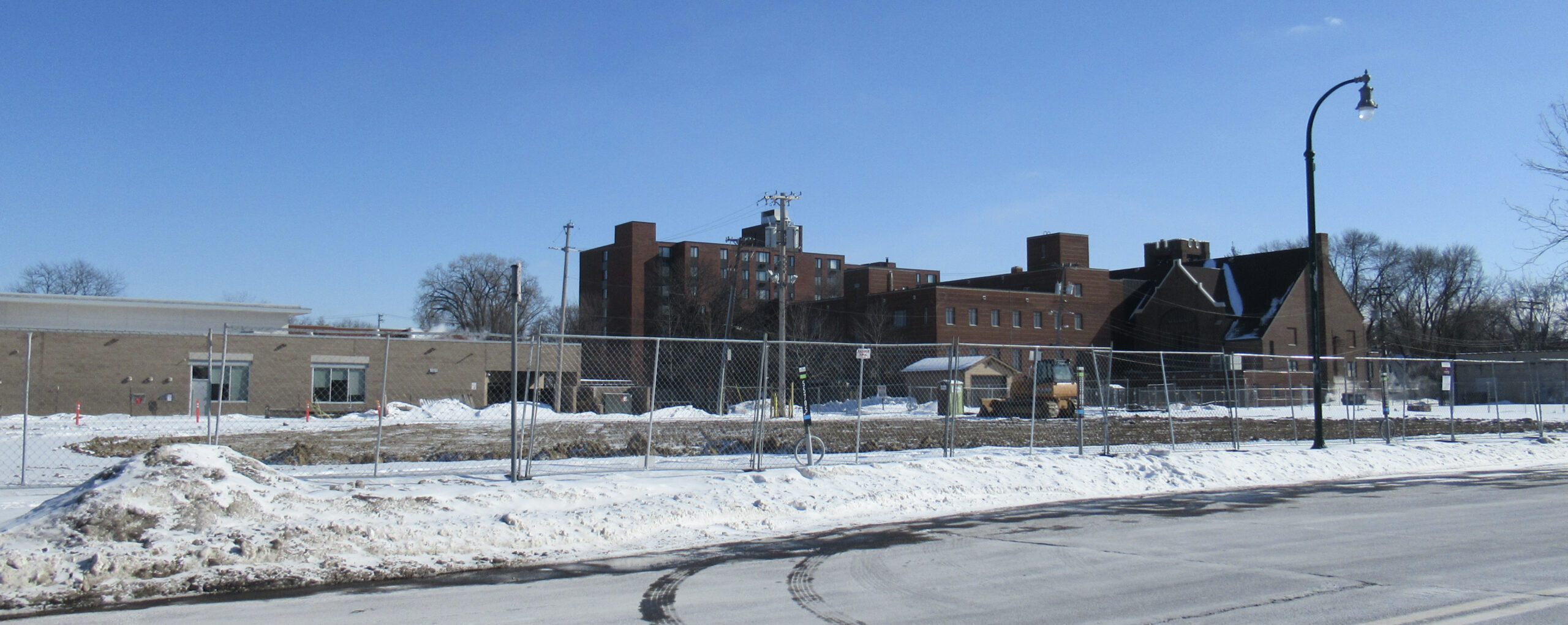
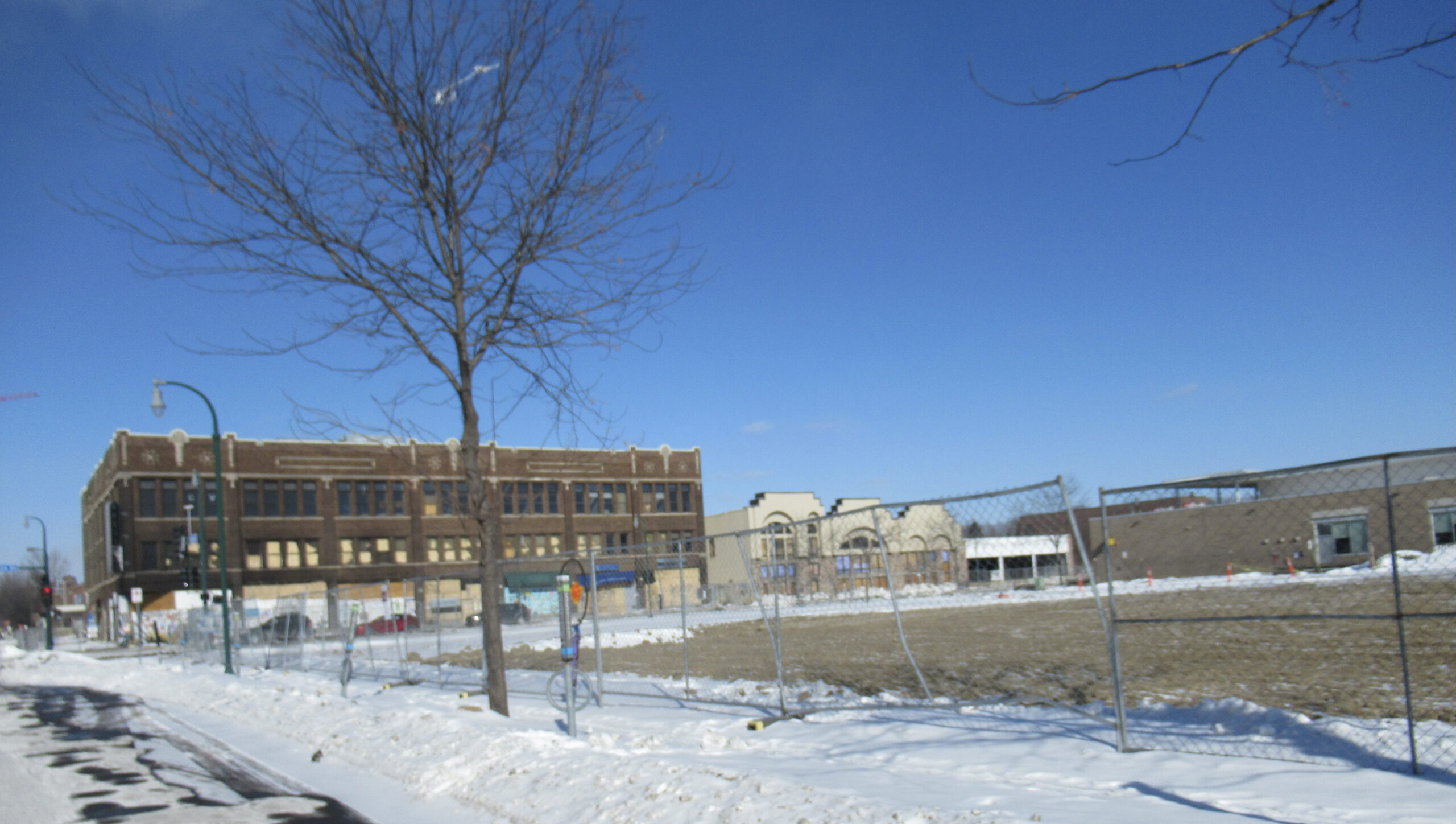
The day after urban terrorism at 27th and Lake, Minneapolis the end of May, 2020. My good friend owned a popular restaurant right behind the burned out building. It, too, went up in smoke the next day. The ruins remain as of this day. (See final photo, below)  I think the perpetrators of the fire are still at large, but for how long?

Deer near walking route Juy 30, 2020

Fall colors early October, 2020, St. Paul MN

Nov. 7, 2020. I watched this ‘project’ all summer along my walking trail. One time I saw the kids and their Dad working on this build, using deadfall from the woods. It was a good use of time, I felt. Sometimes it would change shape, or number of structures. This was the latest and perhaps last for the year.

A declaration of resilience at Gandhi Mahal, the restaurant of my friend, burned down at the end of May, 2020. Photo: Oct 31, 2020. (The restaurant was next door to the burned out building in the photo above.)

This day, Dec. 14, 2020, the state electors chose Joe Biden and Kamala Harris as incoming President and Vice-President.  Their inauguration is January 20 2021.  This was the day of the first U.S. innoculations for Covid-19.  This is a day for hope, though the wars continue.

This day, also, came an e-mail from JoAnn, my former state legislator, who is one of those active in changing the conversation about politics.  She included some quotations which deserve sharing as our history as a country hopefully proceeds towards national healing:

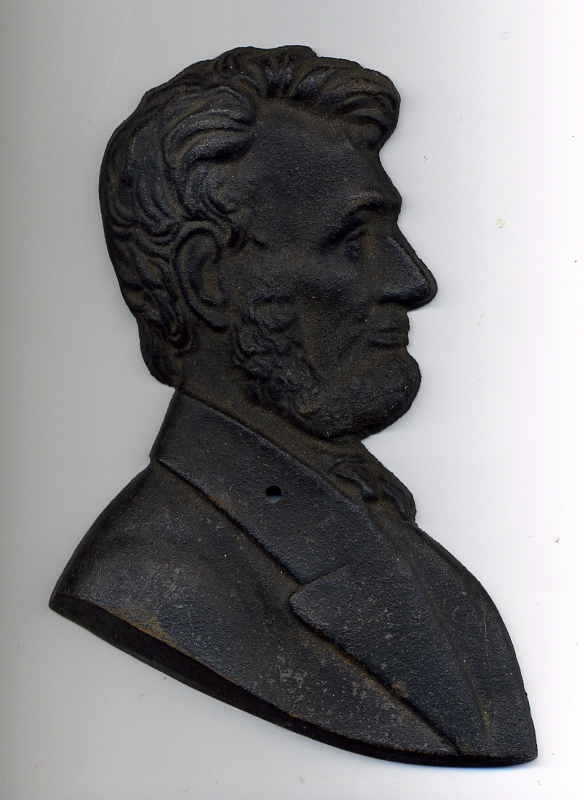
“We are not enemies, but friends. We must not be enemies. Though passion may have strained, it must not break our bonds of affection. The mystic chords of memory … will yet swell the chorus of the Union, when again touched, as surely they will be, by the better angels of our nature.”
Abraham Lincoln, 1861
 
“Life is short, and we do not have too much time to gladden the hearts of those who travel with us, so be quick to love and make haste to be kind.”
Henri-Frederic Amiel
“There are two primary choices in life: to accept conditions as they exist, or accept the responsibility for changing them.”
Denis Waitley
 
“So let us begin a new remembering on both sides that civility is not a sign of weakness, and sincerity is always subject to proof. Let us never negotiate out of fear. But let us never fear to negotiate.”
John F Kennedy

What are your memories of the year now past?  What are your commitments for the year about to begin?  All best wishes for a hopeful Christmas and New Year.

A quotation that sticks with me: “If it is to be, it is up to me.”

POSTNOTE;  Monday Dec. 14 Just Above Sunset: History here

COMMENTS (more at end of post):

from SAK:

Thanks Mr Bernard that is so moving, those memories & thoughts of peace.

I remember a quote from the Boston Herald I came across once. This was written in 1913 most probably and proclaimed that Great Britain, the United States & Germany had reached such a level of civilisation that war between them was unthinkable. And then there was World War I or The Great War.

Well even during that dreadful slaughter the guns were silent the first Christmas & carols rang out! A film was made about that truce.

The original Silent Nightwas in German & composed by an Austrian& I was just watching parts of The Great Escape which I had first seen decades ago . . . Steve McQueen, Charles Bronson, James Garner, James Coburn, David McCallum & many others. That was the other & even worse disaster: WWII.

Can we be sure that there won’t be other major wars? Difficult to bet against it! With economic distress & rising nationalism it’s usual for violent passions to take over. ” Against stupidity the gods themselves rage in vain,” Friedrich Schiller:

Predictions  & forecasts point to a sad 2021 but hope springs eternal & I wish you & yours a Merry Christmas & a glorious New year.

Response from Dick: Thank you.  Re the 1914 Truce, for those with access to public television, a wonderful musical was made last year in the Twin Cities, and has aired twice recently on PBS.  It is titled “All is calm”, as I recall, and about the 1914 Truce.  The powerful song, Christmas in the Trenches, by John McCutcheon is readily accessible on-line at YouTube.

from Larry: There are several children’s book versions of the Christmas Truce story.  The one I’m most familiar with, SHOOTING AT THE STARS, is in my December SUN POST column, link here.

The World Is My Country

You have possibly heard about, and perhaps even seen, this film about Garry Davis, which premiered here in 2017.  It is free, on-line now through next Wednesday, Dec 16.  It’s “popcorn length” – about an hour.  Thu. Dec 17, 7 p.m. there’s live on-line discussion with film producer Arthur Kanegis.  Details below.
Regardless of your own history with the film, I urge you to watch it one more time, and join the online debrief with producer Arthur Kanegis on Thursday, December 17, 7 p.m.  All details are here (website globalsolutionsmn.org), scroll  to Third Thursday Film Discussion group.  You need to register for both film, and the Third Thursday Zoom.
Personally, I hope there are so many interested that live audience participation will be restricted to q&a.  That’s my dream.
*
Re the film, one of my CGS MN colleagues raised a question with my group earlier Wednesday. Tactics.  It is a good topic for thought before watching the film, and I’m including his observation, Eleanor Roosevelt’s critique of Garry Davis’ tactics in 1948, and my response, below.  Please note especially the “PS”.  Succinctly, I think this film is thought provoking and stimulating to today’s youth who wonder if they can make a difference; and Garry Davis made a huge difference.
The film, has been recommended for possible airing on U.S. public television stations by their umbrella organization, NETA. This is a very big accomplishment. Wherever you live, if you like the film, recommend it to your local public broadcasting station. Our local station carried the film in December 2019.
*
Here is the earlier on-line conversation:
*
From Jim, Dec. 10  (Jim is a long-time good friend): I am looking forward to the discussion about Garry Davis and his tactics.
I am concerned about his tactics.  I am attaching, here, a 1948 article by Eleanor Roosevelt that expresses some concerns about Garry Davis approach  — just more perspective for the discussion.
*

Response from myself: This is one of those items I printed out including Eleanor Roosevelt’s December, 1948 commentary).

Concern about tactics is certainly not unique to Garry Davis and Eleanor Roosevelt.  A single example: Martin Luther King was ceaselessly and sometimes viciously criticized for his tactics.  In the end he was assassinated.  Dr. King wrote his famous Letter from the Birmingham Jail in response to religious leaders who felt he shouldn’t be rabble rousing in Birmingham, but rather be moderate in his approach.  MLK was a non-violent protestor till the end.
I spent my career as a teacher union organizer back in the day when teachers got the right to bargain and there were a bunch of teacher strikes.  Teachers had waited long enough, but were urged to wait some more.
Eleanor Roosevelt, who I deeply respect, was very much part of the establishment, in all ways.  Garry Davis was a nobody, in context of the meeting she discusses.   The two weren’t on a level playing field, shall I say.  It is natural that they had differing rules of engagement.
At the same time, I think both Eleanor and Garry had a great deal in common – maybe in this case there was simply a different focus on how best to get to the same destination.
*
PS:  My personal enthusiasm for The World Is My Country was ignited in the fall of 2012 when I asked producer Arthur Kanegis if I could show an early rough cut of his film to a dozen or so high school kids at a high school in St. Paul.  This was before the public preview in Jan 2013.  I wanted to see how kids would react to it.  On Nov. 12, 2012, the day of the film, I gave the students a slip of paper before the film, told them it was about an old man telling his story, and asked them to rate it from 0 to 10 – how they thought they’d evaluate it.  I think the resulting average was 4 (after all, it was a movie!).  During the film, I noticed they paid close attention.  The draft was longer than today’s version.  At the end, I gave the kids a second slip of paper, and asked the same question.  This time the average was 9.  It was that single encounter that convinced me that The World Is My Country was a great film to show and discuss with young people – and they are the ones who will inherit what’s left behind by our generation.  
*
A wish for Christmas: Christmas in the Trenches, John McDermott
Another:  A little change of pace music, here “The Longest Time” from Vancouver B.C..

Dec. 7, 1941 & The World Is My Country

I begin Pearl Harbor Day with a commentary entitled This Particular Civil War”.  Read it later, but please read it, and think about its implications for all of us.

Nov. 8, 2020 S. St. Paul MN.  My daughter did a project to remember veterans on Veterans Day.  Her great-uncle Frank’s poster was among these (below).

This Dec. 7, I ask readers to watch a movie, and think about how it applies to all of us, in the present day.

*

This Dec. 7, the documentary film, The World Is My Country, the amazing story of WWII veteran and peace activist Garry Davis, is my focus.  Davis’s death merited a long front page obituary in the New York Times July 28, 2013.

Garry Davis was born in 1921; Pearl Harbor brought his older brother and himself into the military; his brother was killed in 1943 when his Destroyer was hit off Italy.  Garry’s dilemma of conscience began when he bombed a German city, killing German civilians not unlike the Germans he daily worked with in the theater in New York City.

Davis was in his 20s when he made a difference to change the conversation, and he engagingly tells his story himself, as an old man.

The film is being offered free on-line for a week through December 16, and I encourage you taking the hour to view it.

“THE WORLD IS MY COUNTRY”
Film (2017) | Running time: 58 min

This film has recently been placed on the recommended list for scheduling by America’s public television stations.  Disclaimer: I’ve been supporting the production of this film since I learned of the project in 2011. I found it to be an excellent vehicle for catching young peoples interest and promoting discussion.  Do watch it.  I think you’ll reach the same conclusion.

(Yes, I’m sure you’ll be asked to contribute.  I’d encourage that too.  If you’re interested in participating in an on-line conversation with the movie producer the evening of Thursday, December 17, make your request to me dick.bernard@icloud.com.)

*

A FAMILY STORY THIS DAY. Since 1981 – I recall how it happened – I’ve  annually remembered the death of my Uncle, my dad’s brother, Frank Peter Bernard of Grafton ND, on the USS Arizona, Dec. 7, 1941.  Enter “USS Arizona”  in the search box of this blog and you’ll find many links, likely all relating to my Uncle Frank.  Today’s post is a variation on the others.

Largely war stories have always concentrated on young males, sent to fight, and often die, for their country.  Uncle Frank was 26, probably old among the victims that Sunday in Honolulu.  War and Peace is not a simple conversation.  I have a grandson in the Marines; I know antiwar people including a good friend who went to prison for his beliefs.  I’ve served myself, and come from a family for whom service was expected and a duty.  But there is a place for all in this conversation.

As noted, there are many military veterans in my family and circles, including myself.  There are many stories, told and untold.  For a single example: across the street is friend Don, 91, who did his two years in Germany after WWII (the reconstruction years).  His memories often go back to those years.  Some years ago he gave me a CD, which I’ve again listened to in its entirety: Danny Boy: John McDermott.  The link (clink to enlarge) has the play list of this marvelous CD; several cuts of which directly relate to war and its consequences.  Most likely you can easily find all of the songs on YouTube.

Today’s Family Story

Frank Bernard was my dad’s younger brother, born 24 July 1915.  He joined the Navy Sep, 1935; assigned to the USS Arizona Jan 1936, died aboard the Arizona Dec. 7, 1941.  He served his career on the Arizona.

Frank Bernard, Honolulu pre-Dec. 7, 1941

In 1942, Mom’s brother, George W. Busch, (born 11 Jan 1916), completed Naval Officer training; and thence spent three years as an officer on the USS Woodworth (DD 460) in the Pacific Theatre.  His Destroyer survived the war.  They landed at Tokyo Sep 10, 1945, and he arrived home through Portland OR in late October 1945.  He began his career as a public school science teacher.

Naval officer George Busch with family and new spouse Jean Busch with Busch family, May 1944.  He was on leave and married his college sweetheart.  From left, back row, siblings Edithe, Art, Vincent and George.  Standing front: Sibling Esther, mother Rose, wife Jean, dad Ferd.  Kids in front row, Mary Ann and Richard.

Personally, I was one year old when Pearl Harbor happened.

In May and June, 1941, I traveled by car from North Dakota with my parents and grandparents Bernard, destination Long Beach, California. This included an apparently unanticipated visit with Frank Bernard, while the Arizona was berthed at nearby San Pedro.  My Aunt Josie lived in Los Angeles, and since 1937, Grandma and Grandpa usually spent part of the year in Long Beach.  Many others did the same.

What follows is part of a 1941 Shell Oil road map of the U.S.  The actual trip is described in two earlier posts, linked below, in which my parents describe the general routes we followed to and from.

Here’s a pdf of the same map: 1941 road map west U.S.

Here and Here are two previous posts about the 1941 road trip to and from California from North Dakota.  They didn’t take the trip to be remembered by history, but certainly they did contribute to our knowledge of this time.

Enjoy.

Late June 1941, Long Beach CA, from left: Henry and Josephine Bernard, Josie Whitaker, Frank Bernard, Richard, Henry and Esther Bernard.  Grandma Josephine wrote on the back of this photo: “Taken June 22, 1941 at Long Beach.  The first time we had our family together for seven years and also the last.  This is where we lived.”


A Million Copies

Two years ago today was not a usual day.  I spent it mostly unconscious, in open heart surgery at Fairview Hospital in Edina MN.  There are endless veterans of similar experiences.  We survive, or don’t; there is a long period of recovery which works or doesn’t.

I’m two years older; I think my surgery worked well, and I’ve tried to help it succeed.  There is much to be grateful for, today.

Next month I’m 21 years retired.  It hardly seems possible.  Like everyone fortunate enough to be able to retire and to survive the experience, a task was that of re-inventing myself in an unfamiliar world.  A speaker I heard back then, Michael Meade, described it well, “The Canyon of 60 Abandon”.  My Christmas greeting for 2000 gave a brief description, here: Canyon of 60 Abandon002.

21 years have taught me that there is indeed life beyond retirement.  In 2008, I put up a website, A Million Copies, for the sole purpose of honoring a couple of heroes I met after retirement: Lynn Elling and Joe Schwartzberg, recently rebuilt, but still the same basic content.

Lynn Elling died at 94 February, 2016.  Joe Schwartzberg died at 90 in September, 2018.

They made a difference.  So can we.

Here are photo of both men, very late in their respective lives.  As I once heard a eulogist speak about someone who died, both Lynn and Joe “lived before they died, and died before they were finished.”  They went out with their boots on for peace and justice in our world.

It is easy to dismiss old men…and women.  Take a few moments to celebrate their lives.

There’s lots of work still to be done.

Lynn Elling calls his last meeting, November 5, 2015, at Gandhi Mahal.  He died Feb, 2016.

Joe Schwartzberg with some of his droodles, March 13, 2018.  He died six months later.

Technology

One year ago this time of year, was one of the worst times of my life.  I usedcomputer a lot, innocently, and I was maliciously and viciously hacked.  It wasn’t till the end of January 2020 that I was back in business, older and hopefully wiser.

It is not easy to be ‘wiser’.  Most recently, today, a simple family letter with replies and a forward went somewhat awry, some recipients had trouble reading the text – too small, or too wide – the sort of thing all of us experience crossing technologies, platforms and whatever.  A real letter, with stamp, is preferable, but an e-mail is so much more convenient, faster and easier to transmit to more people, instantly.

Can’t win for losing (for my family, and anyone else interested, I’m passing along the earlier communication at the end of this post, about music in my ancestral family.)

On a more positive note about technology and its partner, real paper, it is daily being confirmed that the fears of interference in the 2020 Presidential election did not materialize.  On Sundays 60 Minutes former cybersecurity director Chris Krebs confirmed that this election was not disrupted by mischief.  One of his biggest shoutouts was to paper ballots, which can and did confirm the accuracy and security of the technology used in this election.  (Krebs was fired by Tweet by President Trump.)

High tech has great positive potential; and great potential for peril.  Hackers, mis- and dis-information by global evil-doers require caution.  For me, a learning from my bad experience is to no longer have passwords saved, and to go through the process of turning off the computer when I’m off-line, and re-signing in each time.  Nothing is a guaranteed.  But more diligence, not only just by myself, makes serious problems less likely anyway.

*

Now, here’s the family story (which happens to be about music in the old days) which even non-family members might find of interest.  This story essentially continues three Thanksgiving time posts on the same general topic, here, here and here.

*

Music in the family: the errant e-mail chain.

Nov. 28, Mary: Hi guys and I fully expect I put the wrong e-address for Dick.  Auto population and advanced years keep me sort of annoyed!

Anyway, a local retired musician is a great fan of Lawrence Welk and of course knows all things Welk except did not know he was born in Stasberg North Dakota.  So, I need my history of the Lawrence and Ferdinand connection confirmed.,,.I think they were about the same time frame but I do not think they ever played together Grandpa was fiddle (violin?) and I believe he did some local gigs.  I also think Stasberg is not too far from Berlin though I have never been there.
Anyway, David would love to know more if you know anything about Grandpa Busch’s foray into music-especially if there actually is a Welk connection.  David is Eastman trained and was a professional musician before he retired into his current job as volunteer usher coordinator for the local philharmonic.
In the rest of the world as we know it, Thanksgiving was quiet but the turkey I roasted was big enough for a year of leftovers and big pot of soup.  I will go out biking for awhile today as our 50 plus temperatures are not expected to last very much longer.  Hope all is good, enjoyed the holiday notes!

from Dick, Nov. 28: Well, quickly for now.  Strasburg and Berlin are about 100 miles apart (here).  Grandpa was born in 1880 and they moved to ND in 1905 and Lawrence was  born in 1903, and there is no lore that the Busch’s ever met Welk, though they certainly would’ve loved the music.

I went out to the Welk home in rural Strasburg with Vince and Edithe one time (here).  It was just a small typical rural farm place which was a tourist attraction.  The year after Edithe died (2014) a niece of Lawrence came down to St. Rose from Jamestown and talked to the residents about her uncle.  (Photo). That was the closest call I think they had to the man.  The Nursing home audience was very attentive!
I have a letter somewhere from Aunt Josie, Dad’s sister that says that Grandpa Bernard and Lawrence Welk were friends.  This is plausible, because from the late 1930’s through most of the 1950s Bernards wintered in Long Beach, and during the 50s Lawrence Welk was very prominent in the LA music scene, and the odds that Bernards went to see him from time to time is pretty good.
That’s about all I can offer.
Frank, Nov 30: There was a piano in the Yellowstone West Thumb employee rec hall and one summer I learned a few chords (ie C, D etc) while on break from my busboy job.  That would have been 1960s.  Later on at the Busch farm I sat down at the old upright, opened up the keyboard and did a little chording.  Grandpa  was very interested and got out his fiddle and we did a few tunes — all of course limited by my minuscule musical ability.   So, if Grandpa played with Lawrence and I played with Grandpa, you know someone only twice removed from Lawrence Welk.  That, and $2.50 will get you a tiny coffee at Starbucks, should they ever be allowed to reopen, of which I am becoming less certain of as days go by.
Dick, Dec. 1:  I think Grandpa Bernard is the one who may have actually met Lawrence Welk in California, per Aunt Josie’s recollection.  Of course, no way to prove that, either!  No doubt, Grandpa Busch was a country fiddler when he was young.  He apparently read music, rather than improvise.  He had a small group and played neighborhood dances, like in Grand Rapids.  The Busch’s were all interested in music, it seemed.  I wonder what finally happened to the old piano, which I tried to research years ago.   Attached is a photo of Grandpa, fiddle and family about 1912 or so.  He would have been in his early 30s.  Grandpa is holding the fiddle, Grandma is behind him.  Mom would have been 3, probably to Grandma’s right.  I don’t know for sure who the other people were.

Busch family with visitors about 1912. Ferd is at center with the fiddle; Rosa stands behind him. At the time there were three children. Lucina is in front of her parents, Esther, my mother, is to her sisters right. A younger sister, Verena, is probably not in the picture. She was born in 1912. The other children are from the other family(ies).


In addition,  I wanted to note that the picture was taken at the west wall of the original house.  Where they were standing was likely what later became the living room where the piano stood.  Mom’s memories (p.124-25 in the Busch-Berning family history) says “After I left home [about 1928] the folks acquired a rather badly worn piano but it was a real boost to the musically inclined in the family.  Lucina had taken piano lessons at the [St. John’s] Academy [in Jamestown] and she would chord or play the melody while Dad played the violin and the rest of us sang, both hymns and popular songs.  Dad bought a lot of sheet music and seemed to have most of the current songs in his repertoire.  He could read notes and that helped with the violin.”
  On page 120 Mom says “Rural entertainment was something else.  We used to have Yoeman club dances in the Yoeman building in Grand Rapids once a month during the winter time.  [Dick: I think the building still stands on the Main Street of Grand Rapids and was remodeled]. We would go with sled or buggy, bring a box lunch and dance until two o’clock in the morning.  Many of the dances were square dances and quadrilles.  My dad was always the fiddler with some assistance from other musicians in the area.  I even played the banjo one night along with the dance band.  There was always a good piano player at least good at chording and rhythm.  If the children got sleepy they slept on piles of coats in the club kitchen and many slept the whole night long.”

Travels

Related posts Nov. 22 and 26.

Today is the return trip after Thanksgiving.  Despite warnings around Covid-19, many travelled, now returning home.  This seems a good day to reconstruct some travel in the old days, and this U.S. map, in a ca 1941 Shell Oil road map of Iowa, show the U.S. in those days (a pdf is also included below).  I’ll focus on my own family research.

U.S. Map on Shell Oil road map for Iowa ca 1941. Pdf of this Map: U.S. Map ca 1941 Shell Oil  (click to enlarge)

Traveling has always been a part of the life experience of immigrants.  All of my ancestors were immigrants to North America, the French side to Canada in the early 1600s; the German side to Wisconsin territory in the 1840s.

My first family reaching the Twin Cities (Bernard side) reached what is now the Minneapolis area (Dayton MN) somewhere around 1854, with six children in tow, from about ages 3 to 16.  My great-grandmother, was then about 5 years old, the second youngest.  Exactly how they came from eastern Ontario will forever be unknown.  Railroad did not reach this area until 1867; early roads were very primitive; riverboats did come up the Mississippi for those who could get to embarkation points downriver.  Doubtless there was lots of walking, but that would be an incredible task, particularly from home in eastern Canada with several young  children.

I know my grandparents Bernard took a major trip home to Quebec in 1925 almost certainly by train from Winnipeg, ending at Quebec City.  I have their photographs from that trip.

In 1934, my Aunt Josie moved west from Grafton ND to Los Angeles.  In 1939, living in Los Angeles, she made a major trip with friends to a Convention in Toronto.  It is possible that a reason for this trip related to Josie’s husbands death after a surgery.  They had been married only two or so years.  Years ago she gave me the AAA Road map which the group kept, which I adapted to simplify here: Josie Bernard trip 1939001.  It is a one page pdf with explanation (click to enlarge).  Josie was near life-long deaf, and the Convention was of an insurance company catering to deaf clients.  So, even in those days, there was mobility, certainly not to todays standards, but not unknown either.

In 1941, my Busch grandparents made a driving trip from North Dakota to rural Wisconsin, near Dubuque, the probable reason for the Shell Oil road map that is the source of the U.S. map above.  Family photographs revealed the reason for the trip. Grandma’s sister, her maid-of-honor at her wedding, Julia, was in the end stages of ALS (Lou Gehrigs disease), and this was a sad family reunion.  Julia died the next year, at about age 60.

Also, in 1941 as a one year old, I took my first long trip, from North Dakota to Long Beach California by car with my parents and grandparents.  It was on this trip that I met my Uncle Frank on shore leave from the USS Arizona, five months before he died at Pearl Harbor.  Dad’s writing recounted the route west.  A few postcards sent home to the Busch’s reveal that my parents and I came home via the west coast highway thence east from Oregon or Washington.

Late June 1941, Long Beach CA, from left: Henry and Josephine Bernard, Josie Whitaker, Frank Bernard, Richard, Henry and Esther Bernard.

There were other similar trips, but they were pretty rare and on particular occasions.  The Busch’s probably went by train to Ft. Wayne IN for their youngest sons wedding in January, 1955.  The next month was their own 50th anniversary.  And so on.

But leaving the farm was not a routine matter.  There were cows to milk, just for one example.

The 1941 Shell Oil map also reveals the radio stations possibly accessible on road trips, so car radios were not unknown.  Here were the midwest radio stations on the Shell map. Midwest Radio Stations ca 1941.

But travel was not luxurious.  My memories begin when I was about 4, a year or so before the end of WWII.  I remember the trips as a kid would.

Those old cars were simply a device to get from point A to point B.  No seat belts, air conditioning, etc., etc., etc.

Now memories of the old days for a now-old-timer!

Gatherings

At my Thanksgiving post a couple of days ago, my brother, John asked me a family history question in the comments section.  I answered the question as best I could.  Thinking about this business of family and Thanksgiving got me to thinking about family gatherings generally in the old days.

Busch family Dec 1942, George center, back. from left, Mary, Florence, Rosa and Ferd, Art George, Edithe, Esther, Vincent and Lucina.  (Verena died at 15 in 1927).

Luckily, the families from which I spring did a more than middling job of documenting life.  In those days, long before today’s technology, photography was not a simple matter.

From my own experience, any time we came to the farm, before we left for home Grandpa would haul out the old 1910 box camera and take a single picture, as the above.  As years went on, as children married additional cameras would document the farewell.  The above photo includes all of the children, someone’s husband, probably Uncle Duane, Lucina’s husband, clicked the shutter.

Not all photos were dated (by pencil on the back).  This was the case with this one.  Family historians have to become amateur archaeologists, so it is with this one.  Things like Lucina’s coat give clues.  I’ve concluded this one was probably late 1942, when Uncle George was making his last visit home after completing training at Great Lakes in Chicago, enroute to three years as an officer on the Destroyer USS Woodworth (DD 460) in the Pacific theater in WWII.

This would have been a pensive time.  We were at war.  Esther’s brother-in-law Frank Bernard, had gone down with the USS Arizona at Pearl Harbor a year earlier. The oldest child in this photo would have been 35.  Grandma and Grandpa were about 58 and 62 (they died in 1972 and 1967 respectively).

There was a certain rhythm to all of these family gatherings.  Weather dictated such visits, so they usually happened in non-snow times, usually spring, summer and fall.  There is no apparent snow in this picture, but no snow in December was not unknown.

If one child came home, likely two or three others were there as well.  Six of the kids were unmarried, three of them living at home.  The visitors came and went home the same day – motels were less available and the house was very small.

Dinner for company was farm fare.  Usually, the meat course was chicken.  Grandma would assess how many chickens were needed to feed the group. Fresh or canned vegetables and home-baked bread and dessert were always part of the meal.  This would have been after the Great Depression so food was probably plentiful.  Hard work kept the folks slender….

The house would have been very crowded this day in 1942.  Bathroom?  The outhouse.  There was radio, and telephone, no television.  Electricity wouldn’t come through rural electric till about 1949, though by 1942, the had a wind charger with storage batteries.  Entertainment? Probably a game or two or whist or canasta before the visitors headed for home.  And there was alway some singing.

Yes it was the old days.  ‘

Happy Thanksgiving.

POSTNOTE:  More about the Busch and Berning family at the North Dakota Historical Society.  Search archive collection 11082.  The collection is not yet complete – Covid-19 caused me to cancel my summer visit in 2020.  Maybe next year….


Thanksgiving 2020

I’m an ordinary citizen.  At this difficult time, there are so many people who support, in a great many ways, my own life and those of every one of us.  All of them deserve our profound thanks.  Let that suffice.  Happy Thanksgiving.  With gratitude.

Friend Molly periodically sends favorite poetry to a list of friends, including me.  Here’s her 2020 Thanksgiving selections: Thanksgiving 2020 Molly  (Click to enlarge).

*

Last week brother John arranged a Zoom call for we assorted family members, and his background was the below photo, which he had skillfully edited to emphasize the magnificent wild turkey in California.

California Turkeys March 17, 2020

I asked John for permission to use the photo, and also for a little more information about his photo: “Taken on Pleasant’s Valley Road between Winters and Vacaville, California on 17 March at about 11:15 in the morning.   As I mentioned in the zoom session, this was the area that was completely burned over this August in a lightning caused wildfire.”

My ask of John related to preparing my thoughts for this Thanksgiving writing, and John’s photo reminded me of this 1910 postcard from our ND grandparents collection:

Thanksgiving Postcard from early 1900s, received at the Busch farm rural Berlin ND.

There are endless messages in the above, all pertinent to this day.  Just for a single instance: John’s photo was taken at the very beginning of the pandemic we are all enduring, and before one of the catastrophic west coast wildfires this past summer.

*

For what does one give thanks this year, or any year?  Certainly turkeys, their siblings and ancestors wouldn’t be especially happy.  (Yes, I eat turkey, and while I always prefer vegetarian.)

This years message, in this year of hundreds of thousands of unexpected death from a deadly disease, still is one of hope for a better future if enough of us apply our own lives lessons from our own pasts.

*

Autumn, the wonderful manager of my local Caribou coffee place (which has been takeout only since the pandemic began months ago), mentioned in the last few days her grandmothers recent death from cancer.

We were having a brief chat, and as I recall, her home had been the home hospice for grandma, a woman about my age.  They wished to give grandma her last days at home.

Autumn was remembering something told her by someone – her Mom? – that all of we humans have two events in common: we are all born; we all die.  Then there is all that time in-between, where reality constantly intrudes on our lives….

*

There are a few who might read this post who have known me – for good or ill – for most of my 80 years, including John.

In thinking about this post, I’ve mostly thought back to what I’ve most always considered the most difficult years of my life, which on reflection were by far the most formative, in a very real sense.

They were very hard times, now many years ago, but they’ve had a lifelong impact on my perspective on life.  They were a learning time, a blessing, not a burden.

We’ve all had them…or will….

*

February 29, 2020, one week before the Pandemic brought our lives to a screeching halt, I was speaking to a group at the Little Canada Historical Society about a small newsletter for French-Canadians I had edited for over 15 years back in the 1980s and 90s.  How does one summarize about 1000 pages and 1000 snippets of life in 25 minutes?

I told the group that I had started helping with the newsletter “half a lifetime ago” at the beginning of what I would later, and still, call “the best and the worst year of my entire life.”

I said I thought that many of those sitting in the room probably could remember a personal year list that fit my descriptor.

One lady, at least, got it.  I saw her nodding “YES”.  I’m sure there were more.  Every life’s road has ruts, for everyone.

This Thanksgiving is in the midst of one of those difficult times.

*

Again, Happy Thanksgiving, especially to Autumn and her crew, and everyone else who is making our lives livable even in these hard times..

*

NOTES:  Related and pertinent is this post,  here.

Another post with John’s work is “Paradise” here.

The old French-Canadian newsletter can be found online here.  Click on Library, then Chez Nous.  The volumes are fully indexed.

Talk on politics?  I am extremely concerned, but my opinion can wait till after Christmas.  Here’s a column which started my November 24, 2020: “Not Quite Dramatic Capitulation”.

COMMENTS (more at end of post):

from Fred: A terrific Thanksgiving memoir Dick! Thanks! Happy Thanksgiving.

from Jeff:  Happy 100th anniversary to the poem that every writer needs to know.  Here. 

from Sonya, whose done local history in one of my ND counties:

I never ran across much about the Spanish flu or any medical advice given to people in the area. While searching for information on the soldiers from the County who died in WWI, it was heartbreaking to find that many of them died before they even went into combat. Of the WWI names on the memorial stone at the park, more than 50% died from things such as the flu, training accidents, or pneumonia.

As you have probably heard, Covid is raging in the Dakotas (our new nickname is North Dacovid). Our County has been hard hit. Many people we know have had it and recovered, but I’ve heard from multiple sources that every county nursing home resident tested positive, and 14 of them have died in the last 3 months. Every week the local paper has more obituaries than normal.

I hope 2021 brings some normalcy to our lives.

response from Dick: my mother, who grew up on a farm about five miles from where Sonya lives, wrote her memories of growing up about 1980, and said this about the WWI flu: “I think one of the mot traumatic experiences I had happened when I was about nine years old and got the World War I flu. Many people were very sick and some died.  I had a very rough siege with that flu and remember when Dr. Salvage came out in some very cold winter weather, in the middle of the night, to keep me from bleeding to death.  I don’t remember what he did but I had a very high fever and was bleeding from the nose and I spit out chunks of blood.  I think they thought I was gone for sure.  I recovered though and it took a long while for me to regain my strength.  I can remember having some wild dreams and nightmares and must have been out of my head at least part of the time.”   (p. 116 of the Busch-Berning family history, Pioneers, April 2006.)

:


Lifetime

Today as part of my daily drive I went by Lifetime Fitness, which had been my daily haunt till Covid-19 closed it in mid-March.

I took a photo.

Lifetime Fitness Woodbury MN Nov. 20, 2020

The parking lot was active this day, though Lifetime will again close as of midnight.  Like other businesses it was closed a few months and then reopened for a few, and now it’s closed again.

Personally, I’ve taken a vacation from Lifetime these last few months, preferring my long-time outdoor route.  We’re getting into snow-time and daily cold weather, so it won’t be as comfortable as the tread mill with neat videos of walking in scenic areas around the world in perpetual sunlight and perfect summer weather.  So be it.

*

The first day I walked in the park last March, I came across some prairie architecture off the walking path.  It utilized assorted deadfalls in the woods – things like tree branches and the like.  Every now and then, there were changes: additional ‘structures’, modified designs….

Recently I actually saw some people around the project – some kids and their Dad from one of the houses a short distance away.  It was some nice useful activity.  Here’s the latest rendition of their “house”: a nice constructive use of time during a terrible health crisis in our world.

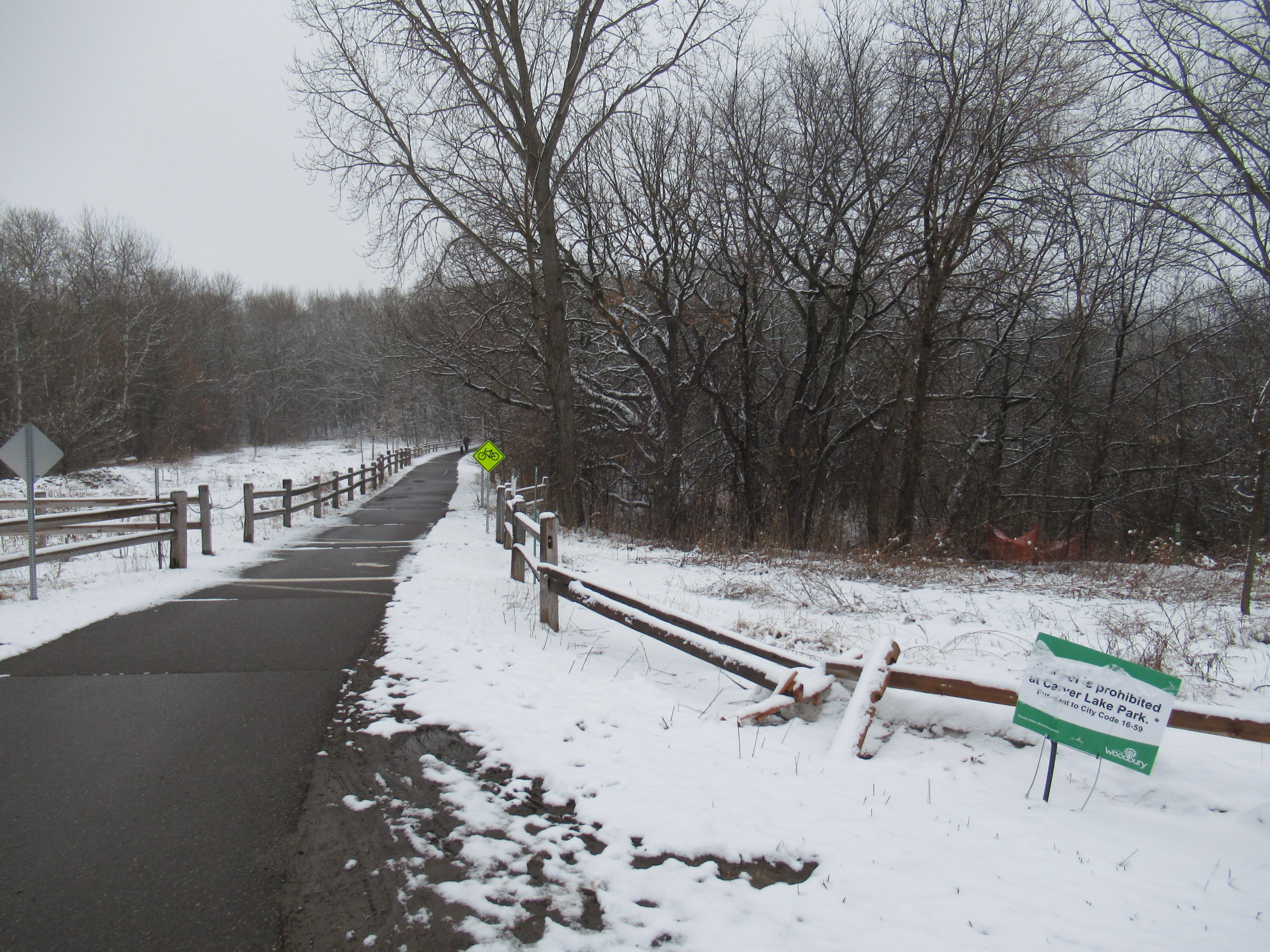
In the Carver Park woods, November, 2020

Back in March, 2020, in the same park down the same path I saw a note somebody left which whose sentiments I hope we can subscribe to for as long as it takes.

At entrance to Carver Park walking trail, Woodbury MN April 8, 2020.

*

There’s nothing funny about Covid-19, but this cartoon from the 2021 calendar (January) from the Union of Concerned Scientists seems appropriate for the occasion.

2021 Center for Science and Democracy Calendar, Union of Concerned Scientists.  Artist (c) April Kim Tonin

POSTNOTE: Saturday’s Minneapolis Star Tribune had a front page graphic of Covid-19 in Minnesota.  Note especially the November timeline on the right side of the page: Covid-19 and MN 2020 (click to enlarge).

Saturday afternoon I went by the empty parking lot of the local movie theater, which was a popular destination in per-Covid-19 times.  It, along with other gathering places in Minnesota, is again shut down for several weeks.  As marquee announces: “See you after the shutdown:.

Woodbury theater, Saturday afternoon Nov. 21, 2020. Note the message on the left side of the marquee.