At Thanksgiving 2025.

Have a very good Thanksgiving. We’ll spend Thanksgiving with family in town; and Christmas, still unplanned.  “Over the river and through the woods” will, for us, be about three miles, and no snow, likely chilly.  All very best wishes.

POSTNOTE FRIDAY, NOVEMBER 21, 2025 10;10 PM.  I watched the entire 12 hours of Ken Burns American Revolution on PBS.  This consisted of six 2-hour programs,  If you missed this program, or any part, here are details from PBS and/or check with your local public broadcasting outlet for other arrangements for future viewing.  Every American should take the time to view, discuss, and reflect on the meaning of this extraordinary program on the creation story of the United States of America.

*

I’ve summarized here my impressions after a week of watching Ken Burns American Revolution.  What follows below, unchanged, is my Nov 14 post.  I invite you to visit the post for Nov. 19 “The Epstein Affair“; and Nov.  21 “Drones“.  At the end of the Drones post is an important update on the situation re Ukraine/Russia/U.S.

This is not a usual, normal holiday season.  My personal reflection will be on the many positive aspects of the year near passed, while acknowledging that this has not in any way been a normal year.  There is a great deal of work we all need to do, daily, to save the essence of our country, and the future of democracy in the world we all live in.  I’ll continue to pay attention and write as things come to mind.

*

For more than 15 years in the 1980s and 1990s, a hobby of mine was doing a small “kitchen table” newsletter for fellow French-Canadians mostly in the Twin Cities.  For some reason a particular issue came to mind for this year, and you can read the first three pages here: Thanksgiving and Christmas Chez Nous 1993.  A photo from the Minneapolis Star Tribune Oct 19,1993, below, was one of the three pages, and is what my minds-eye saw when I got this idea for this commentary:  (For anyone interested, all of the 1000 or so pages of Chez Nous are indexed and accessible on line here , click tab Library then click Chez Nous.)

from Minneapolis Star Tribune Oct 19, 1993 accompanying article by Jim Northrup: “Parching wild rice in a container set near a fire: Just call it a lot of hard work.”

Thanksgiving is still almost two weeks out, and Christmas about a month after Thanksgiving, but this will not be a usual annual holiday season, hard as folks might try, in my opinion.

We’re in very dangerous times in this country of ours, and we can’t afford to look away and pretend all is okay.  But this moment seems a good time to focus a bit on an aspect of our past as we prepare for our 250th.

As days go on between now and the New Year, I will likely continue to write, so just check back once in awhile if interested.  All best wishes.

Ken Burns: American Revolution

FRIDAY, NOVEMBER 21, 2025 10;10 PM.  I watched the entire 12 hours of Ken Burns American Revolution on PBS.  This consisted of six 2-hour programs,  If you missed this phenomenal series, or any part, here are details from PBS and/or check with your local public broadcasting outlet for other arrangements for future viewing.  Every American should take the time to view, discuss, and reflect on the meaning of this extraordinary program on the creation story of the United States of America.

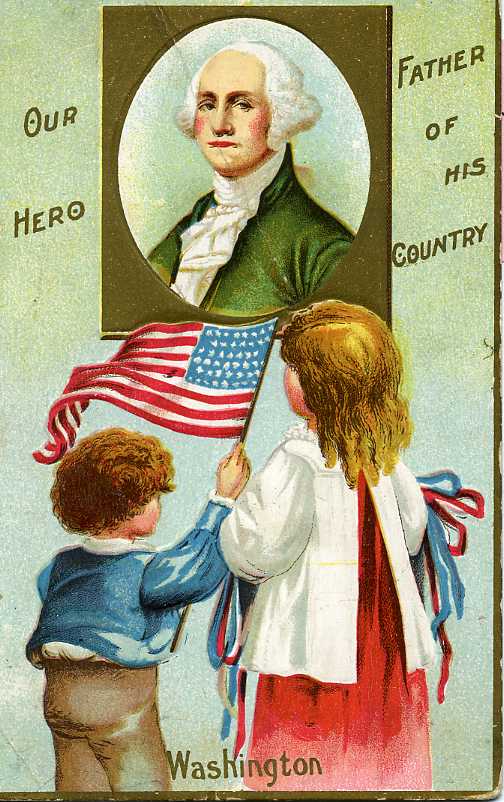
George Washington, born 1732; 43 in 1775

If you were born and went to school in the United States, you learned a shorthand version of our native land.  Of course, it was not the whole story.  The shorthand version was much like the old farm postcard from before 1910.  Of course, we young scholars remembered fragments of that already much condensed version.

As I watched the twelve hour summary of our history over 6 evenings, Nov. 16-21, I mined my memory for the scraps I recall about my country.  Here is my condensed version.

George Washington cut down the cherry tree and could not tell a lie; and threw a coin across a river.  (Some myths, here).

The Boston Tea Party; Paul Revere’s ride; Benedict Arnold betraying his country; the First Thanksgiving; Valley Forge; the King of England; people that looked a lot like me did all the work to establish the United States of America.  Ours was “the land of the free and the home of the brave” – “America, the Beautiful”….

Of course, life goes on, and as time went on there were more snippets, each adding to my own knowledge:  Several trips to our nation’s capitol, visits to the White House and the U.S. Capitol, the sites of Boston, Lexington and Concord, Colonial Williamsburg, Philadelphia, on and on.  Each visit expanded my knowledge a bit.

Slaves, Native Americans, Quebec (supposed to be one of the original states.  My Dad is 100% French-Canadian, which makes me half French-Canadian), the role of France….

These and many, many other fragments of information were like fashioning a puzzle out of many pieces.

The pieces are not all glorious, for certain: the Civil War; the refusal of the new United States to recognize the slave revolt which led to an independent Haiti in 1803, right after our Constitution was ratified.

Endless pieces.

What Ken Burns and crew endeavored to do, and did it masterfully in the series, was to make a portrait of America more consistent with the actual history as it really happened, with the glorious and the shameful; the personal virtues and the failing of human beings in what was a very long and difficult struggle.   (The Tea Party was not immediately followed by a festive Thanksgiving Dinner thrown by grateful natives.)

Old North Church Boston, June 1972 (Dick Bernard). (“one if by land, two if by sea”)


Tom Bernard at Liberty Bell, Philadelphia June 1972

independence Hall (Pennsylvania State House) Philadelphia old postcard from Busch farm from early 1900s.

Constitution Hall, Philadelphia PA 1972


Give yourself and your family gift:  Make it a point to not only watch the entire 12 hours, but to talk about what the revolution means in context with today.

POSTNOTE Nov. 23: This post from Heather Cox Richardson dated Nov. 22, seems pertinent to this conversation.:

COMMENTS (more below):

from Chuck: Thanks Dick.  I suggest passing this prayer around your thanksgiving dinner…each person read one part: Iroquois Thanksgiving.  [here is a verbal explanation by an elder]

from Michael: Hi Dick. This is the best article ever written about the US Peace Prize.  NOTE: Michael is founder and director of the U.S. Peace Memorial Foundation.  I am a supporter of this foundation, and a friend of Michael.

from Claude: Dick, this might also be relevant to this point in history.  NOTE: Claude is a good friend and long time advocate for international cooperation.

from Larry: Am currently watching, Dick – DVR’d all the episodes, taking ’em one by one. Excellent Ken Burns film! Again!  LG

from Norman: We did as well and I agree that it was outstanding!

from Jeff: watched the first 8 hours…yes, good,  MAGA would not like it.

from Ruth: My superficial impression based on the visuals is that George Washington was a great general.  He had the advantages of knowing the landscape and geography.  British generals and officers were possibly more experienced in terms of training and tactics, but probably did not understand distances and geography in North America.  The Revolution might not have succeeded if French and Spanish had not got involved to defeat their British enemies.  European conflict was transferred to North America.  I missed the part about Benedict Arnold invading Canada and Quebec.  Have read about that.  I will have to see that part again.  Fell asleep a few times and missed the good bits.  I liked his criticism of American Indigenous and Black slaves who tended to think they were better off with the British than the Americans.  They lost their lands and human rights along the way.  He was honest about that.

from Robin:  Totally agree this is a stunning and eye opening series. A new perspective on the creation of our republic.

Wonder if it would contain a number of topics to be subjects of a discussion for a future MAP meeting.

from Bob: My biggest take-away was how our nation has destroyed our indigenous folks and the black Americans.
And the current administration is just making that worse.I think we should get all of Congress, the Executive branch, and the Supreme Court and lock them in a room to watch the entire series.


from Jeff: After watching the 5th installment this old American historian (M.A. Oregon 1978)  comes to some conclusions I have gleaned over the years, and some that reflect perhaps the more negative “woke” view of some of US history.

aa) America is and always has been a conservative country, its founding story and its “revolution” is the result of propertied classes seeking to protect their property and privileges and to avoid taxation and administrative controls and restrictions on growing their fortunes. (in other words it has more in common with the English Cromwellian revolution than the French Revolution)
bb) My synthesis of American history particularly up to about Teddy Roosevelt is controlled by:  Land speculation, resource extraction with no limits, slavery, and genocide.
cc) Within the story are alot of high ideals, and grand words, and obviously bravery and sacrifice, but essentially done in service to aa and bb.
My good wife and by genetics our kids, are descended from several male ancestors who were veterans of the Revolution.

from Ruth: What I don’t like about Washington is that he married a wealthy woman and used her money to buy Black slaves and Indian land.  I have read quite a bit about Thomas Jefferson and his Black slave concubine or whatever the right word is.  She was his wife’s Black sister.  Wife’s father was a slave owner and had Black children with a Black slave woman.  This just about turns my stomach what those women went through.  It is so hard to reconcile a hero like Jefferson with him keeping a Black slave, his wife’s “sister”, who looked like Martha Washington, but she was a “little bit Black”.  Yuch!  What was he thinking.  She was his prisoner!  Suffered from his daughter who was jealous and would not acknowledge that Jefferson let this Black woman, his wife’s sister, to run his household.  Bad for the family after he died!  Not a hero to me!  I think he had abouut 7 children with her and did not free them.  But he turned a blind eye when they escaped and “passed” as white.  Why did he take her back to Virginia and slavery?  He loved Monticello more than her. He put her and her children back into slavery.  yuch!

from Dick, some scraps in reflection:  I am a casual historian and geographer, with a college major in geography.  Throughout life, I’ve picked up “scraps” whenever and wherever I can – roadside historic site signs are like a magnet.  Like with a rag quilt, random pieces can make a coherent whole!  That’s the beauty of Ken Burns work.  Taking many difficult years at the time of formation and making them into 12 hours of civic engagement 250 years later is a real chore.  And he did it.

My ‘research’ after the film has been minor.  I think the colonies had about 2 1/2 million people east of the Appalachians at the time of the Declaration of Independence.  England had about 8 million population and already a worldwide empire.  (The twin cities where I live are over  3 1/2 million; Minnesota nearing 6 million).

George Washington lost more than he won, but he was a gifted leader; when the chips were down, which were often, enough volunteers showed up to advance the cause.

The novice leaders modeled their new system on the English, because they were mostly English.  They understood the system.  Most, but not all, did not want to have a king.  To study them one has to be very aware of the circumstances of their time.  The results speak for themselves.  So far we’ve been fortunate to last for 250 years, warts and all.  That history is in serious jeopardy now, and “we the people” have to be the volunteers to save our past and assure our future, just like those volunteers did during revolutionary times.  Somehow they all had the stamina to last it out.

Finally, I’m very aware of the Canadian/French/English component of this particularly since my Dad was 100% French-Canadian, and I have spent more than 40 years delving into family roots and stories.  My LAST French-Canadian ancestor arrived in Quebec only two or three years before the English defeated the French at the Plains of Abraham in 1759.  This was 16 years before Lexington and Concord and the like.  At the time, the area that is now Minnesota was by and large considered part of French Canada.  In 1818, the U.S. – Canada borders were set.

The treatment of the natives and the slaves were inexcusable – the nature of war, I suppose, and the attitudes prevailing then.  We cannot undo the past; the worst we can do is to try to continue  the sins of the past.  The best, working to make things better for the future, rather than revert to old, failing ways.  It’s up to us.

from Jim: Well, I wish I could be as confident about America’s future as other commentators are. First off, we are constantly told a rather one-sided, pleasant history of America. The history of the real America takes some digging or luck in what you read.  For example, did you know that Charles Lindbergh, yes our Lindbergh, twice led a coalition to Nazi Germany to ask how that government could be replicated, at least in part, in America? Lindbergh was an ardent supporter of eugenics, a seudo-science theory that white people were genetically superior to all other races. Though eugenics may have started in Enland, American philosophers were it’s strongest supporters. Hitler’s government adopted eugenics as justification  as you might expect. Lindbergh and followers also demanded that Roosevelt surrender on Germany’s terms when Hitler’s Germany declared war on America. Fortunately, Roosevelt ignored that advice.
But these are just a couple of examples, there are many others (like holding on to slavery for forty years after all of western Europe ended it). To really understand America, we must balance the good, which we hear about constantly, with the not-so-good. It’s that balance that might lead to a better America.


Drones 2025

November 21 Fred sent a note with link to a most interesting post he’d read about Drones and the future of War.

Fred: “[My] friend sent this Noah Smith article along:  “The future of war is the future of society”.
Smith effectively makes the case that massive drone warfare is inevitable. Even worse he says, “drone technology is in its infancy.” Sure hope the West will be able to match the Chinese will to dominate. His brief summary of the history of turning points in human warfare is also quite interesting.
We just gotta get past the Epstein case and the Tariff War and we can start getting ready.”

*

Dick: I’d urge you to read this article, and if you wish, afterwards, read a few personal comments by myself, including my note that I’ve long had a general interest in Drones, generally, and first wrote about them here in the Spring of 2009, 16 years ago.  Caveat: I’m no expert in most anything, certainly not drones.  Still you might want to read that first post before proceeding.

My response to Fred continued: I stirred up a lot of dust with another post in December 2011.


In all, my archive says that 22 posts have at least mentioned the topic.
Fast forward to today, absolutely nobody is safe in the era of drones (which I presume are what is blowing up the boats off Venezuela).  Scary times.
Sometime in these past 19 years I remember a movie whose “star” was a mini drone masquerading as a bird which blew up some terrorist in the room of a house.  Yes, it was just a fictional movie, but very plausible.

*

Speaking only as a citizen, it is a given that the technology of war is being perfected at an accelerating rate, from the ancient sticks and stones to ever more sophisticated technology we all have heard about.

POSTNOTE: Thanksgiving week seems to be an important week in the history of Ukraine/Russia/U.S.  Heather Cox Richardson summarizes in her usual expert way, here.   She shares some important information with us.


and communication technology is itself a weapon…character assassination is a weapon of choice in this day and age).

I am skeptical that, short of a mistake or misappropriation of something like a nuclear weapon and its launching code, armageddon is on the near or even far horizon.

Today, we are a global society, and have been such for a long time.  If China becomes the dominant world power, is it to its advantage to disable our economy, which is a very significant part of the total world economy?  I think not.  This applies more broadly: the rich control more and more of the wealth everywhere.  Does this help increasethe strength of the consumer network, which fuels the economy and most enriches the already rich?  I think not.

Drones can be personalized down to specific targets, such as small boats on an ocean.  I live in a community of 83,000, and if a drone was used to take out someone, say the mayor, would this win the war for hearts and minds of the rest of the population?  I think not.  It would very certainly be a disruption, but would it be beneficial to destroy all of the disrupters…or would it create a critical mass of the community arise to quell the threat?  I think so.

Advanced weaponry, of course, is a boon to the economy.  Note the little article in my college newspaper in 1961,


Lots and lots of people earn their living making sophisticated weaponry, and whole communities directly benefit.  Is this a problem?  Yes.   Is it fatal?  No.  People can be redirected to employment that is of benefit to all.  But this is a choice hard to make especially if those who benefit by the old ways feel threatened.

I could go on and on.

This is not to say that drones are not a problem.  They are.  But neither are they the ultimate end game.

Best we figure out how best to work out problems, which will always exist, and avoid selecting or enabling those who might want to make life more difficult for the peaceful majority.

1978 card from Women’s International League for Peace and Freedom.


The Epstein Affairs

PRENOTE: I have watched the first six hours of the Ken Burns series on the American Revolution.  For sure, I’ll watch the 12 hours.  It is an outstanding primer for the 250th anniversary of our stressed nation.

*

November 18, 2025: The votes have now been taken in House and Senate and the results sent to the President for his promised signature.

The games begin.  I’ll amend this post as more information is published.  I will be surprised if the requested documents, including names, ever see the light of day beyond what the Epstein estate has released to Congress.

*

In the interim, for anyone interested: while I don’t pretend to know how this sordid affair will play out in the end, I do remember another dramatic time in our political history: the Bill Clinton impeachment in 1998-99,  Most of you who are on this list remember the political street theater then.  You can use your own memory to fill in the blanks.

I decided to dust off the two documents I saved from then:  I offer them for your own reflection.  I am not equating Epstein with Clinton.  The issues are very, very different.  Here are the two Clinton era documents: Bill Clinton 1999 Rev. Miller; and Bill Clinton 1998 Lieberman

What I am asking folks to think about is how to approach the incessant discord to come, the moralizing, the recriminations, the lies, the everything.

I’d especially recommend the public sermon by Pastor Miller, who I think was, at the time interim or visiting pastor at House of Hope Presbyterian Church in St. Paul.  (I’m not Presbyterian, and I’ve never been in House of Hope, but the sermon was intended to get around.)

PS:  I have written and mailed, on November 18, my own letter to my two U.S. Senators Klobuchar and Smith and Congresswoman McCollum, and included a copy of the above two documents.

Thanksgiving

PRENOTE: Tonight Nov 14 8 p.m. CST on public radio and television, the Minnesota Orchestra will be live.  Details here [Minnesota Orchestra] including program notes.  Also TPT.org .  We saw this concert in person Thursday afternoon.  Excellent as always

Don’t forger, Ken Burns 6 part series on the American Revolution starts on PBS on Sunday.  Check local listing.  I think, must watch.

Re Armistice Day post, especially read the postnote at the beginning, and the comments at the end of the Nov. 11 post.   There are also some additions in the originating post.

*

In anticipation of Thanksgiving and Christmas….

For more than 15 years in the 1980s and 1990s, a hobby of mine was doing a small “kitchen table” newsletter for fellow French-Canadians mostly in the Twin Cities.  For some reason a particular issue came to mind for this year, and you can read the first three pages here: Thanksgiving and Christmas Chez Nous 1993.  A photo from the Minneapolis Star Tribune Oct 19,1993, below, was one of the three pages, and is what my minds-eye saw when I got this idea for this commentary:  (For anyone interested, all of the 1000 or so pages of Chez Nous are indexed and accessible on line here , click tab Library then click Chez Nous.)

from Minneapolis Star Tribune Oct 19, 1993 accompanying article by Jim Northrup: “Parching wild rice in a container set near a fire: Just call it a lot of hard work.”

Thanksgiving is still almost two weeks out, and Christmas about a month after Thanksgiving, but this will not be a usual annual holiday season, hard as folks might try, in my opinion.

We’re in very dangerous times in this country of ours, and we can’t afford to look away and pretend all is okay.  But this moment seems a good time to focus a bit on an aspect of our past as we prepare for our 250th.

As days go on between now and the New Year, I will likely continue to write, so just check back once in awhile if interested.  All best wishes.


Armistice Day 2025

POSTNOTE: Kathy highly recommends a two hour program at Carnegie Hall about WWI.  This is excellent.  I watched it on Thursday.  I’m not sure that the link will work for everyone.  The title of the PBS program is American Heart in WWI: A Carnegie Hall Tribute – The history of the Unknown Soldier and veterans Day.

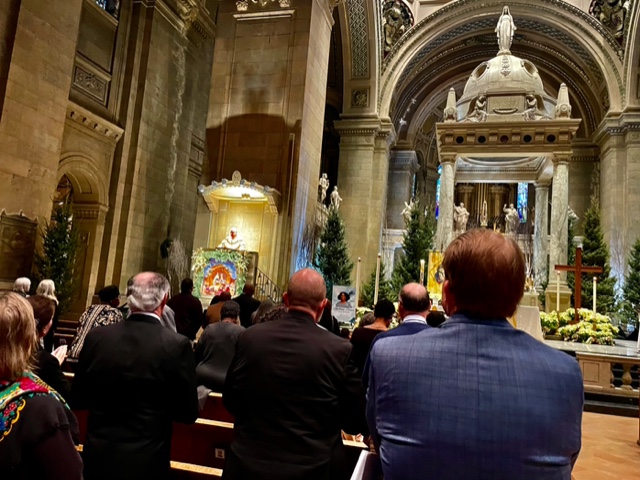
I attended the event at St. Joan of Arc on Tuesday morning.  It too was excellent.  Photo of Larry Johnson below.

*

PRENOTE: If you read nothing else below, at least read today’s Heather Cox Richardson Letters from an American in its entirety.  We – all of us – ARE the government we like to criticize.  DO SOMETHING.  And watch and reflect on the meaning of the Ken Burns 6-part special on the American Revolution which airs beginning later this week.  Check you local Public Broadcasting Station for details.  We sink or we swim together.  All is NOT okay.

*

97 years ago, at the 11th hour on the 11th day of the 11th month of 1918, an Armistice ended WWI.  It’s now called Veteran’s Day in the U.S.  No matter – in most of the world it is Armistice Day and continues as an aspirational goal for world peace.

I’ve made a habit of recognizing this day – see NOTE at end of the post.

I want to call attention to three items this day.

1) in Minneapolis there will be an observance, as detailed by my friend Larry Johnson:

Every year on November 11 St. Joan of Arc Church (SJA, 46th St. and 3rd Avenue in south Minneapolis) holds a special Armistice service at 11.  For many years Veterans Day was called Armistice Day because the armistice formally ending World War I was signed at that 11th hour of the 11th day of the 11th month, 1918.  For many years bells rang 11 times at that time on November 11, and it was not uncommon for even the President to say things like, “We’re gathered to honor those Veterans who have sacrificed, sometimes all. There is no greater tribute we can pay than to work diligently to end war so that fewer need to make that sacrifice in the future.”
Some of us, Veterans who believe in nonviolence, ring Armistice Bells at the SJA service.  One Veteran tells his or her Armistice story.  THIS YEAR THAT WILL BE ME, and I’d be honored if you were able to be there.  On my own each year, I walk to the service, and some of you have walked with me.  You’re all invited.  This year it’s just a mile, leaving from Seward Coop  on 38th and 3rd Avenue at 10:15.  I’ll be in the little eating area at Seward (N.E. end of the store) at least by 10, ready to walk out at 10:15.  Good idea to let me know if you’re walking so we know to look for you.  Otherwise it would be great to see you at the church at 11.  [pdf of program: Armistice Day 2025 at Joan of Arc]

Larry Johnson tells his Armistice Day story at St. Joan of Arc Nov 11 2025

2)  Larry’s newspaper column in the October 23, 2025 SunPost publication is about Armistice Day and his long term passion in behalf of veterans.  He discusses Armistice Day and also an important initiative, the Veterans Resilience Project.  Check it out.

3). In addition, I’d recommend to readers a recent blog I noted in the website of the French-American Heritage Foundation.  It speaks for itself, here.  The column is about an American soldier, Alfred LaGrandeur of Somerset WI,  who arrived in Europe about October 1, 1918, a month or so  before the Armistice.

Alfred had no way of knowing when he signed up for service “over there” , that he would be in France essentially for postwar duty.  That is the lot of the soldier.  You serve as assigned.

The aspiration of the Armistice Day peace in 1918 has never been realized,  Unfortunately, the terms of settlement between victor and vanquished in 1918 essentially acted as fuel for the fire of WWII, which began with the humiliation and financial depression of Germany in the 1920s, and burst into flame ignited by an enraged WWI veteran named Adolf Hitler.

This is a good day to remember and reflect.  Every human generation has had to deal with the evil reality of war – ever more dangerous, including our present civil war among neighbors in our own country.  We may not be shooting each other, but the net result is the same as 1861-65.

In peace.

NOTE;  By my count, there have been 18 November 11ths since I initiated this blog in 2009.  On 12 of these, I’ve blogged about Armistice Day on the 11th.  On four others I’ve deviated by a couple of days.  These posts were: Nov 9, 2013, Nov 8, 2018, Nov 10, 2020 and 2023,  I missed Nov. 11, 2021, since we were in New York.  Armistice Day is important to me.  (My habit of recognizing the day long precedes 2009.  The others are not recorded for posterity.)

COMMENTS (more below)

from Peter:  my first public demo was 1958, Ft. Detrick, MD, where I met Albert Bigelow, skipper of “Golden Rule,” a small ketch he had just sailed into the bomb test area near the Marshall Islands. Coast Guard towed him to Hawai’i before they got very far.

This started a lot of things, including, I think, the early test ban treaty.
A few years ago the VFP found her and hauled her up off the bottom, and rebuilt “Golden Rule” to sail again. The film is her story.
At that demonstration, Margaret Rawson, who became a mentor of mine, had organized the little band of Quakers in Fredrick, and her husband, she later told me, was head of development in the fort, for biological warfare. The head of the based went to his office and said, “There’s a bunch of commies out at the gate, do you need an escort home?” To which the man replied: “Nah, my wife’s out there with ’em, they’re all coming over to dinner later. Would you care to join us?”
When I told the Golden Rule project about being ten years old and meeting Bigelow, they made me an organizer, and I ended up as an associate member of the Vets for Peace, of which my dad was a charter member. I now volunteer with the Uranium Weapons working group. And I can tell you, we are all in terrible danger, not just from the loonies who have got hold of these things, but from the radioactive materials and wastes they keep making more of, and tossing about the landscape like confetti.
Here’s a picture of Dad, doing what he loved best, with two of his friends from the Philadelphia Orchestra…

Vietnam War Protest ca 1968 Philadelphia PA, the Golden Rule

New film about the Golden Rule from the project is accessible on YouTube here.  More about the project here.

from Heather Cox Richardson, Letters from an American, a history of Armistice/Veterans Day, here.

from Fred: I haven’t forwarded an American Heritage for a while. This is an exceptionally good one. It honors the US Marine Corps on the occasion of its 250th birthday by detailing a number of great battles.

from Kathy: American Heart in WWI: A Carnegie Hall Tribute  Nov 11th Channel 2. [link is at beginning of this post]. I did not know Quentin Roosevelt was killed during World War I. If you can access it is well worth  watching.

from Dick, a few closing comments: As noted, I’ve done something on Armistice Day almost every year.  This year the post brought diverse comments (above and below) that add significantly to the general conversation.

I am not a scholar of note on the topic, but over the years I have picked up numerous bits and pieces about the tangled web of WWI and II, and war generally.  A visit some years ago to the Museum of Russian Art in Minneapolis’  brought some valuable insights into the origin of WWI; most recently, viewing American Heart last night (see Kathy note above) was extraordinary look at WWI from the minds eye of the United States.  In between, of course, came the monstrosity of WWII and the relationship to Adolf Hitler and Germany to both wars.  (I was always curious about what the First and Second Reich’s were, related to the Third Reich of the Nazis.  If you don’t know, it’s easy research.)

Seems to me, lust for power fuels wars, and must be facilitated by people already in power, and lusting for more (or defending selves from losing power).  The victims are the ordinary people who in all the numerous ways die or are damaged by the wars, often as seemingly willing accomplices.

We won’t end war.  It seems a permanent part of the human condition, imprinted in our DNA.

But what we can do as individuals is to dampen the enthusiasm for war, one person, one act at a time.

Work for peace.


The Path Forward

Today is my youngest Childs 50th birthday.  Happy birthday, Heather!

Heads up: A week from today public television will begin a six part, 12 hour, Ken Burns series on the American Revolution.  Check with your local public broadcasting schedule.

*

It was a good night for my (Democrat) side on November 4.  My initial thoughts including vote totals are here.

Having said that, the narrative the days following, from people who know the terrain of elections from long experience, has been uniform:  It is no time to rest on your laurels.  The next and even more important election is November 3, 2026.  The prudent person engages NOW, and stays engaged every day.

Engagement doesn’t have to be dramatic.  Endless organizing anthems I’ve heard over the years emphasize “the power of one” – you and me – individuals wherever we live; being part of our community.

Elon Musk and I are equals.  He may have a trillion dollar contract, and the megaphone of “X”, but he and I each have a single vote when the time comes to select our leaders.  His ultimate objective apparently is Mars, for some odd reason.  Have a good trip.  (Here’s a bit about the realities from NASA.)

Personally, I think the 7+ million involved in the “No Kings” demonstrations should be the big story going forward.  These were real people, everywhere, showing up to express concern.

*

POSTNOTE: A note about realities.

The U.S. from our beginning has been a competitive sort of place.  In recent history competition seems to have gotten more ridiculous than ever.  We are in a continuous internal Civil War, as deadly as the historical one, 1861-65, except the weaponry is different – killing the opponent by disinformation.  Institutional character assassination, as it were.

Having a divided country might seem like fun to some.  It certainly doesn’t make us stronger, rather it weakens us.  The usual metaphor I use is a bird – which to fly has to have co-functioning and equal left and a right wings that must work seamlessly together for the bird to even fly. Coordination depends on a ‘head’, which for us are leaders at all levels of our society.  For good or ill, we choose the leaders.  We need each other together, sharing responsibility.  Period.  Absent that we become weaker.

Of course, there are endless “yah, buts”, but I think the analogy holds together pretty well.

*

The game of winners and losers is not quite as simple as it might seem.

Yesterday for some reason I was thinking back to the “good old days” of WWII (I was only 5 when the war ended, so, no, I’m not an expert!).  First, World War II helped get the U.S. out of the Great Depression, as I suppose it helped Hitler get revenge and bring prosperity to Germany after World War I.  I suppose that is a “benefit” of War.  But war also had a huge cost beyond $$’s, and WWs I and II are huge examples of the failure of war as simple win/lose proposition.

I have an interest in history, and a thought that came to mind yesterday was “The Battle of the Bulge” which is pretty generally acknowledged to be one of the largest and bloodiest single battles fought by the U.S. in WWII.  It is memorable, certainly, but not quite as often remembered officially.

You can easily access the details of the Battle of the Bulge yourself.  The battle went from 16 December 1944 to 25 January 1945.  The Germans threw everything at the Allies in a final, and failing, offensive. In the end, the Allies prevailed, albeit at great cost.

About three months later Hitler died in his bunker, at age 56.  Three weeks after that, Germany surrendered.  Victory had been sweet f0r awhile – by 1943 the tide turned.  The cost of war for the Germans was immense, and recovery slow.

My mother was 100% German ancestry.  Her German relations were farm people maybe three hours from “the Bulge”, and at least four men from the family were drafted into German service, and refused to talk about their experiences afterwards.

In 1954, an American relative visited kin in Germany, and below are two evocative photos from the time.

Below is same viewpoint different photo.

I was to this farm, in 1998, and I’m quite certain one of the girls is the relative I stayed with in the 1998 visit.  Today, the farm  is a prosperous place, a dairy operation, more or less a suburb of Essen in the Ruhr Valley, not far from the Rhine and close to the border with the Netherlands.

Memo to extremists: There’s a cautionary note from the post: winning and losing are uncomfortable and absolutely certain companions.  Winning is never permanent; losing seems always a companion – the next step.

It is by no means unusual for desperate reaction when confronted with an uncomfortable truth, as the Nazis were at the end of WWII.  They threw all they had at the enemy, which of course was not enough; the Germans, generally, paid an extremely heavy price over many years.  This same reaction is always a possibility in our present national situation.   The only difference will be the kind of weapons used….

Best we figure out how to live and work together for a better world.

The task is up to all of us.

COMMENTS:

from Norm:

Again, Dick, just some suggestions as I am sure that you have more than enough issues on your own to blog about.

response from Dick:  Thanks, Norm.  You and I would agree, I think, on a couple of broad observations: 1) there are an almost infinite variety of issues attracting attention of potential voters anywhere; and 2) you and I and most everyone else are mostly interested in a society that works fairly well, and 3) that government is essential to all of us, even as we complain about this or that defect.  In short, we are a big family, with all the complexities that involves.  Our Democratic Party seems to try to do the family model, and thus has all the raggedness of any family!

Ironically, about the same time as your comment ‘crossed my desk’, came the Paul Krugman conversation linked below, which is a great conversation on issues and polling and Nov. 4.  I hope you can access it, and that you check it out.  Thanks again.

from Paul Krugman: his column/interview on Nov. 4. which came today is long, and very interesting.  Take a look and decide, here.

from MaryEllen Nov. 11:  Part of my reaction to the vote to end the shutdown is to see those Democrats and that Independent as people who care more about ordinary citizens (who need paychecks and food and jobs reinstated) than about ideology. From my point of view, Republicans lost this round. Big time. Ordinary people vote. I think we are all glad this shutdown has ended. The fight continues.

Election Day 2025

POSTNOTE NOV. 6: SD47 and ISD #833 vote totals Nov. 4: SD 47 and ISD 833 Nov 4 2025 (My state Senate and local School Districts)

PRENOTE: Check out the link here. For your calendar, if you wish.  I plan to sign up.  No cost, open to all.  I’m a longtime member of the sponsoring organization, though no longer active.


6:50 p.m. Tuesday Nov. 4:  In my corner of the world, as I write, we are voting for a new Senator in our local Senate District, and for four local school board members.

This is truly an off-year in the normal scheme of things.  I’ve voted, and expressed my preferences to those in my orbits.  As is my personal practice, I’m writing this before the polls close here.  I know who I think will make the best legislator for our district.  We shall see.

Whatever the outcome, the people who have the right to vote will decide, by their action or inaction.

This afternoon I had a short visit with the cashier at the local McD’s.  She’s in my age group, and she volunteered that she wasn’t sure she was going to vote, but she asked her friend for a recommendation, which was given, and she’s voted, I would guess.

I didn’t ask, and she didn’t volunteer, who she voted for or why.  Neither did she.  Probably neither of us will bring up the topic when we next see each other.

You all have your own stories, I’m sure.  I have my own.

As is usual, I’ll note how many could have voted and how many actually voted, and who they voted for.  The numbers will probably be known by tomorrow morning, unless they’re close calls.

The voting process, as usual, was honest and very civil.  And I would suspect this is true everywhere.  This does not stop the accusations at a distance that there is fraud.  It seems like these are always leveled at places far away, with not a scintilla of evidence.

The TV folks watching New York, Virginia, New Jersey and the like, will report on the crucial races.  As usual, they will pick two or three voting on both sides who’ll very briefly say why they voted the way they do.  It is easy to become cynical.  The folks have a lot of air time to fill to be covered by advertising dollars, and that is the media’s need.

Whatever, that single vote that I cast for five different people today is the most crucial vote, as is yours, and yours and yours….

I’ll fill in the blanks as I know them.

In an hour or so I’ll go to the post election watch party.  I’m never good for more than an hour or two there – past my bedtime! But at minimum want to express my thanks to the candidate I supported for legislature today.

All of us are the future of this country.  This election and all that came before nnd come after wherever they are are equally important.  Voting is our most crucial job.

10 a.m. Wednesday Nov. 5, 2025

After publishing the above I went to the post election watch party for my preferred candidate, Amanda Hemmingsen-Jaeger.  There were perhaps 100 of us crowded into a restaurant room.  I’ve been to lots of these events over the years, and they’re all the same – no one knows the outcome for sure until the returns come in.

Last night, they came in: 13, 527 for Amanda, 8,383 for her opponent.  61.69%.  There were 59,440 potential voters.

What happened in my community yesterday was replicated in thousands of ways across the country from one-on-one conversations to the 7+ million “No Kings” participants.  We experienced what can happen when politics truly becomes local.

Senator elect Amanda Hemmingsen-Jaeger speaks Nov. 5, 2025.  WCCO-TV, local CBS affiliate, used film of Amanda’s talk.

This morning I learned that the four school board members I voted for all won very convincingly.

It was a good night…at least for my side.  Amanda was my state legislator.  She has been a stellar representative.

Overall, last night here and most everywhere seemed to be a demand from we, the people, for a return to sanity.

I live in a middle class community.  Most would consider Woodbury relatively prosperous, a community well positioned for the future.

I’ve lived here for 25 years, and I’m aware of my town, and politics generally.  And my sense has been and remains that the general public is not anti-government, nor does the average person have an inclination towards being better than his or her neighbors.  The body politic, it seems to me, depends on and respects government to be both regulator and protector of the common good.  And further, we, the people, are not troubled by differences of opinion, which are a feature of everyone’s life.

All the rest is argument.  And the specifics of all the other elections, yesterday, anywhere, have their own analyses.

A LAST WORD: At the post-election gathering I found a chair next to a local activist I’ve known for years.  In conversation I said “I won’t ask your age, but I’m 85, and I remember how astonished I was to learn, more than a year ago, that both Kamala Harris and Tim Walz were younger than my oldest son.”  My friend said she was 86.  I think we both agreed that this is now the time for the younger folks who will in the long run be most affected by what is happening now.

Early Wednesday morning came an e-mail from another friend to two of us, all three of us senior citizens.  Here’s exactly what he said: “My message/warning to National dems regardless of their politics take a look at the 3 big winners, Spanberger, Sherrill, and Mamdani…..all of them under 60 

Sherrill:  53 years old
Spanberger: 46 years old
Mamdani: 34 years old
one of the answers to their problems is staring them in the face….but will Schumer, Pelosi, et. al. get it? it is called a “fresh breeze”.

My response, most certainly we all ‘get it’.  Letting go is more difficult, of course.  This is how life has always been.  The only difference between us and the youngsters is that we’ve had more years to experience more things, and make more mistakes.  People like Amanda are ready to take the reins.  Time to let them do so, and give them whatever support we can.

POSTNOTE:  Within the last week I did listen in full to a very interesting podcast from Paul Krugman.  If you can access it, I would really encourage listening to a very stimulating conversation with Jacob Silverman, author of the book “Gilded Rage”.  Here is the link.  It is lengthy, but well worth it.  I’m a subscriber to Krugman.

Here is the link to my earlier comments on this election.

COMMENTS:

from Norm (from another Twin Cities Senate District:

Congratulations to you and your senate district for electing a DFLer to replace Mitchell to assure that the DFL retains its very slim control of the state senate.
St. Paul has elected a Hmong woman as its next mayor.  That is good to see as the Hmong seem to be very good citizens who seem to understand good government as a facilitator and not as a source for creating dependencies.
On the other hand, while Frey won the first round, the use of RCV [ranked chance voting] in the Mill City and the agreement of the three candidates running against Frey to gang up on him using that process may well result in the election of the what a country candidate with all of the baggage that demographic has accumulated with the massive frauds involving millions of taxpayer dollars may bring to that office.
NYC elected its first Muslim mayor meaning that donnée will already be working on plans to send the Marines in to overthrow the choice of the voters.
On the other hand, that new mayor elect has promised all number of “free” stuff for the residents which no doubt attracted votes to his side.  It will be interesting when push comes to shove and the new kid on the block tries to find a way to pay for all of that “free” stuff that he has promised in order to win the election.  Will the taxpayers be happy paying for all of that? A good question to be answered in the next year or two.
Same with Fateh if wins via the problematic RCV.
Many of donnée’s candidates lost last night, some of them badly.  I don’t know if those losses are a reflection of concerns and disgust with donnée’s policies and actions or just a reflection of local issues.
No doubt, the political pundits will have a field day trying to explain what those results mean, of course, but…


Election Day 2025

Tuesday, November 4, 2025, is Election Day in my community (Woodbury, ISD #833, Senate District 47).  I voted on October 16; my personal recommendations and my rationale are here: succinctly, my choices State Representative Amanda Hemmingsen-Jaeger for State Senate; School Board incumbents, Katie Schwartz, Louise Hinz, Sharon Van Leer and first time candidate Elizabeth Bockman Eckman.

There are relatively few elections tomorrow.  This isn’t a Presidential election year; nor is it the off-year election, which is 2026.  Every election is important.

Virtual certainty tomorrow is the prospect of a lower than normal voter turnout, which has its own implications.  Non-voters can easily decide elections as certainly as voters do.  In a representative democracy, which we still are, whether you vote or not matters, a great deal.

For sure, vote, and cast a well informed vote tomorrow.

As I always do, Wednesday I’ll be most interested in the number of eligible voters, and how many actually voted, and who the majority elected.


Capital Gains?

NOTE:  I’ll be offline through Nov. 1.  Our thoughts particularly with the people of Jamaica in the wake of the monstrous hurricane.

Heather Cox Richardson has a very excellent summary of the 1920s in her Letters fr0m an American for October 28, 2025.  It is well worth your time to read and reflect.

The Great Depression which followed the Roaring Twenties, was disastrous, but not for all.  “Catastrophe” can spell “Opportunity” for those positioned to survive.  “Buy low, sell high” comes to mind.  The Oligarchs of the time had the cushion, the connections, the savvy, that the rest of the population did not have.  There were the haves and the have nots….  Of course, the entire story is extremely complicated.  But I think this is a good time for sober reflection.

*

Every family has its story, if there were ancestors around during the Dirty Thirties.

I’ve done family history for years, so I have a few off-the-cuff insights, from what I learned from Mom and Dad’s family experiences.  Fill in the blanks with your own.  I will only summarize my own, the blanks filled in by actual demonstrable facts.

Mom’s parents were farmers who came to ND in 1905.  Grandpa clearly had ambition to be a ‘cut above’ the average.  He was an activist in the local scene.  He had smarts.  (I only talk about the men, here, because then only the men were generally the legal entities.)

The 1920s dawned fairly well for this farm family.  WWI and the WWI Flu were in the rear view mirror.  Grandpa was an inventive sort, and patented something called a Fuel Economizer in about 1924 which was good enough to be purchased by somebody for  few hundred dollars.

Grandma and Grandpa purchased a neighboring parcel of land on contract for deed, enlarging their farm.

In my hands, here as I type, are two stock certificates issued to Grandpa, one issued June 15, 1927, the second April 20, 1929.  They were farm related, and I found them in the farm junk when I was closing out the farm now ten years ago.

Also in the farm junk was a series of letters from a lawyer where the Busch’s lost their additional land for non-payment on the contract they had signed.  The back story is they did not have the money, and it was in the 1930s.

Grandpa was in the founding group of the North Dakota Farmer’s Union about 1928, and judging from some letters published in the County weekly paper he was an enthusiastic union organizer.  His local had a bank account; he apparently was Secretary-Treasurer.  The last of the few checks written is below, dated October 12, 1929.  The dream was ending.  In the 1930s, the family story goes, the oldest daughter, my Aunt Lucina, saved the farm literally by paying the taxes and living at home while teaching school.

The Bernard’s family story is similar, but simpler.

Dad graduated from high school in May, 1927, and his plan was to matriculate at the University of North Dakota in the Fall.

The family would probably be considered middle class at the time.  Grandpa for years had been Chief Engineer at the local flour mill, and his brother was chief miller.  It was a small operation, but seems to have had perhaps 15 employees, and important to the town.

In May of 1927, the bank holding the family savings went under – I think fraud was the suspicion.  In the same month, the flour mill closed, and Grandpa’s job went with it.  All plans changed for everyone.

I didn’t show up on the scene till 1940s, but I remember my grandparents Bernard living in a tiny house in Grafton; and my grandparents Busch plugging along as small farmers in North Dakota.

WWII brought employment and some sense of prosperity, along with the tragedy of the War, and that is yet another story.  Their son, George, was a Naval officer and his ship docked at Tokyo September 10, 1945.  He had been on the ship since January of 1943, one of a great many family and community stories of WWII crossing many borders.

*

None of us know for sure what’s ahead for all of us as 2025 ends.

Are we in the early 1920s, or the early 1930s.  Be alert.

POSTNOTES:   Grandpa Bernard was 57 years old when his job disappeared in 1927; he turned 65 in 1937, about coincident with the enactment of Social Security (1935, first social security checks 1940).  Grandma was homemaker, so probably not covered at the time.

Medicare and Medicaid was signed into Law on July 30, 1965, a day after my first wife’s funeral.

In checking references, I happened across the SocialSecurity.gov site which goes into great detail about income security history.  The thrust seems to be less about federal social security than individual responsibility (as in privatizing).  I have not checked this further at this point.  Check for yourself.  There is a long history of getting rid of social security as a government responsibility,  This is what raises my antennae about the longer narrative.

COMMENTS (also see end of post):

from Joyce: My parents did okay during the depression; my Dad was employed as an English teacher and soccer coach in the New York City public schools, and he was never unemployed. My parents married in 1935, and were even able to tour Europe in 1938.

from SAK:  Since we corresponded about Lincoln & the recent book Team of Rivalsby Goodwin and since you mentioned the great depression of the 1930s as well as Heather Cox Richardson, you might also be interested in her “letter” of the 11th of February, 2025:

https://heathercoxrichardson.substack.com/p/february-11-2025

It’s about both Lincoln & the depression. What she wrote reminded me of acquaintances who have drifted, sadly as she describes, into followers of those who manipulate them in order to further their own interests, not the country’s. As the wise British labour leader Aneurin Bevan said: “The whole art of Conservative [Tory party] politics in the 20th century, is being deployed to enable wealth to persuade poverty to use its political freedom to keep wealth in power.”

Here’s how Heather Cox Richardson ends her letter:

‘But those who objected to the liberal consensus rejected the idea that the government had any role to play in the economy or in social welfare and made no distinction between the liberal consensus and international communism. They insisted that the country was made up of “liberals,” who were pushing the nation toward socialism, and “conservatives” like themselves, who were standing alone against the Democrats and Republicans who made up a majority of the country and liked the new business regulations, safety net, infrastructure, and protection of civil rights.   [Here she means during the decades pre-Reagan]

That reactionary mindset came to dominate the Republican Party after Ronald Reagan’s election in 1980. Republicans began to insist that anyone who embraced the liberal consensus of the past several decades was un-American and had no right to govern, no matter how many Americans supported that ideology. And now, forty-five years later, we are watching as a group of reactionaries dismantle the government that serves the needs of ordinary Americans and work, once again, to concentrate wealth and power in the hands of an elite.

The idea of a small government that serves the needs of a few wealthy people, Lincoln warned in his era, is “the same old serpent that says you work and I eat, you toil and I will enjoy the fruits of it. Turn in whatever way you will—whether it come from the mouth of a King, an excuse for enslaving the people of his country, or from the mouth of men of one race as a reason for enslaving the men of another race, it is all the same old serpent.’

from Fred:  Interesting and sobering tale.

My paternal grandparents managed to hang on to their home only because a brother who worked for Sanitary Dairies of St. Paul. He had enough extra to pay the interest on their home mortgage. They were lucky.

from Chuck:

Opinion: The consequences of America’s moral drift:

Consumerism and the addiction economy are undermining the republic.

By Spencer Cox and Ian Marcus Corbin   October 26, 2025  (6 min read). Printed in Washington Post, Oct 28, 2025 

Spencer Cox is governor of Utah. Ian Marcus Corbin directs the Public Culture Project at Harvard and is a senior fellow at the think tank Capita.

In July 1926, President Calvin Coolidge delivered a speech near the Liberty Bell to mark the 150th anniversary of the Declaration of Independence. At the heart of his oration was a striking claim: The Declaration is a “great spiritual document,” composed of principles such as equality, liberty, popular sovereignty and the rights of man, hashed out in church meeting halls over generations, whose origins lay in “the unseen world” of American religiosity. Unless anchored by these deep “things of the spirit,” he warned, “all our material prosperity, overwhelming though it may appear, will turn to a barren sceptre in our grasp.”

Twenty-first-century America is starving for the spiritual depth and moral direction that Coolidge identified. Too many Americans, especially the young, feel adrift. This is visible in high rates of loneliness, depression, anxiety, suicide and drug overdoses. It is further manifested in the rising tide of mistrust and the poison of political hatred, descending to violence. The young man who is accused of killing Charlie Kirk in Utah last month spent much of his life in the addictive cocoon of online gaming and message boards.

The problem feels fundamental; many people, including many leaders, seem unclear about who Americans are as a people, who they want to become and what kind of world they want to help build. This drift amounts to a civilizational crisis of agency, interwoven with an epidemic of addiction. Addressing this crisis will require the nation — as it approaches its first quarter-millennium — to reimagine the bounds of public life.

In a 2023 Harvard study, 58 percent of young adults reported lacking meaning and purpose in their lives. Without a moral or spiritual orientation, shared values and projects that can give shape to a life, and knit a community together, start to seem inaccessible, relics of a bygone past. Such conditions lead to toxic politics and a turn to harmful substances and behaviors that grant a small hit of dopamine, or some thin imitation of belonging, but render us only more powerless and lonely.

Too much of American economic life is designed to amplify and profit from these addiction spirals. As historian Christopher Lasch put it in the 1970s:

“In a simpler time, advertising merely called attention to the product and extolled its advantages. Now it manufactures a product of its own: the consumer, perpetually unsatisfied, restless, anxious, and bored. Advertising serves not so much to advertise products as to promote consumption as a way of life.”

It’s one thing to buy well-made shoes because they protect your feet and look attractive. It’s another to buy yet one more pair of shoes because advertisers have convinced you that your present life is shabby but this next purchase will finally make you happy.

The online attention economy, especially social media, has intensified the reality Lasch described. Practically every aspect, down to the shade of red that alerts you to a new comment or like, has been calibrated not to make you wiser or happier but to get you hooked. Other examples of the addiction economy include the destructive rise of buy-now-pay-later financing, mobile sports betting, online pornography and vaping.

Shrinking the addiction economy will require Americans to upend decades of conventional political and economic wisdom. For some time now, we have imagined that robust moral judgments should be relegated to the private sphere, places such as churches, homes and private schools. Government, work, public schools and universities, in this vision, should not only remain neutral on large questions of the good life but also generally avoid those questions, for fear of starting conversations where perfect agreement is impossible. Instead, as employees, consumers, voters and leaders, they should focus on maximizing opportunities and resources to deploy in whatever way suits them. Under this paradigm, a chief executive is not obligated to ask whether his or her business is making life better or worse for customers, employees or the community, but only to offer products that people will purchase.

This approach is unable to sustain the well-being of the republic. An amoral public sphere ends up shaping even those private parts of the world where meaning is supposed to take shape. For that reason, public life also needs to become a place where people can reason together about the physical and spiritual health of society. Fundamental questions should be debated in the halls of government, in companies and schools — not just inside churches and homes.

Utah is exploring ways to bring moral reasoning into the work of government. We recently passed some of the country’s most powerful regulations to prevent social media companies from stealing children’s attention and agency. Utah has also launched lawsuits against TikTok and Snap Inc. to curb their use of addictive features — endless scrolling, push notifications and AI chatbots — designed to hook teens, often facilitating sexual exploitation and drug trafficking. A new year-long paid internship for gap-year students has benefited students and nonprofits throughout the state. The University of Utah now provides college credit for military service, religious missions and humanitarian work, recognizing the value that such service brings to the life and education of students and neighborhoods.

Education has the potential to be one of the most central forums for this revival. This could mean following the lead of countries such as France by requiring students to grapple with philosophy coursework during high school. It could also mean a renewed focus on the search for meaning in higher education. Too often, universities have presented education as glorified job training and allowed campus culture to be shaped by stultifying orthodoxies rather than intellectual vitality and openness.

But there are promising signs. A pilot program at Utah State University places questions of meaning, purpose and civic responsibility at the heart of general education. All enrolled students will engage with the works of Plato, John Stuart Mill, Lao Tzu and Alexis de Tocqueville, fostering civil discourse and critical thinking. A new initiative called the Catherine Project has led thousands of people through readings of great books, online, for free. At Harvard, the Public Culture Project serves the public interest by hosting conversations with leaders from across society on matters of moral and spiritual import.

The nation will need more ideas than the ones above. Our democracy will not last another 250 years if it is populated by communities lacking direction and animated by addiction. As Coolidge proclaimed, we cannot rely on material prosperity alone. We must recover the “things of the spirit” — meaning, purpose and reverence for the good — if America is to endure.

////

Comments 1,171  Readers are responding:  The conversation explores the impact of moral and spiritual orientation on young adults in America, with many participants expressing skepticism about the role of organized religion and political figures in providing moral guidance. Several comments highlight the perceived… Show more

WARNINGS: FINDING CASSANDRAS TO STOP CATASTROPHES  By Richard A. Clarke and R.P. Eddy,  2017:    The first 8 chapters detail the millions of lives and hundreds of billions of dollars lost to catastrophes,– natural and human engineered – due to people in power failing to act on the advanced warnings of experts.   The last eight chapters estimates the billions of lives and trillions of dollars that could be saved if humanity collectively works to prevent the other dire warnings now being given regarding other threats (some existential).  Chapter 11 “The Journalist: Pandemic Disease”.   Most instructive is Chapter 9.  It outlines three cognitive reasons why humans ignore such warnings.

Chuck Woolery

Former Chair, United Nations Association Council of Organizations

Former Issues Director, Global Health Council.

Former Action Board member, American Public Health Association.

Author of 1996 and 1997 Congressional testimony warnings regarding threats to US and global bio- security.

chuck@igc.org