
The Day before 250
What follows are personal reflections on relationships that built the United States of America. Included here are a few others who sent some reflections of their own. Yours will be gladly added if you wish. The other reflections so far: Jim, Larry, Lois, Nancy, Jane, Brian. Yours? See also, Stephanie, and July 4, 2026, and Fred, July 5. and Doug
Directly relevant to this post is one on Canada and the Revolution which I published July 1, here. It includes some very interesting commentary.
If your interest is in the history of the events immediately prior to Independence Day in 1776, here is Heather Cox Richardson’s description of events at the time.. I strongly suggest subscribing to Dr. Richardson’s daily journal of our nation’s history.
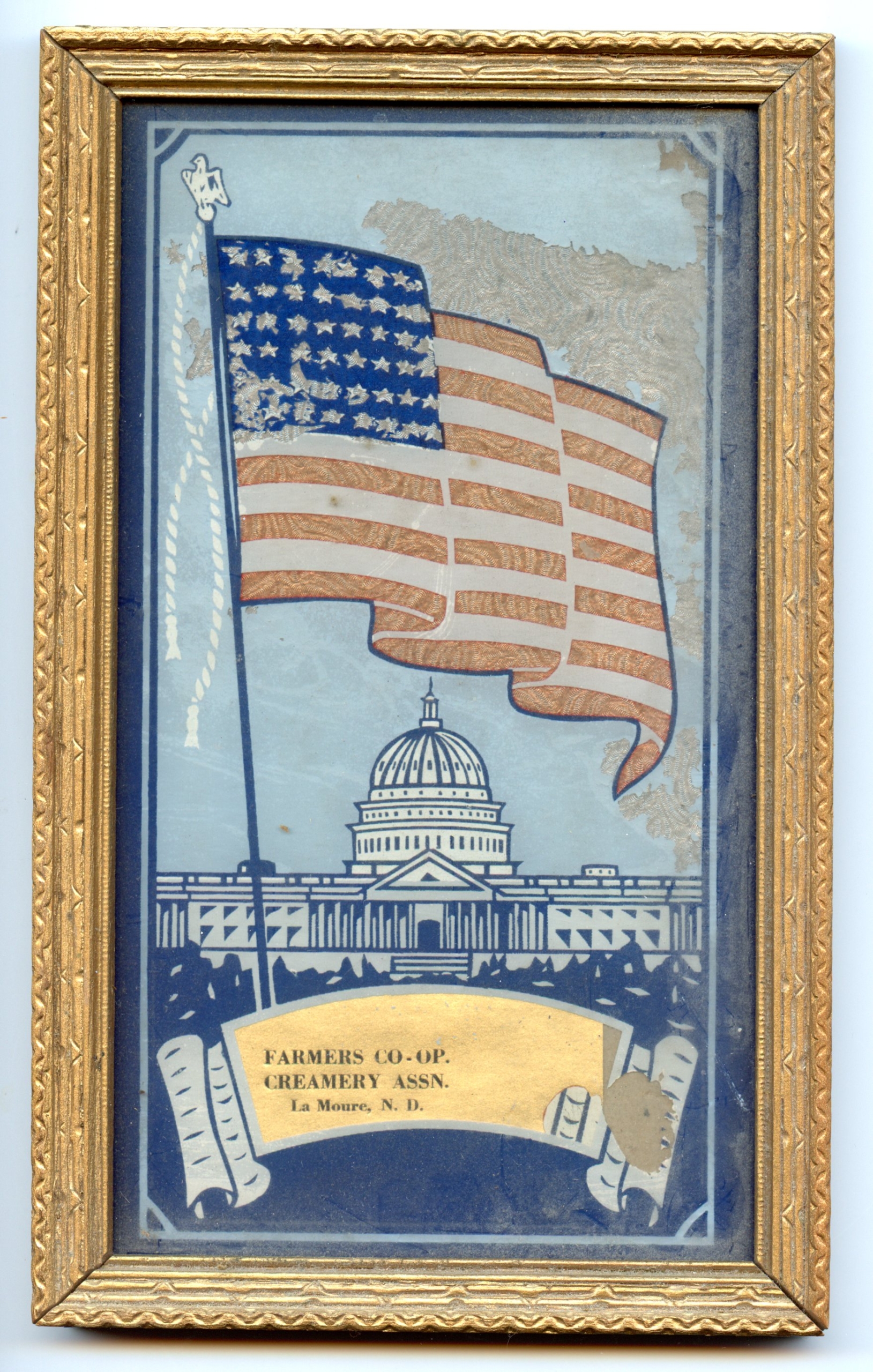
5 1/2x 8 1/2 wall plaque found at the Busch farm in ND, likely predating the admission of Alaska and Hawaii as states (1959).
The 250th Birthday is July 4, 2026. For me, after thinking a lot about this. tomorrows birthday is specifically for those in their 20s. As has been true for all of our history, the youngest adult generation is ultimately accountable for the future our nation and our world will see 50 years from now. This years birthday is by no means like all the rest; what we do has major consequences for those who are beginning their adult lives.
This isn’t ‘passing the buck’, what is ahead matters a great deal. An exercise for elders: tHow did your road of life matched what you thought might happen? What would you have done differently if you knew. Trace your own experience from when you turned 18 (or 21). it’s acknowledging the reality those of us who are older has experienced ourselves or seen through our elders experiences.
*
Following is part of my story as I have learned it over the years. I gave others an opportunity to share whatever they wished of their own stories. The first responses lead this post. How about adding your own even if not on the printed page? More responses are welcome.
pdf of blank U.S. map: US Map
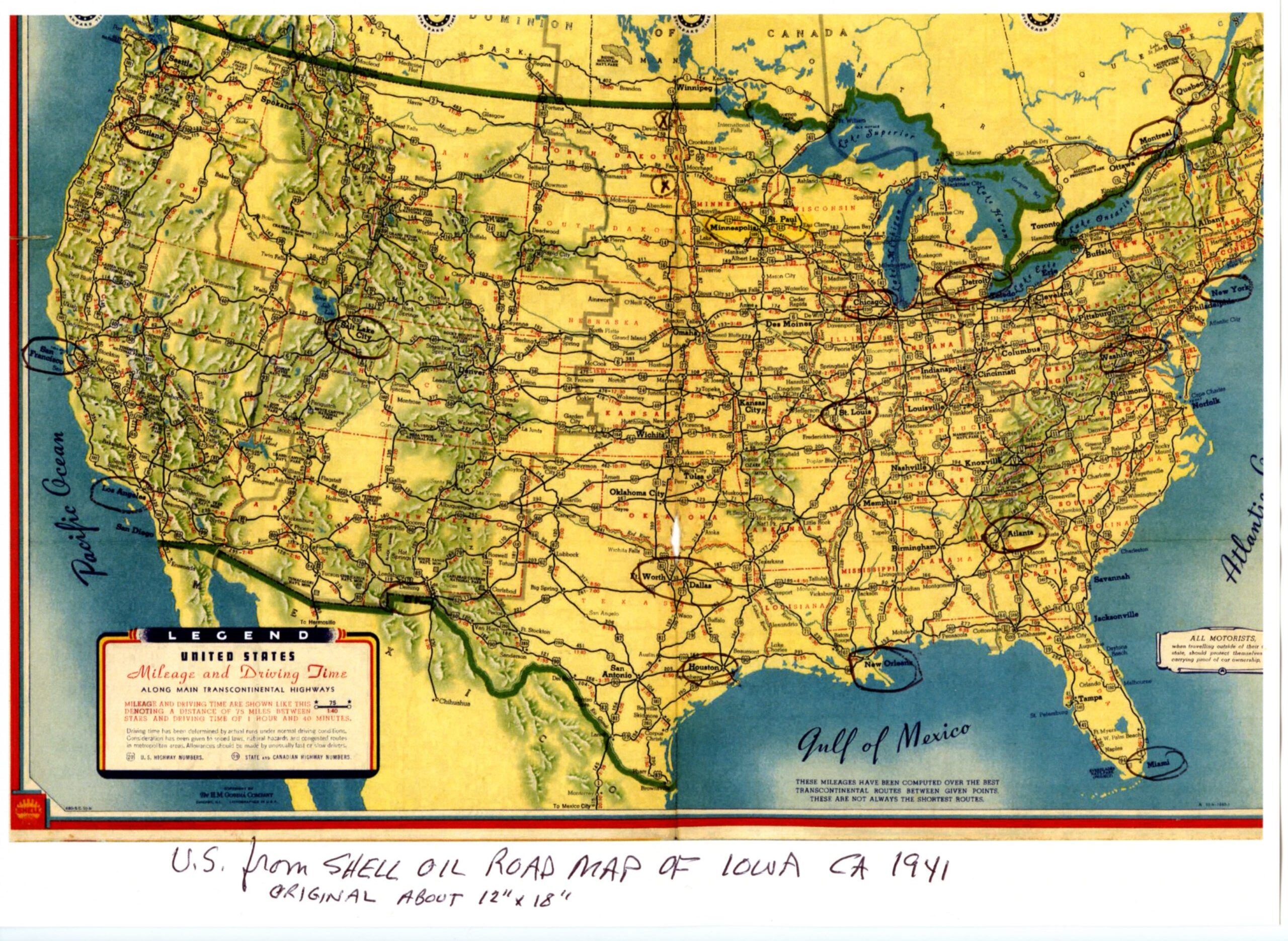
I am weighing in on history on the last day of 250 years, rather than at the beginning of the next year which begins our future legacy should we be so fortunate as to figure out how to survive this crucial juncture at this point in American history.
There has been much change in the first 250 years. The original 13 colonies had about 2 1/2 million population in 1775 (including slaves but not native Americans). The estimate for today is 349 million in the U.S. Of course, this likely translates into more than a billion humans added over all in the 250 years.
I’ve had the opportunity to look back on history through the lens of the average and ordinary citizen, of which I am one.
In 1980 I was given an assignment to learn about my forebears. I was in a Family of Origin workshop. I was 40 and hadn’t been much interested in my roots. I got hooked, and still am. My general history is here in two books; much more in the archives of the North Dakota State Historical Society, including hundreds of Photos at the History Center website, and even more in assorted boxes in my garage. More on the Collette and Bernard family history accessible in Series 29 of the IF Midwest collection at the University of North Dakota Chester Fritz Library.
I’ve learned that family history is an endless river once you dive in….
When I started my project in 1980 I focused on the roots of my four grandparents. (Bernard, Berning, Busch, Collette). This rapidly exploded, of course. I had two parents, they both had two parents. 8, 16, 32…. Don’t forget siblings, aunts and uncles…. This is true for everyone.
In the society from which I descend – white European – going back to ancient history the legal footprint defining family was almost always the man, the “breadwinner”, who “brought home the bacon”. The woman – mom, homemaker etc – was “the Mrs”, the person who had the children and held the household together and rarely got the glory. (One of my photos has about 15 women, probably a church group n the 1940s, and on reverse everyone is identified by name as “Mrs, ____”. Not one is identified with her first name. I asked an elder who knew the women. One, also “Mrs”, apparently didn’t have a husband.)
In my family, it seemed more likely that the girls received more school education than the boys. I think this was more a function of role differences – the male was the person who plowed the ground, and such. The “woman’s work” was every bit as hard – maybe even harder – but the girls possibly spent more time in school.
Grandpa Busch was apprenticed to a blacksmith, and personally earned three U.S. patents fashioned in his shed workshop. He apparently went to 6th grade.
Grandpa Bernard, with a first grade education, came to ND as a carpenter and became chief engineer in a flour mill, and was a very active volunteer Fireman in Grafton and he “brought the first fire truck to Grafton, a marked improvement over the horse drawn vehicles of the past.” (Grafton. Centennial History 1982 p. 79), He was youngest child in his farm family. He’d worked in a sawmill, as a miner and as a lumberjack before coming to ND.
*
My first French-Canadian ancestor came to Quebec in 1618, and his first known child, Euphrosine Nicolet, was from a union with a Nipising native in what is now Ontario. Euphrosine was educated in a French school, married and became part of my family tree perhaps 14 generations back. So far as I know, she’s my only native ancestor.
My last French-Canadian ancestor came to Quebec about 1757, two years before the British defeated the French at the Plains of Abraham 19 years before the Declaration of Independence. (The 13 colonies had in mind Quebec as #14, which didn’t work out.)
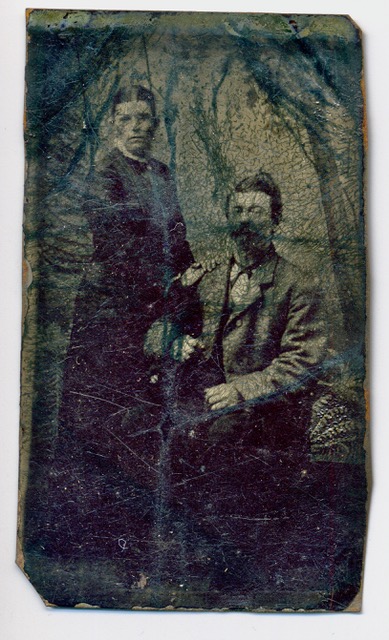
Clotilde Blondeau and Ocatve Collette, St. Anthony (later Minneapolis) MN 1869. The earliest family photo I have.
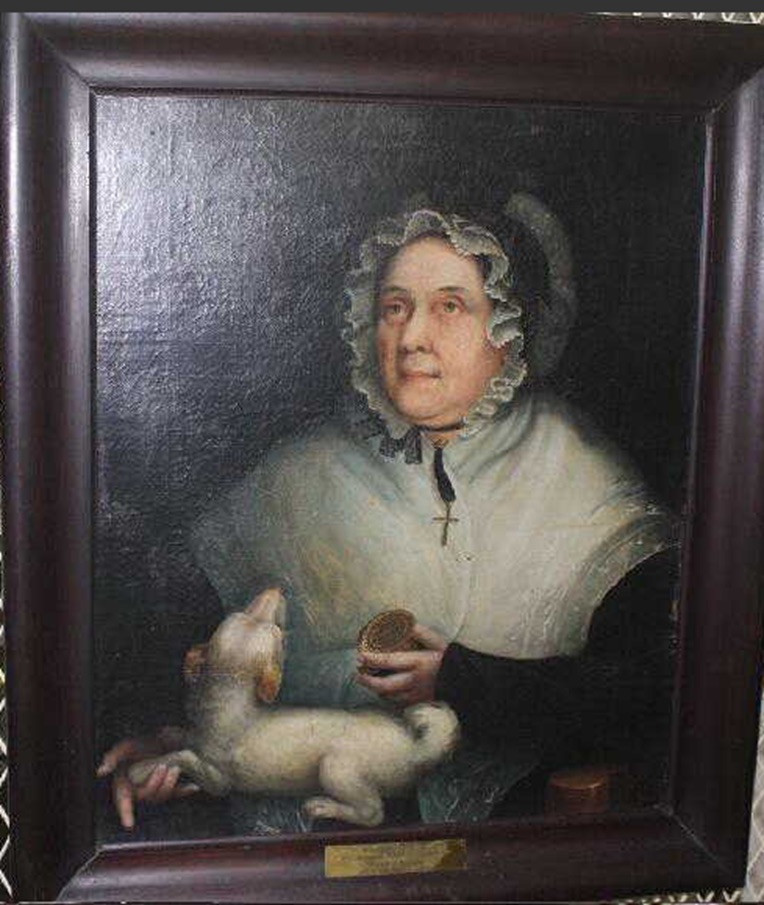
Marguerite Blondeau Guion (undated but before 1832 in St. Louis MO) (see note at end of post)
Marguerite and Clotilde Blondeau (photos above) had the same Blondeau ancestor, though about 100 years apart in age. Still they were blood relatives. (The painting of Marguerite is in the Smithsonian collection, unsure of date. It is conceivable, though probably not provable, that it was done sometime about the time of the Louisiana Purchase and Lewis and Clark Expedition (1804-06).
*
My first German-American ancestor came to the United States in the 1850s to Grant Co, Wisconsin (territory near Dubuque Iowa). Both paternal great-grandparents came from northwest Germany, near the Netherlands. Their home communities (near Heiden and Rheine) were perhaps 50 miles apart, but they likely didn’t know of each other until meeting in America. Most of my German ancestors came to the U.S. in the mid-1860s to early 1870s. They were rural people.
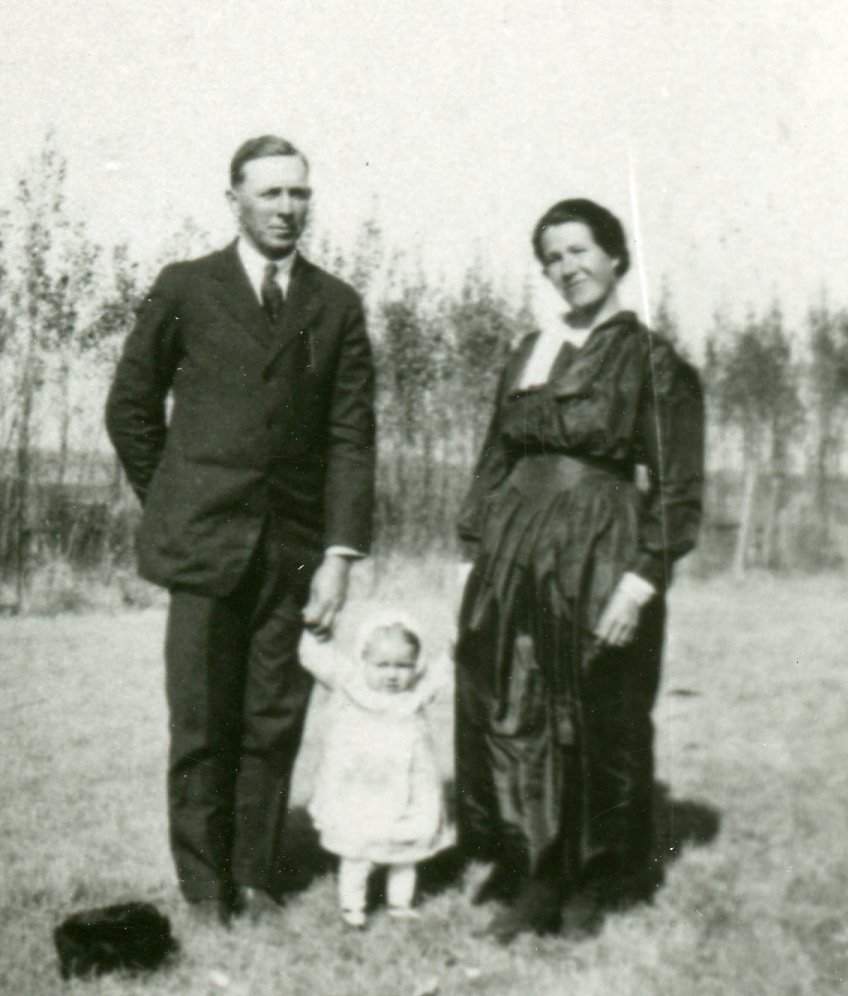
Ferd and Rosa Busch with Lucina 1907
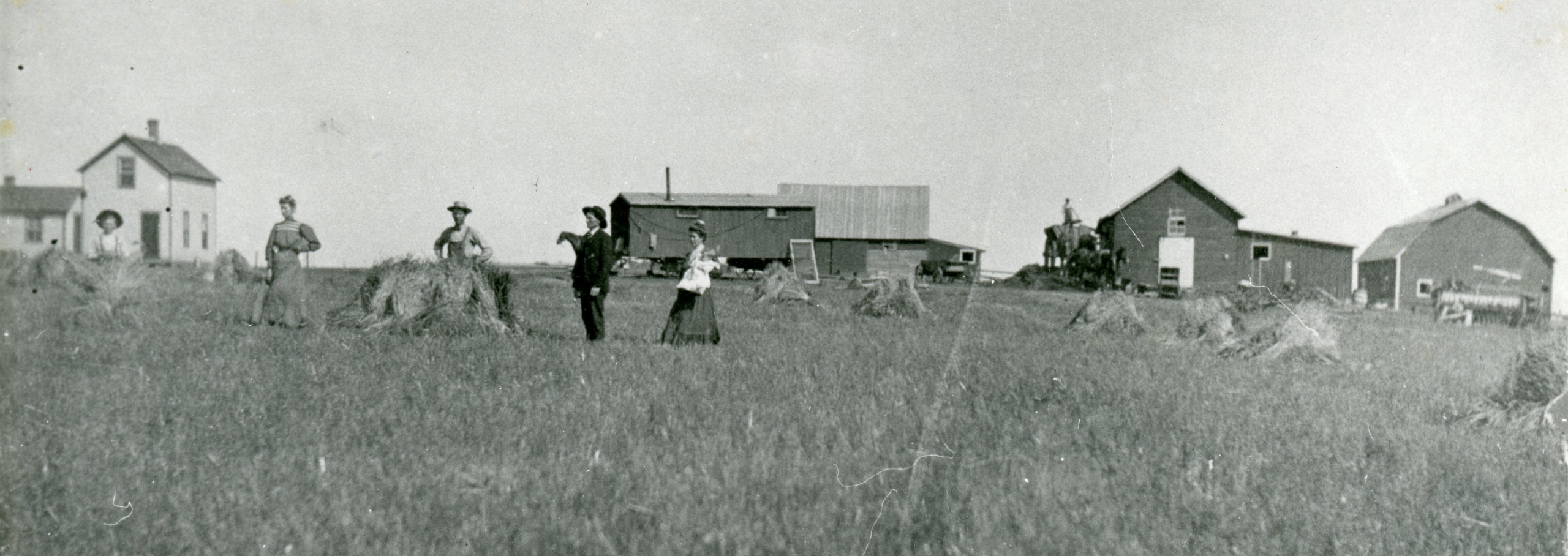
The Busch farmstead 1907. From left: Frank Busch, Ferdinand’s brother; Lena Berning, Rosa Busch’s sister, Ferd Busch (27 years), Wilhelm Busch, Ferd’s father, Rosa Busch (23) with daughter Lucina.
Their offspring, my grandparents Ferd and Rosa, homesteaded in North Dakota in 1905 during a vigorous wave of settlement in “teenage” North Dakota.
Grandpa was very active in the ways that people could be active in those rural communities. Grandma was, too, without any fanfare.
The above Busch photos may hold an untold story of their own. Ferd’s sister, Christina, and Rosa’s brother, August, married and had a farm near to the above home place. They came about a year after the Busch’s. The family history notes that Christina and August’s first child, Erwin, died at six months, and this may be the reason for the visit from Wisconsin, and the Busch’s in ‘dress up’ garb. At this time in history there was no nearby church, and it is unknown where the baby was buried.
*
On the other ‘side’ the oldest grandparent, my grandfather Bernard, was born in Quebec in 1872 and came to North Dakota in the 1890s. His brother preceded him. Their (thus my) roots go back to the early 1630s in Quebec. The rest of Grandma Bernard’s family (Collette) came to the U.S. starting in the 1860s. Grandma was born in 1881 in what was then Dakota territory. ND became a state in 1889.
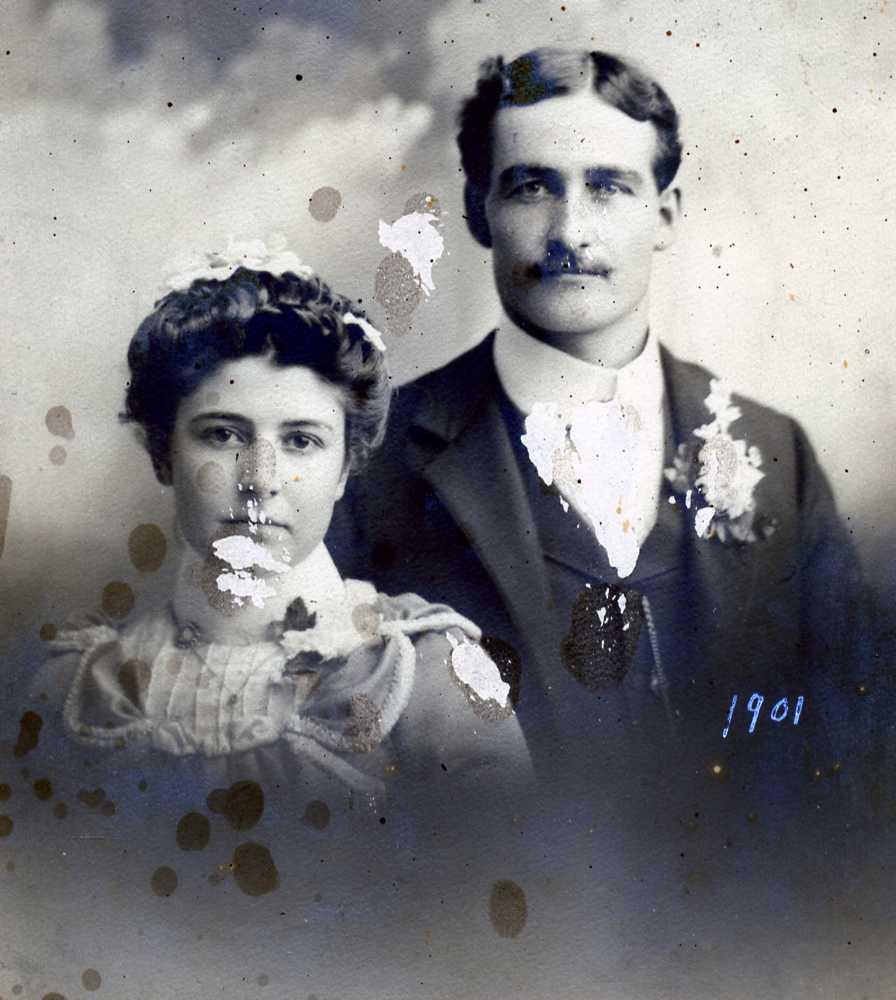
Josephine Collette (20) and Henry Bernard (29) wedding photo 1901 Oakwood ND. Henry (Honore) was born in 1872 in Quebec and the oldest ancestor that I actually knew. He died when I was 17.
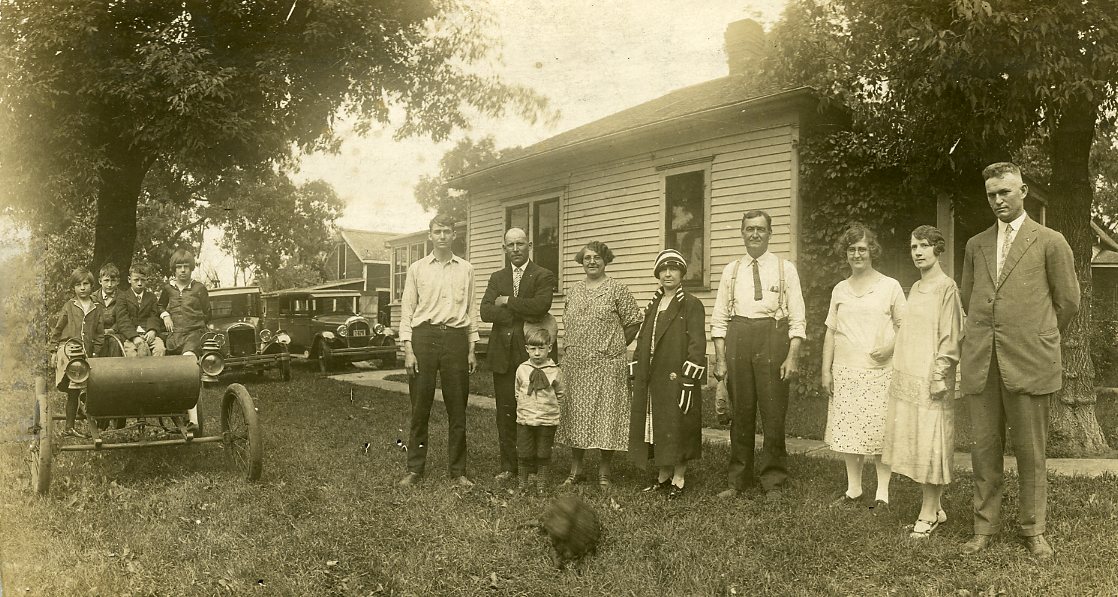
Grafton ND ca 1920 Henry and Josephine Bernard and their three children, Henry, Frank and Josie, and visitors from Winnipeg. Also in picture their 1901 Oldsmobile and Fosto, the family pet.
Grandpa Bernard was chief engineer in a flour mill where his brother was chief miller. He was said to have a first grade education. His background included life as a lumberjack, a miner, and a carpenter. He had a knack with machines, and he was well respected in the community.
*
All of my parents and their siblings were born at home. Almost everything we take for granted today were unknown or primitive in their time. The families were like virtually all families. One hesitates to make any judgement of the whole or the parts.
Best I can make out, they were basically hard-working and productive citizens. They survived the punches of WWI, the flu pandemic, the Great Depression, WWII and all the rest. There was lots of military service in the families, both sides. Many served in the military and civilian service like the Peace Corps. They were pretty religious, Catholic, and lived in communities where you could survive knowing only the ancestral language.
All of them from my parents generation back are now part of history. We are left to carry on.
POSTNOTE ABOUT MARGUERITE BLONDEAU GUION: Marguerite was a latecomer to my personal family history, and was not ‘fleshed out’ until 2026 with great thanks to my cousin Remi Roy.
Marguerite Blondeau Guion was reputed to be the first white woman to set foot in what is now known as St. Louis MO in 1764, born about 1740. She had a direct ancestral connection to my Blondeau roots, beginning with my great grandmother Clotilde Blondeau Collette born 1847. Their shared ancestor was Lambert Blondeau.
Marguerite’s husband, stone mason Amable Guion, is elsewhere in another branch of my French-Canadian family tree. He was killed in a battle with the British and Indian allies at St. Louis in 1780. At the time St. Louis was Spanish territory.
Around 1800, Napoleon and France took control of the area, and very shortly thereafter sold the huge parcel known as the Louisiana Purchase to the U.S., which later became famous through the Lewis and Clark expedition, 1804-06. My stories about Marguerite Blondeau and Amable Guion can be read here and here.
They didn’t realize at the time how they both fit into the complicated history that evolved into present day United States.
No one knows who painted Marguerite Blondeau’s visage, nor when, but it was in St. Louis and likely came about sometime after the Lewis and Clark expedition when it became part of the lore of the new western territory of the United States.
COMMENTS:
from Dick: Jane has updated her comment (link at beginning of post. I have a new post on July 4, and will continue there. Link at beginning of this post.
from Jim: Best wishes today, and much hope for the next 250,
from Dick: Thanks Jim. We’ll see if we’re up to the task ahead. “We” is a great number of citizens of the U.S. Don’t give up on us.
from Jim: Well, Dick, if were I inclined to, I would never give up on you folks.
Even the best of neighbours go through bad patches, and Lord knows the “we” up here are not without our flaws! Have a hot dog and celebrate all the good!
Leave a Reply
Want to join the discussion?Feel free to contribute!