
The Day before 250

What follows are personal reflections on relationships that built the United States of America.  Included here are a few others who sent some reflections of their own.  Yours will be gladly added if you wish.  The other reflections so far: Jim, Larry, Lois, Nancy, Jane, Brian.  Yours?

Directly relevant to this post is one on Canada and the Revolution which I published July 1, here.  It includes some very interesting commentary.

If your interest is in the history of the events immediately prior to Independence Day in 1776, here is Heather Cox Richardson’s description of events at the time.. I strongly suggest subscribing to Dr. Richardson’s daily journal of our nation’s history.
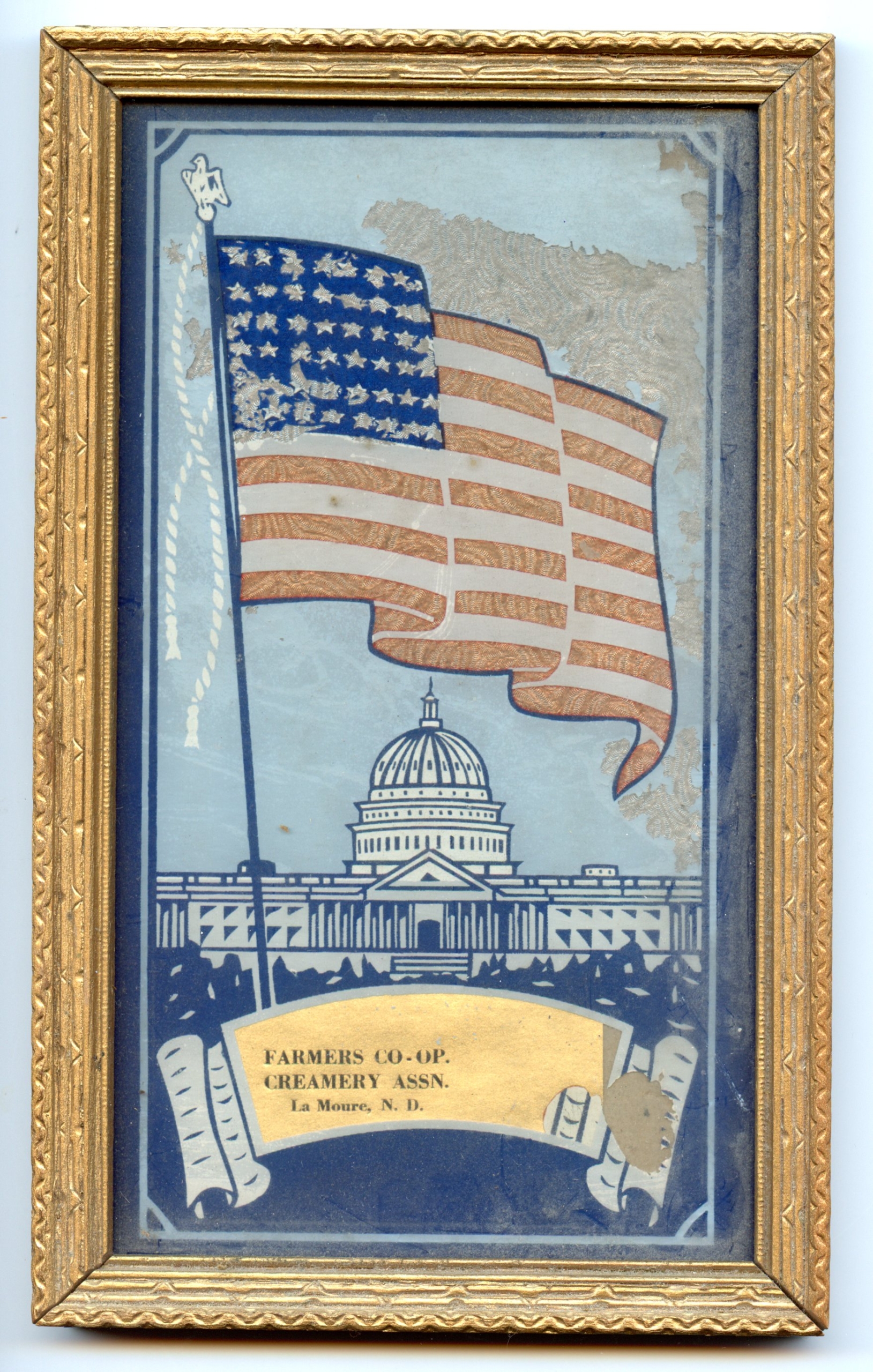
5 1/2x 8 1/2 wall plaque found at the Busch farm in ND, likely predating the admission of Alaska and Hawaii as states (1959).

The 250th Birthday is July 4, 2026.  For me, after thinking a lot about this. tomorrows birthday is specifically for those in their 20s.  As has been true for all of our history, the youngest adult generation is ultimately accountable for the nation and our world will see 50 years from now.   This years birthday is by no means like all the rest; what we do has major consequences for those who are beginning their adult lives.

This isn’t ‘passing the buck’, what is ahead matters a great deal.  An exercise for elders: tHow did your road of life matched what you thought might happen?  What would you have done differently if you knew.  Trace your own experience from when you turned 18 (or 21).  it’s acknowledging the reality those of us who are older has experienced ourselves or seen through our elders experiences.

*

Following is part of my story as I have learned it over the years.  I gave others an opportunity to share whatever they wished of their own stories.  The first responses lead this post.  How about adding your own even if not on the printed page?  More responses are welcome.

pdf of blank U.S. map: US Map
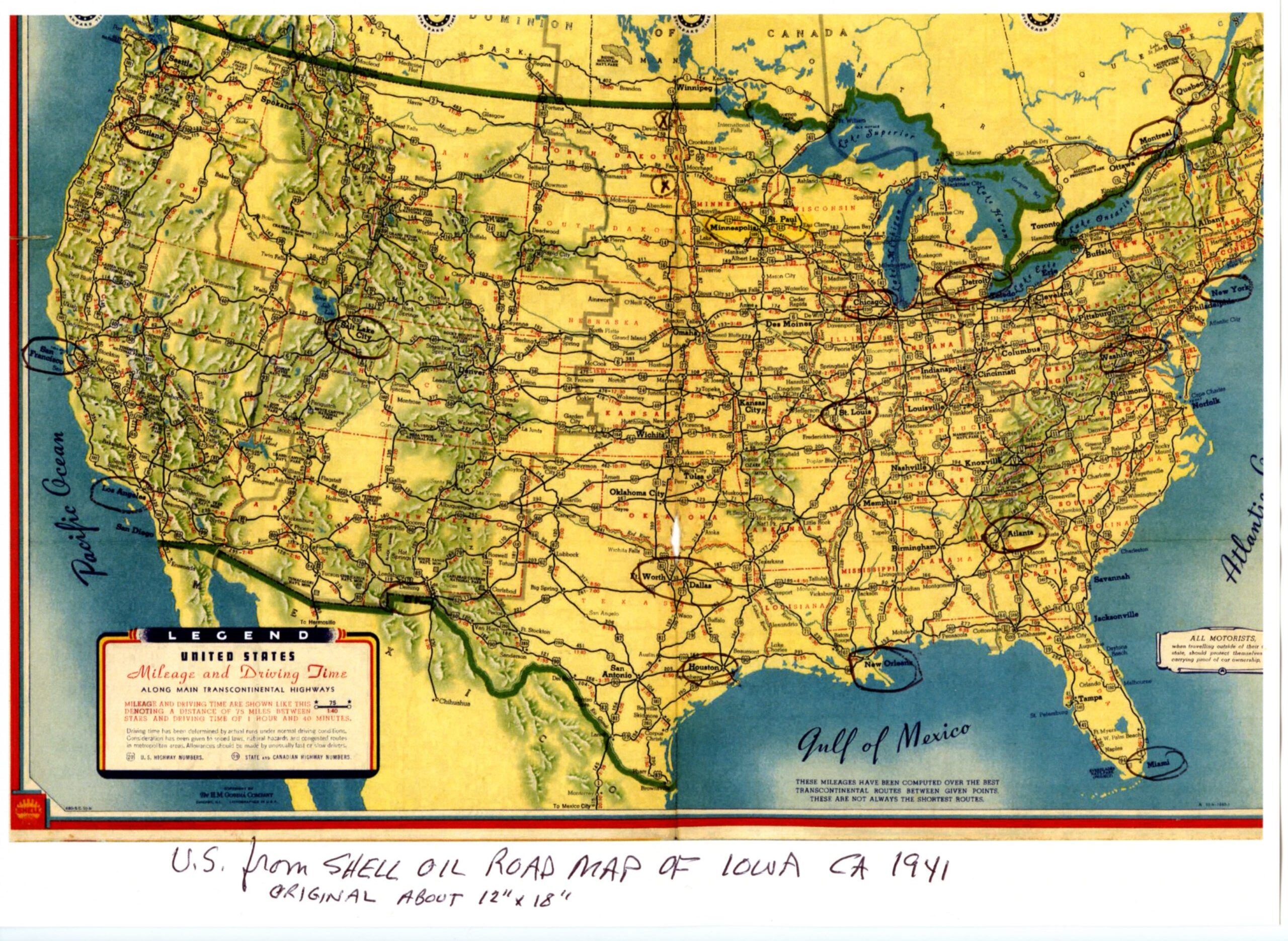
I am weighing in on history on the last day of 250 years, rather than at the beginning of the next year which begins our future legacy should we be so fortunate as to figure out how to survive this crucial juncture at this point in American history.

There has been much change in the first 250 years.  The original 13 colonies had about 2 1/2 million population in 1775 (including slaves but not native Americans).  The estimate for today is 349 million in the U.S.  Of course, this likely translates into more than a billion humans added over all in the 250 years.

I’ve had the opportunity to look back on history through the lens of the average and ordinary citizen, of which I am one.

In 1980 I was given an assignment to learn about my forebears.  I was in a Family of Origin workshop.  I was 40 and hadn’t been much interested in my roots.  I got hooked, and still am.  My general history is here in two books; much more in the archives of the North Dakota State Historical Society, including hundreds of Photos at the History Center website, and even more in assorted boxes in my garage.

I’ve learned that family history is an endless river once you dive in….

When I started my project in 1980 I focused on the roots of my four grandparents. (Bernard, Berning, Busch, Collette).  This rapidly exploded, of course.  I had two parents, they both had two parents.  8, 16, 32….  Don’t forget siblings, aunts and uncles….  This is true for everyone.

In the society from which I descend – white European – going back to ancient history the legal footprint defining family was almost always the man, the “breadwinner”, who  “brought home the bacon”.  The woman – mom, homemaker etc – was “the Mrs”, the person who had the children and held the household together and rarely got the glory.  (One of my photos has about 15 women, probably a church group n the 1940s, and on reverse everyone is identified by name as “Mrs, ____”.  Not one is identified with her first name.  I asked an elder who knew the women.  One, also “Mrs”, apparently didn’t have a husband.)

In my family, it seemed more likely that the girls received more school education than the boys.  I think this was more a function of role differences – the male was the person who plowed the ground, and such.  The “woman’s work” was every bit as hard – maybe even harder – but the girls possibly spent more time in school.

Grandpa Busch was apprenticed to a blacksmith, and personally earned three U.S. patents fashioned in his shed workshop.  He apparently went to 6th grade.

Grandpa Bernard, with a first grade education, came to ND as a carpenter and became chief engineer in a flour mill, and was a very active volunteer Fireman in Grafton and he “brought the first fire truck to Grafton, a marked improvement over the horse drawn vehicles of the past.”  (Grafton. Centennial History 1982 p. 79),  He was youngest child in his farm family.   He’d worked in a sawmill, as a miner and as a lumberjack before coming to ND.

*

My first French-Canadian ancestor came to Quebec in 1618, and his first known child, Euphrosine Nicolet, was from a union with a Nipising native in what is now Ontario.  Euphrosine was educated in a French school,  married and became part of my family tree perhaps 14 generations back.  So far as I know, she’s my only native ancestor.

My last French-Canadian ancestor came to Quebec about 1757, two years before the British defeated the French at the Plains of Abraham 18 years before the Declaration of Independence.  (The 13 colonies had in mind Quebec as #14, which didn’t work out.)
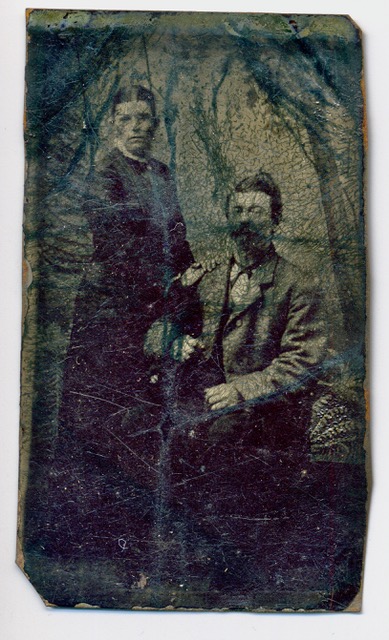
Clotilde Blondeau and Ocatve Collette, St. Anthony (later Minneapolis) MN 1869.  The earliest family photo I have.
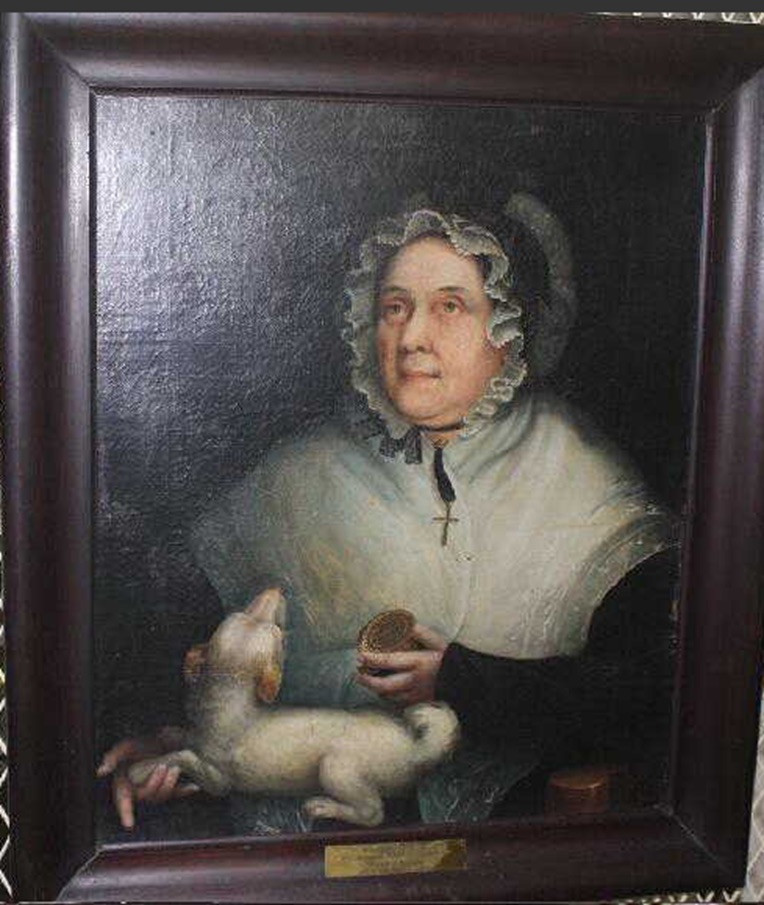
Marguerite Blondeau Guion (undated but before 1832 in St. Louis MO)  (see note at end of post)

Marguerite and Clotilde Blondeau (photos above) had the same Blondeau ancestor, though about 100 years apart in age.  Still they were blood relatives.  (The painting of Marguerite is in the Smithsonian collection, unsure of date.  It is conceivable, though probably not provable, that it was done sometime about the time of the Louisiana Purchase and Lewis and Clark Expedition (1803-05).

*

My first German-American ancestor came to the United States in the 1850s to Grant Co, Wisconsin (territory near Dubuque Iowa).  Both paternal great-grandparents came from northwest Germany, near the Netherlands.  Their home communities (near Heiden and Rheine) were perhaps 50 miles apart, but they likely didn’t know of each other until meeting in America.  Most of my German ancestors came to the U.S. in the mid-1860s to early 1870s.  They were rural people.
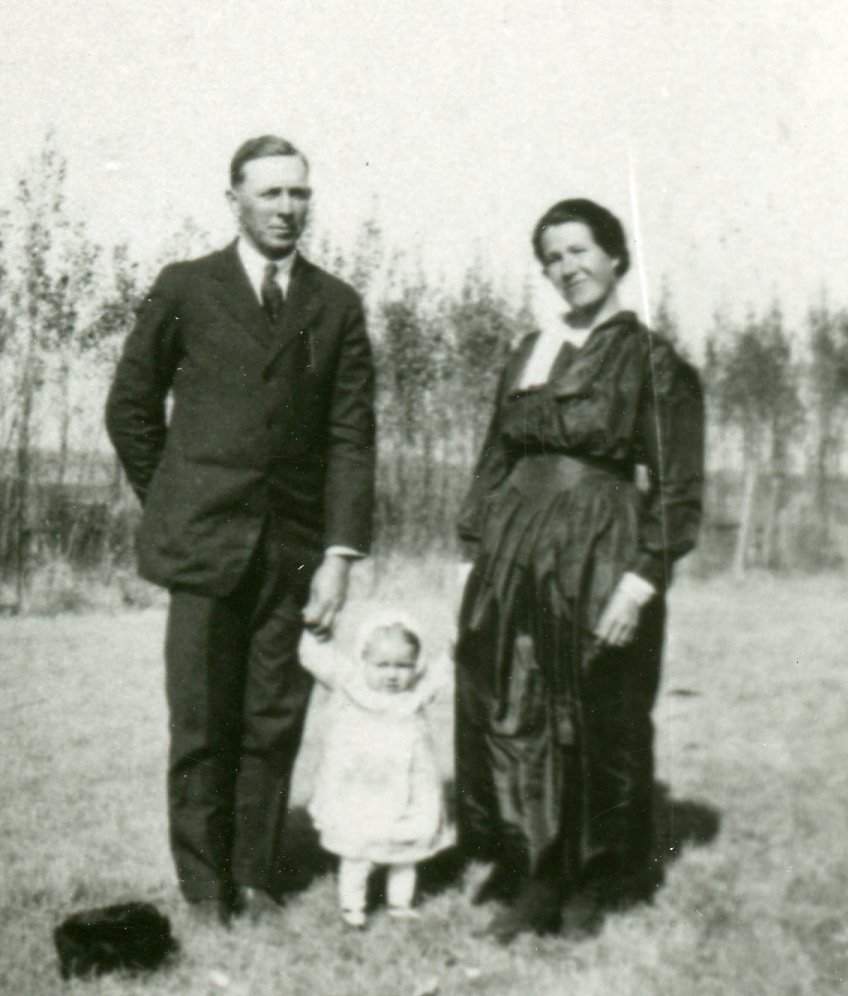
Ferd and Rosa Busch with Lucina 1907
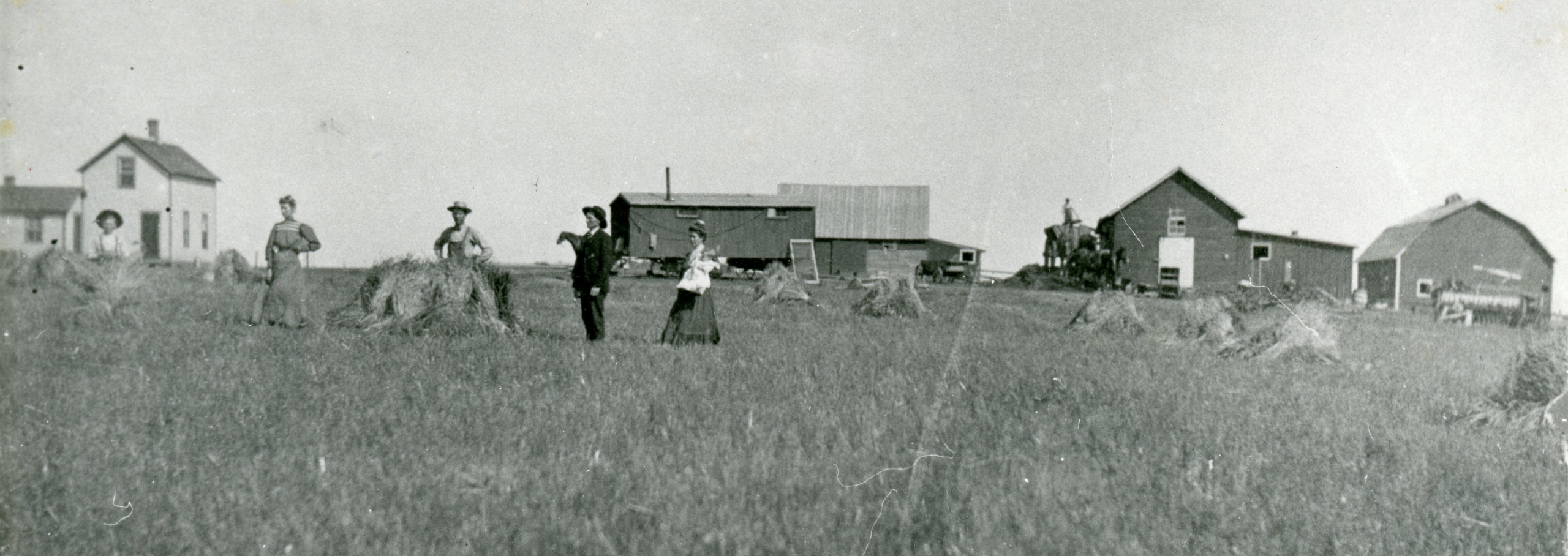
The Busch farmstead 1907.  From left: Frank Busch, Ferdinand’s brother; Lena Berning, Rosa Busch’s sister, Ferd  Busch (27 years), Wilhelm Busch, Ferd’s father, Rosa Busch (23) with daughter Lucina.

Their offspring, my grandparents Ferd and Rosa, homesteaded in North Dakota in 1905 during a vigorous wave of settlement in “teenage” North Dakota.

Grandpa was very active in the ways that people could be active in those rural communities.  Grandma was, too, without any fanfare.

The above Busch photos may hold an untold story of their own.  Ferd’s sister, Christina, and Rosa’s brother, August, married  and had a farm near to the above home place.  They came about a year after the Busch’s.  The family history notes that Christina and August’s first child, Erwin, died at six months, and this may be the reason for the visit from Wisconsin, and the Busch’s in ‘dress up’ garb.  At this time in history there was no nearby church, and it is unknown where the baby was buried.

*

On the other ‘side’ the oldest grandparent, my grandfather Bernard, was born in Quebec in 1872 and came to North Dakota in the 1890s.  His brother preceded him.  Their (thus my) roots go back to the early 1630s in Quebec. The rest of Grandma Bernard’s family (Collette) came to the U.S. starting in the 1860s.  Grandma was born in 1881 in what was then Dakota territory.  ND became a state in 1889.
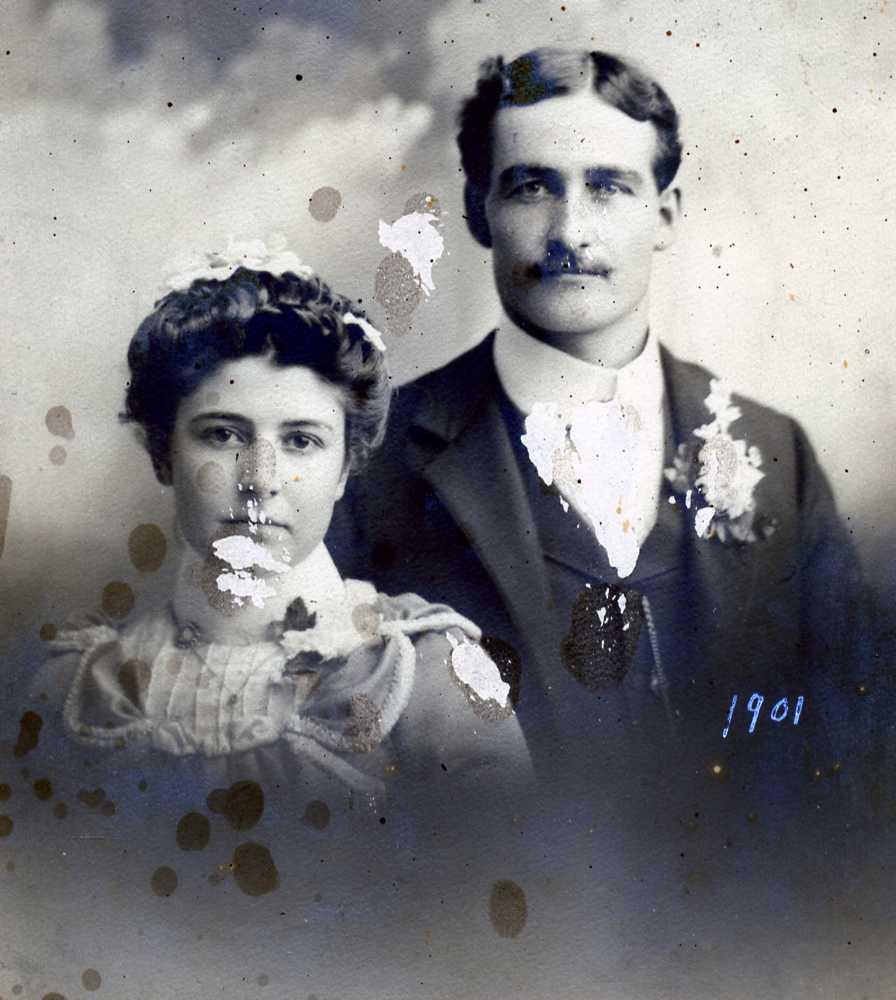
Josephine Collette (20) and Henry Bernard (29) wedding photo 1901 Oakwood ND.  Henry (Honore) was born in 1872 in Quebec and the oldest ancestor that I actually knew.  He died when I was 17.
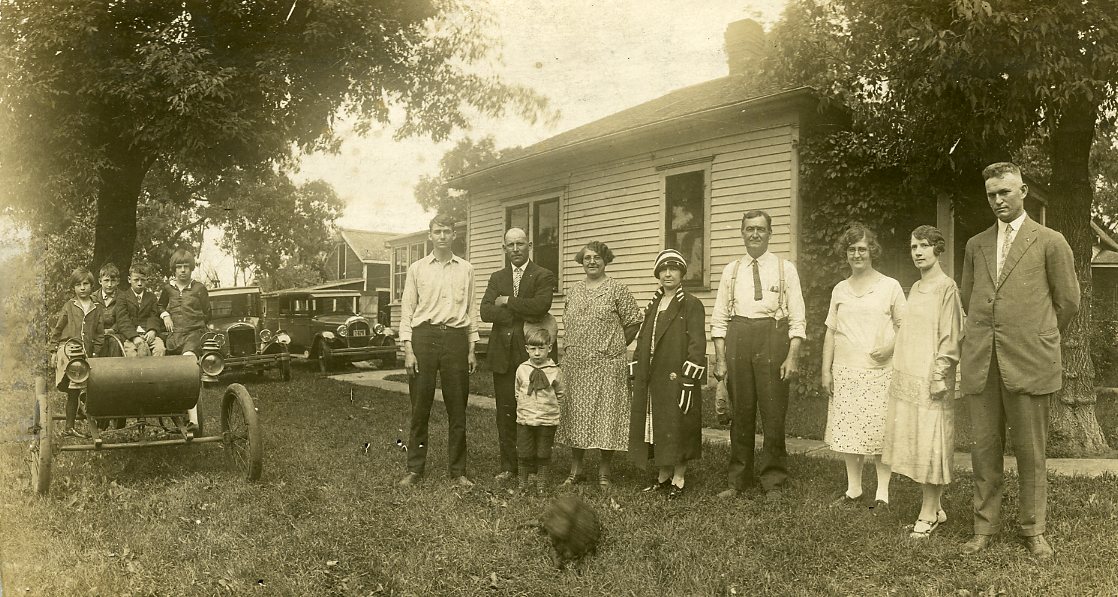
Grafton ND ca 1920 Henry and Josephine Bernard and their three children, Henry, Frank and Josie, and visitors from Winnipeg.  Also in picture their 1901 Oldsmobile and Fosto, the family pet.


Grandpa Bernard was chief engineer in a flour mill where his brother was chief miller.  He was said to have a first grade education.  His background included life as a lumberjack, a miner, and a carpenter.   He had a knack with machines, and he was well respected in the community.

*

All of my parents and their siblings were born at home.  Almost everything we take for granted today were unknown or primitive in their time.  The families were like virtually all families.  One hesitates to make any judgement of the whole or the parts.

Best I can make out, they were basically hard-working and productive citizens.  They survived the punches of WWI, the flu pandemic, the Great Depression, WWII and all the rest. There was lots of military service in the families, both sides.  Many served in the military and civilian service like the Peace Corps.  They were pretty religious, Catholic, and lived in communities where you could survive knowing only the ancestral language.

All of them from my parents generation back are now part of history.  We are left to carry on.

POSTNOTE ABOUT MARGUERITE BLONDEAU GUION: Marguerite was a latecomer to my personal family history, and was not ‘fleshed out’ until 2026 with great thanks to my cousin Remi Roy.

Marguerite Blondeau Guion was reputed to be the first white woman to set foot in what is now known as St. Louis MO in 1764, born about 1740.  She had a direct ancestral connection to my Blondeau roots, beginning with my great grandmother Clotilde Blondeau Collette born 1847.  Their shared ancestor was Lambert Blondeau.

Marguerite’s husband, stone mason Amable Guion, is elsewhere in another branch of my French-Canadian family tree.  He was killed in a battle with the British and Indian allies at St. Louis  in 1780.  At the time St. Louis was Spanish territory.

Around 1800, Napoleon and France took control of the area, and very shortly thereafter sold the huge parcel known as the Louisiana Purchase to the U.S., which later became famous  through the Lewis and Clark expedition, 1804-06.  My stories about Marguerite Blondeau and Amable Guion can be read here and here.

They didn’t realize at the time how they both fit into the complicated history that evolved into present day United States.

No one knows who painted Marguerite Blondeau’s visage, nor when, but it was in St. Louis and likely came about sometime after the Lewis and Clark expedition when it became part of the lore of the new western territory of the United States.

Recollections: Jane

    Families!  Mine was (and still is) the most dysfunctional middle-class family in America!  I dare anyone to match their family’s dysfunction against mine.  Ground rules:  Your family has to be White, middle class, gainfully employed and have at least two kids.
     My parents lived in a two-bedroom house and still managed to not speak to each other for over ten years.  “Tell your father to pass the salt.”  The silent treatment perfected!  How the freak did they even do that?  My sister refused to sign my father’s burial consent unless we gave her all his money — even though she hadn’t spoken to my father for seven years.  No one told me when my sister died.  I had to read her obituary nine months later.
     My family managed to raise middle-class dysfunctionality to a fine art!

Recollections: Brian

Hello Dick!
Here’s my story:  I was 18 years old growing up in Texas.  I was too young to vote or to drink alcohol legally.  However my pastor (at our church), my government (LBJ) and my parents wanted me to go off to Vietnam to fight!
Fight?   Kill or be killed?   Scheiße!   I said “No way, José!”.   Instead I went off to Denmark to work with a bank there.  There were wild, wonderful women there.   So sweet.  I wasn’t in to sex but they were.   Well, instead of that we drank expensive beers, dear 🙂   I so loved it!I a
In my mind I’d left the USA forever.  But my Momma was smart.  She made a deal with the draft board.  If I came back to the USA, I would get a very high draft number, meaning I wouldn’t almost certainly  be drafter.  It worked great.
When I arrived in NYC I only had $7, so I had to ask my brother for a loan for $100.  Easy peasy.
I am a fence sitter.  LBJ was a Democrat.  I called then Democ-Rats, ha ha.  And I called the Republicans, Republi-CONS, ha ha.
But now I am so much happier.  Even with Trump for whom I pray for.  Oh, Jesus and Mary!  🙂
Love,
Brian
P.S.  Later I went to Vietnam to help my German friends there strengthen credit unions.  They could speak English but not French.  In Vietnam they speak French.   I so LOVED it there.  I rode a little motorbike all over, even up to the China border.  Fun!
It’s okay to publish 🙂

Recollections: Nancy

A classmate of mine from LaMoure has been writing short stories and sending them for me to read, and I didn’t know about them until today.  I will have lots of reading and deleting to do.   I am beginning those things today at the library where help is still within reach.
Yesterday was June 2, which was my grandfather’s 145th birthday.  He was born in Iowa in 1881.   His name was Charles Carl Paulson.   He was from a family of 12.   He worked on the railroad there and got married.   In about 1904 his brother Herman moved to Adrian, ND to farm.   He invited Charles to take the farm across the road from him, so Charles and his wife Marie packed their belongings and mules into a train and rode it to Adrian in LaMoure County.  Their third child, my mother Vivian was just a few months old when they arrived in Adrian in 1907.   Charles eventually quit farming and started selling cars and building roads.
In 1928 when my dad Albert Hurley entered the family by marrying Vivian, Charles taught him the ropes of road building.   Charles moved to LaMoure and got elected sheriff.   He and another man traded off as sheriff and treasurer for many years.   Yesterday our son Luke and his wife Johanna had a son they named Hunter Lucas Erickson.   I was glad the baby arrived on my grandpa’s birthday.


Dick, another few details of Grandpa Paulson.  As sheriff of LaMoure County, he would deputize his kids at times.  His sons Lester and Cleo were athletes whose football training served them well when chasing and tackling an offender running through the corn rows or whatever.  He’d deputize my mother or one of her sisters when he needed to drive a woman to the mental hospital in Jamestown.  He deputized my dad when he needed him to scare a man who claimed to be paralyzed into admitting he’d killed his sister at the farm where they lived.


My sisters were lucky when they were old enough to get their driver’s license that he said, “They’re good drivers” and they got to skip the written and driving tests.
My grandpa was such a leading citizen in LaMoure that his obituary rated the front page of the Chronicle when he died in 1952.   There is always more to my stories!   This time I will sign it Nancy Patricia Hurley Erickson

Recollections: Lois

One ancestor, Runyon C. Tunison, comes to mind as a person of interest.

  1. C. was the oldest of 6 children born to William and Elizabeth Fitz Randolph in 1817. Siblings were Tunis, Ira, John, Alexander, and Sarah E.  He died at age 72 + months per the obituary of Humboldt County IA (putting birth year in 1815 which agrees with enlistment in Civil War Iowa Regiment 31 as age 45).

Runyon married Margaret Breese in 1840, had son William, then Wallais and Ira C in New Jersey.  Margaret died in 1854 of heart failure and he married Elizabeth Chandler Turner, widow of Henry B, and they had two sons – Adelbert John and Willis Wesley …residing in Buffalo NY.

During his lifetime, Runyon lost siblings, a wife, and children – health and tragedy.

  1. Brothers: Ira was killed in Battle of Chapultepec, Alexander died of wounds two weeks after the battle in 1847.
  2. Son Wallais died in 1853 Congestion of brain
  3. Wife Margaret died in 1854 of heart failure
  4. Brother Tunis died in Buffalo in 1873
  5. Son Adelbert “Del” was murdered in Kansas in 1885

In 1880 Runyon was listed on census as a boarder, widowed, in Newark.  His son William was living in Union NJ.  He had divorced Elizabeth and by late 1880’s was living in a County Farm home likely for veterans in Humboldt County IA where his son Ira resided.  Runyon died in May of 1887.

A newspaper article in Rock Island IL in 1870 was titled “Misdeeds of R. C. Tunison” – it was about a scam when Runyon started a collection to provide funds for a man who was injured in a plow works factory, unable to work thereafter.  He recorded names and amounts donated for a time until someone became suspicious, contacted the injured man, and found out he (Mr. Cook) asked R. C. to stop collecting on his behalf.  Within days, “Tunison had eloped, gone – subscription paper and all with a report he had likely collected about $25.  He left a letter with the watchman on the Island bridge telling him to go to his shop and secure a few scraps and keep them, also bidding him good bye, as this place would see him no more”.  The closing line of the newspaper article:  Good bye, Tunison, thy charities covered a mighty mean specimen of morality”.

*********

Researching my ancestors has been fulfilling beyond belief. My grandmother Maggie Tunison’s line and her mother’s line of Hewitt provided 400 years of insight into the lives of my ancestors in America.

Recollections: Larry

My own father sent me away to be raised by an uncle and an aunt who had no children. After a year or so, they sent me to my grandmother in Valley City, North Dakota, a perfect village for a child to be raised in. But I did see my father, occasionally, over the years and I admired him for a number of reasons: his occupation as a railroad telegrapher, his carving of wooden horses, and his insatiable curiosity, which I thankfully inherited. He died at 60 and now I’m 83. Looking back, I understand him better but not completely. Having raised a son and daughter, I both understand yet am somewhat perplexed as to how he could send me away at age 5. But, I remain forever grateful because of where I landed and for the care I received from my grandmother. Happy Father’s Day, Dick. I enjoyed the photos which reminded me of my own “command central.” It’s a place in my life that has always been – now, more than ever – my personal refuge.

Recollections: Jim

I have an interesting, somewhat seminal story of my immigrant roots.  I had the foresight to gather assorted facts and information several decades ago when older relatives freely shared their stories. My father’s mother migrated from rural Norway and his father from Trelleborg the southern tip of Sweden near Copenhagen Denmark. I speak the languages and have visited their original neighborhoods, including historic cemeteries to gather a lot of interesting facts. Life was simple and yet some ways dreary.  Society was rigid with little mobility and few economic opportunities. The news of America was exciting and enticing for the adventurous young people.

My father’s mother Cecilia has a unique story. While very young she bore an out of wedlock child. Her future would be a predictable life with a poor farmer. She made a bold move to leave her baby in the care of her sister and seek passage to America. One way to have American sponsor pay her passage in return for 18 months of service as a domestic servant. My father’s father William had a different challenge. He was apprenticed as a steamfitter with little direct wage and found few opportunities to advance. I believe his family helped him pay for his long passage to Minnesota. He took a very low paying laborer job when he arrived in Minneapolis in 1906. My father’s parents met at a social gathering Dania Hall near the seven corners area in South Minneapolis. After a brief courtship they were married and continued to live in Minneapolis. As Minneapolis residences converted from coal to natural gas there was ample work and the family including my father and aunt thrived.

Later our family story had a heart-breaking challenge. My paternal grandfather, the breadwinner, developed a severe heart condition during the 1930’s and could not do heavy work. As a response, my father’s parents developed a novel solution. In the same South Minneapolis Scandinavian neighborhood, they found an empty underutilized building. They divided the building into 15 separate sleeping rooms and rented them to recent Scandinavian immigrants. Residents could obtain breakfast, a packed lunch and return at the end of the work day for a nutritious supper in a dining room with a radio and phonograph. My father and his lovely (accordion playing) sister grew up in the company of up to 15 adult males. Some of the most colorful family stories are remembered from this austere Boarding House era during the 1930’s.

My mother’s family name is Scanlon, almost pure Irish.   Immediately before living in Minneapolis, the Scanlon’s lived 40 miles south of Minneapolis in the small historic railroad towns Farmington and Elko where her father was Station Manager. Imagine my mother and her four siblings lived their childhood in a series of Railroad stations during my grandfather’s 50-year career for the Milwaukee Railroad.   My mother’s father Francis (nicknamed Pat) grew up in the small town of Adams, MN near Austin (famous for their Spam canned meat). James Scanlon, Francis’ father was born in Montreal Canada in August 1866. We know that James’s father was John Scanlon and his mother was named Jane. John was born County Wicklow and Jane in County Sligo in Ireland. They were married in 1848 in Ireland. The chief reason for the migration was The Great Potato Famine (a massive crop failure due to a fungal disease). While still a young man John migrated first to New York and served with the Union Army and fought in several Civil War battles including Gettysburg. After the war he migrated to southern Minnesota to participate in the rapidly expanding railroad industry and started a family of five children including my grandfather Francis.  My mother’s maternal grandmother Harriet was born in Vermont April 1865. I have names and relevant live dates of her grandparents’ parents that migrated there from England.

The eventful odyssey of   two families Nelson and Scanlon joined together in the late 1930’s.  The two families lived directly across the street from one another in South Minneapolis. My father was Walter Nelson and my mother Frances Scanlon, together was an old fashioned love story. They were married in 1940 and I was born in 1943.  My daughter, Kristin from my first marriage has Dutch ethnicity. Her grandparents immigrated to Minnesota in 1953. My current wife Nenita immigrated to Minnesota in 2012. Many of our social friends are immigrants from the Philippines, so we have an opportunity to explore and appreciate and preserve some of the beautiful and interesting details of each culture.

There are some common threads from my immigrant’s roots. The immigrant experience tends to highly value three human qualities. One is that all worthwhile achievements are the product of hard work. Second, our strong healthy family relationship are vital to our well-being. Third we should always be willing to lend a helping hand to those in need.