
A Little Ride
We watched the conclusion of the Artemis II mission on April 10, 2026. In all ways it was impressive – a perfect landing. Only a few dilemmas. Here was my view as the spacecraft neared touchdown. I was most impressed with the diversity of the four person crew: a woman, an African-American, a Canadian, and a white man, all stuffed in a tiny vehicle, all eminently qualified for their duty.

Near touchdown. I like this photo since it shows how tiny the vehicle is compared with the surrounding earth.
As I was watching the conclusion of the mission I jotted down on a sheet of paper my own close calls with the space program, all of them as a spectator, but actually more occasions – 15 in all – than I had expected.
For me, first on my list was Sputnik, which I watched from my grandparents farmyard in rural Berlin North Dakota in October 1957. There was nothing impressive about Sputnik itself – just a tumbling ball in the sky. This was in the pre-high tech days…but the Soviet Union had won the race, and apparently we were caught unawares.
That first humble satellite which stayed around for only a short time, was very big news, and local newspapers publicized its route if its travels were in the vicinity. In my case, it was a map in the Fargo Forum which showed the route and time across the night sky – in my memory from SSE in a completely clear but totally dark sky with stars as background. We knew where to look, and when. and sure enough on schedule came a twinkle moving across the heavens. It was Sputnik, and as it tumbled it reflected the sun for just an instant, over and over. I’ll never forget it.
The next on my very short list was the moon landing of Apollo 11 with Neil Armstrong and Buzz Aldrin July 20, 1969. I was driving on U.S. Highway 2 near Bagley MN, when Apollo landed. I pulled over to the shoulder.
Late in the evening came the first footsteps on the moon. We watched it on TV, such as it was in those days. Here is my screen shot late in the evening that day. Yes, we had a color TV.
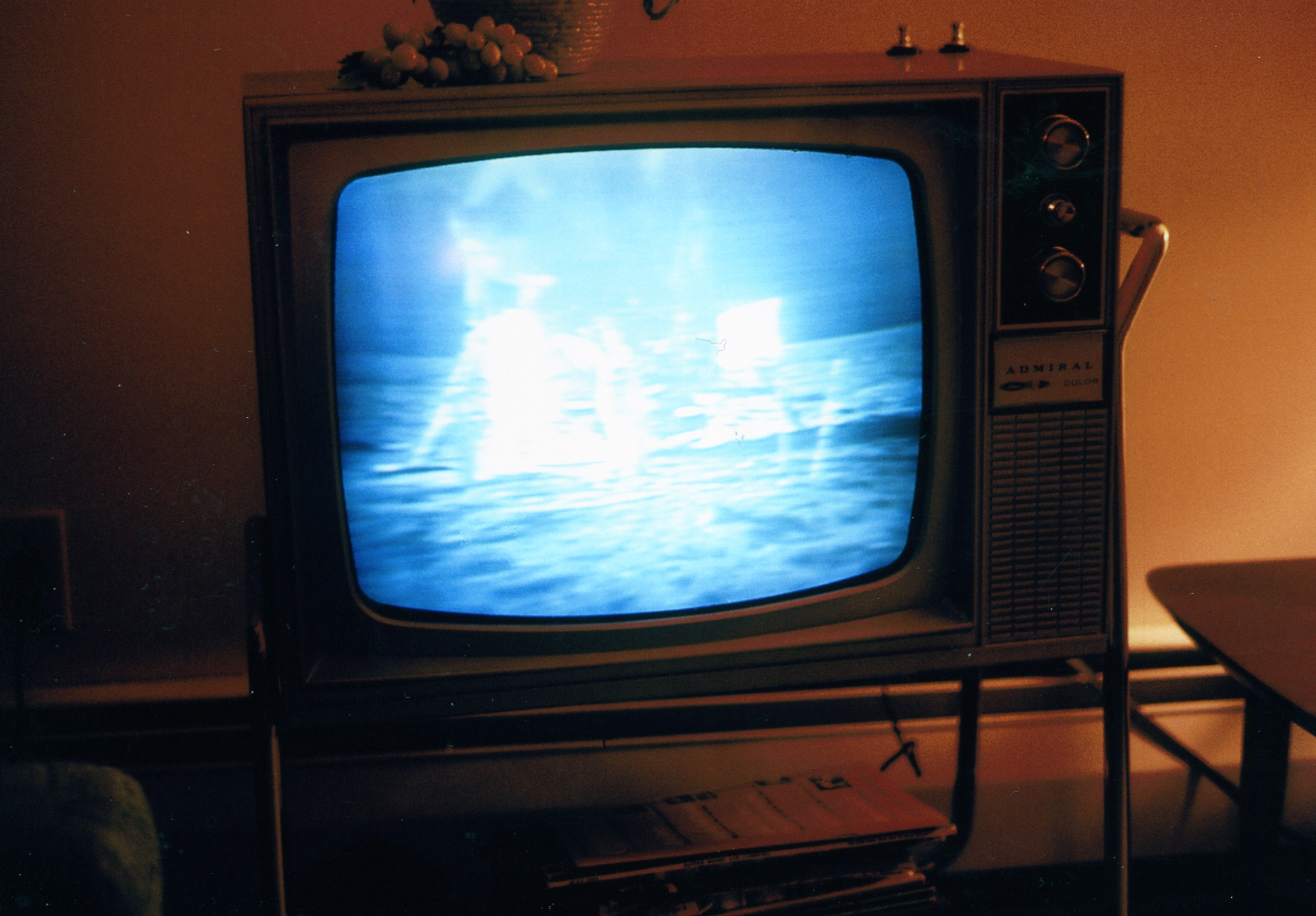
July 20, 1969, man on the moon ‘screen shot’ off TV in Spring Lake Park MN
That compares with the view on Saturday, also on a TV screen.

In the Pacific off San Diego April 10, 2026
I said I had 15 specific contacts with the space program. Perhaps you’ll see these below, perhaps not.
Everyone has their own opinion about the short and long term value of these programs and their role in the competition to be first. Personally, I feel that they do add to the considerable advances that have been made in science, but those same advances could be made without going into space. On the other hand, satellites are helpful to us every day in many ways, such as GPS for road travel maps.
I highly doubt the utility of proposed permanent occupation and settlement of places like the moon and Mars, for just two examples. Just my opinion.
But congratulations for some great work to NASA.
POSTNOTE, briefly: I apparently possess a gene that almost compels me to seek out things to see – if there’s a roadside sign, I’ll probably stop and read it….
With respect to the space program,. there was Sputnik, and stopping by the side of the road, and numerous other vignettes related, including seeing the preserved (at the time) Mission Controls in both Houston and Cape Canaveral for various missions. (The ones before really high tech kicked in, though they used whatever was available in the early days).
Out of the list of things I physically experienced was an e-mail conversation in the 1990s with Myron Tribus, probably the most high-powered intellectual I ever had the privilege to meet.
Myron was a California farm kid from modest circumstances who got his engineering degree in 1942, and early in his career as an engineer he spent time at the Minneapolis airfield as part of a military contingent testing various kinds of anti-icing strategies for aircraft. This involved some dangerous assignments – they weren’t ever certain that this or that innovation would work, but they were kids.
Their work ultimately succeeded, as we know, and at the time they were featured in Time magazine: Tribus 1945 Time Magazine.
Myron and I got to be good distance learning friends and at some point he sent me an e-mail which I wish I kept, but didn’t. His story was that at the time engineers worked across borders and this included between U.S. and the Soviet Union.
The American contingent had come up with some extremely complicated formula which was their intellectual property – a game changer. At some point, Myron was communicating with a Russian engineer, who shared with him a formula which, unknown to the Russian, was the American formula, including some mistake that had been made.
Somehow or other – probably espionage – the secret was out.
Thus goes the world, as we attempt to preserve our secrets, and claim the Moon, or Mars, or whatever as our exclusive turf. In the end analysis, we all live on the fly speck of a planet, and we live or die together.
Myron died 10 years ago, at 95. A great guy. I’m privileged I got to know him, and many others as life has gone on.