
SAK and Jeff on the Past and Present.
from SAK, May 1, 2026:
Congratulations on the 250th birthday! May the next 250 years be happier and even more prosperous for the United States, and if I may script a variation on a J. F. Kennedy formula, may the United States think not what the world can do for it but, as in times past, think what it can do for the world.
Looking back in order to help with the future, I thought two books by US authors would focus minds on a couple of issues that have not ceased to cause division & worse.
The first is The Virginian by Owen Wister. I came across it in the TV adaptation. That was many years ago & most probably in black & white. The whole book is available as part of the Gutenberg Project.
How could a young man resist when it tells of a “world where justice comes not so much from courts as the barrel of a gun.” Did the book start the “western” theme & craze, I don’t know? Even the western film genre progressed from black (“Indian”) & white (cowboys) to seriously dealing with issues of colonialism & racism, e.g. as in many of the films by John Ford – born to Irish parents which probably had something to do with his outlook.
A particular theme of The Virginian could be that the corrupting forces of the civilised east have diminished man, fulfilment will only come from heading west & embracing the freedom that the frontier provides. That is a bit the story of the hero as well as the eastern author who, after a nervous breakdown & being sent west by his doctor, was charmed by the land & the characters enjoying more freedom, and nobility, than the people he left back east.
In one episode, The Virginian, played by James Drury (in the TV adaptation) is “forced” to take part in the hanging of a friend who was a cattle rustler, a grave crime at the time, which saddens him tremendously but which he says he would do again as it is the right thing to do. Compare that with the thousands of pardons to friends & supporters by you know who: another case of what the author of The Virginian points to as the corrupting influence of the civilised east, New York in this case, leading to diminished man 😉!?
Wister values the frontier spirit but at the same time laments that it is slipping away. The book & its many adaptations kept the myth nostalgically alive along with a dislike for what was replacing it. “The feel of it struck cold upon the free spirits of the cow-punchers, and they told each other that, what with women and children and wire fences, this country would not long be a country for men.” Think J D Vance & Pete Hegseth perhaps?
The author’s views on equality are readily available in The Virginian as well as in other writings of his. One chapter of The Virginian is titled Quality and Equality.
Wister: “There can be no doubt of this: All America is divided into two classes, the quality and the equality.
The latter will always recognize the former when mistaken for it. Both will be with us until our women bear nothing but kings.”
He writes:
‘It was through the Declaration of Independence that we Americans acknowledged the ETERNAL INEQUALITY of man. For by it we abolished a cut-and-dried aristocracy. We had seen little men artificially held up in high places, and great men artificially held down in low places, and our own justice-loving hearts abhorred this violence to human nature. Therefore, we decreed that every man should thenceforth have equal liberty to find his own level. By this very decree we acknowledged and gave freedom to true aristocracy, saying, “Let the best man win, whoever he is.” Let the best man win! That is America’s word. That is true democracy. And true democracy and true aristocracy are one and the same thing. If anybody cannot see this, so much the worse for his eyesight.”
According to Wister some men are born superior & democracy should allow them to rise & not enforce some sort of social equality. He thought the ways of the west – at the time – were what made America great & these ways were being betrayed. Sadly, as is often the case, this yearning for a mythological past comes accompanied with a distaste for the present along with all its diversity which Wister, along with many, consider as impurity. Thus from an essay he wrote in 1895, The Evolution of the Cow-Puncher, one can read: “No rood of modern ground is more debased and mongrel with its hordes of encroaching alien vermin, that turn our cities to Babels and our citizenship to a hybrid farce, who degrade our commonwealth from a nation into something half pawn-shop, half broker’s office. But to survive in the clean cattle country requires spirit of adventure, courage, and self-sufficiency; you will not find many Poles or Huns or Russian Jews in that district; it stands as yet untainted by the benevolence of Baron Hirsch.”’ Lament amplified by irony.
Few are spared the slurs & similarly nowadays insults of whole groups are dispensed willy-nilly by people in high, or the highest, places. Wister thus continues:
“Even in the cattle country the respectable Swedes settle chiefly to farming, and are seldom horsemen. The community of which the aristocrat appropriately made one speaks English. The Frenchman to-day is seen at his best inside a house; he can paint and he can play comedy, but he seldom climbs a new mountain. The Italian has forgotten Columbus, and sells fruit. Among the Spaniards and the Portuguese no Cortez or Magellan is found to-day. Except in Prussia, the Teuton is too often a tame, slippered animal, with his pedantic mind swaddled in a dressing-gown. But the Anglo-Saxon is still forever homesick for out-of-doors.”
The second book is Margaret Mitchell’s Gone with the Wind.
The book & film capture America’s myth of its own innocence, capture the origin of white grievance, basically that whites are the victims of black equality and victims of racial justice.
Sarah Churchwell’s book, The Wrath to Come: Gone with the Wind and the Lies America Tells, tells of how parts of America refuse to accept that it has done anything wrong. Many of the ideas below, the better ones, are Churchwell’s.
Gone with the Wind is a big impressive lie but it doesn’t follow that it should be banned: it is literature dealing with complex issues & human dilemmas. I also wonder if any books should be banned at all?
What happens when 2 ideologies come into conflict & one wins over the other? What does the defeated ideology then do? Does it go away or does it go somewhere unnoticed & continues to develop and/or fester. I notice in the Middle East for example the Sunnis vanquished the Shi’ites way back in the 7th Century A.D. The effects of that battle are still with us!
Someone has pointed out the difference between mourning & melancholia. Mourning is linear, with time it ebbs & gives way. Melancholia persists. He pointed to something that afflicts empires etc like the British Empire & referred to it as “post-colonial melancholia”. Empires have to overcome it in order to become a normal state focused on the present & the welfare of its present citizens. The Austro-Hungarian empire seems to have done that admirably & Austria is now a happy place that knows its limitations. The British empire is less successful. The Russian & Ottoman empires are still suffering from acute nostalgia. The US is facing a slightly different melancholia: post-slavery & perhaps even post-hegemony melancholia.
The author, Margaret Mitchell, grew up with stories of the civil war. She said that she had “heard everything in the world except that the confederates had lost the war. When I was 10 years old it was a violent shock to learn that General Lee had been defeated.” Talking of The Virginian, President Trump renamed Fort Gregg-Adams in Virginia back to its Fort Lee name. I wish he were at least honest about things but no, this is his justification: “We won a lot of battles out of those forts. It’s no time to change. And I’m superstitious. I like to keep it going, right? I’m very superstitious. We want to keep it going.” No mention of dog whistles, it just so happens that the at least seven military bases, one of which is possibly the largest in the world, were renamed after Confederate officers.
All this propagates the myth of the “lost cause” which was developed to conquer the shame of the Confederacy losing the civil war. A bit like the “stolen election” which the President continuously hammers, facts or no facts.
Mitchell saw herself as a friend of black people & the plantation owners as doomed chivalrous romantics – not as slave owners. The black slaves in the book are not full-fledged characters but are there supporting the main heroes of the novel like Scarlet whose lives are disturbed by the civil war.
According to Sarah Churchwell, “racism is the operating system of the story, it is what it’s about. The narrator never refers to black people as people, not a single time over the course of a thousand pages. They are either called a racial category so she will use either racialised words or she will compare them to animals. So they are literally described as different kinds of dogs or many different kinds of apes, monkeys, gorillas, hounds but literally never as a human being. I went into every single depiction in the book. So it is a textbook instance of dehumanisation. They are systematically dehumanised. The sympathetic black people who are depicted positively are the ones who choose slavery. They like being enslaved. They choose to stay with their enslavers after the war. They resent the Yankees for coming & trying to liberate them and the bad black people in the story, the unsympathetic black people are the ones who assert their own freedom and who assert equality.”
Still it is a compelling novel although it is a misrepresentation. The film played in London’s Leicester Square for 4 years including during the WWII Blitz. Churchwell writes that one of the first acts of Hitler on entering Paris was to ask to see Gone with the Wind. The issue of slavery & how it was handled reflects badly on many countries aside from the US of course. Britain was complicit in the trade & it compensated slave owners for the loss of their “property”.
For a good while during our lifetimes the pendulum swung in the direction of justice and tolerance away from insistence on social purity & the superiority of certain groups. Now it seems to be swinging in the wrong direction. Let us see what the near future brings . . .
Happy birthday!
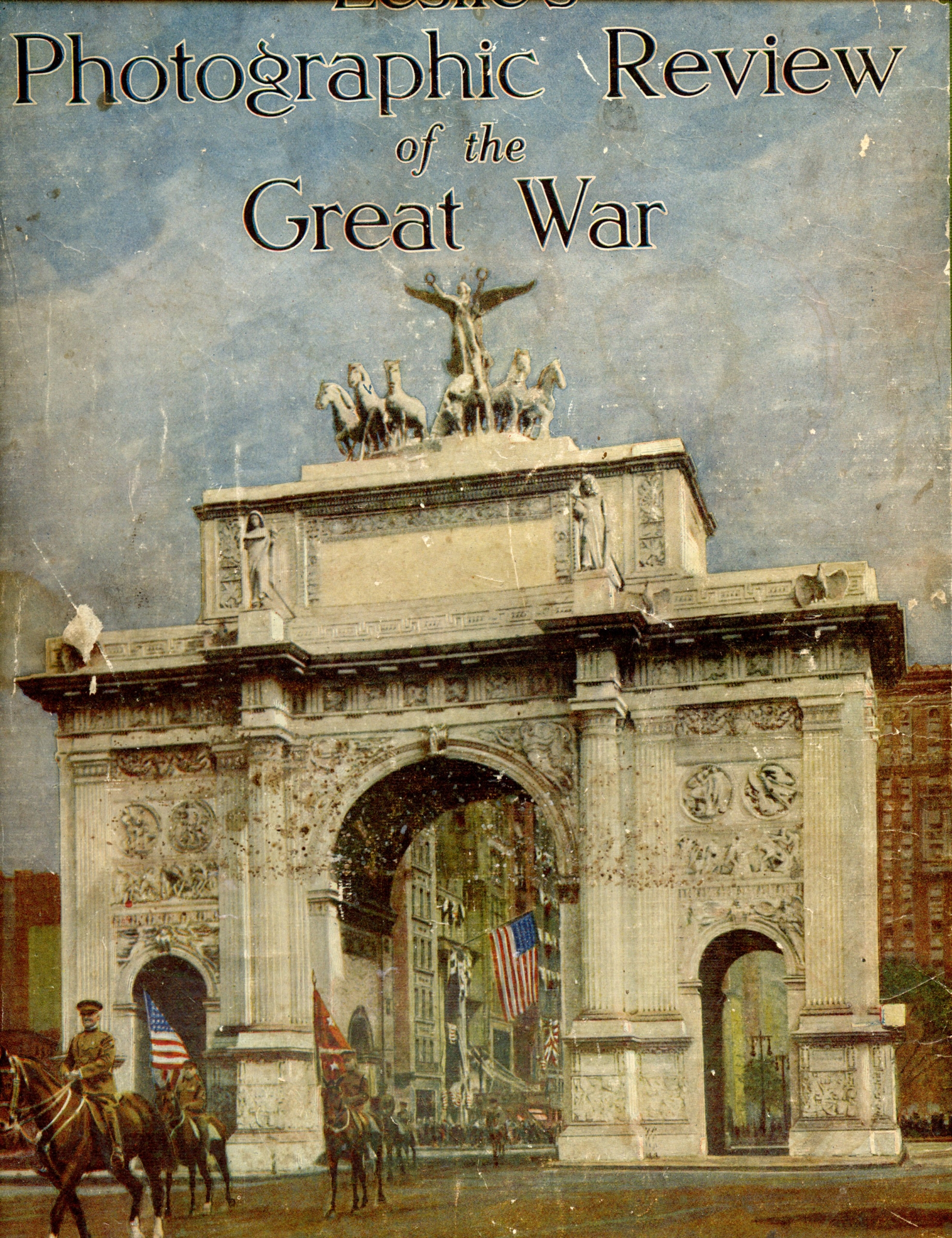
General Pershing at the Arch of Victory (Arc de Triomphe) Paris, at the end of WWI. Cover of book found in farm junk in North Dakota.
Its possible that I am reacting to the finishing of reading the book on the demise of the Weimar Republic just today, where there were so many possible off ramps that could have been taken by many groups and individuals to upend the rise and takeover of Hitler and the Nazis…ugh.
Sure, a historian has the benefit of hindsight, but he quotes journalists and others at the time who understood the gravity of several missed opportunities.
Germany’s unique history leading up to WW1 and its aftermath greatly played into the shifting situation. There remained a strong anti-republican group based in different regions, the Bolshevik revolution in Russia gained strength for the Communists and labor unions were already strong, the Center was declining, much of the Lutheran and especially Catholic establishment tended toward the right wing, if not the authoritarian wing, the Social Democrats, as I said, while comprising a plurality missed the urgency of certain moments and like most liberals held faith in the “law” and the “Constitution” and the better angels!
The Nazis were able to become the party of “change”, upending the status quo, and offered a dynamic leader and understood the power of propaganda and new technologies to disseminate much more than the traditional parties. (sound familiar?)
Another parallel in the book, is that in one election where 84% turnout happened, news articles suggest there were alot of first time voters, and uninformed voters, Ullrich uses this inference to suggest the increase in votes for the Nazis in that election…again, sound familiar?
Leave a Reply
Want to join the discussion?Feel free to contribute!