Family Story

Today is the No Kings Day with major demonstrations country wide.  In Minnesota’s Twin Cities is centerpiece.  Bruce Springsteen and other celebrities will be front and center.  We’ll be enroute to a family wedding in Missouri, so won’t be on site.

But before I go, I’d like to share Paul Krugman’s March 27 post on Immigrants.  It is worth your time.  https://open.substack.com/pub/paulkrugman/p/the-end-of-immigration?utm_campaign=post&utm_medium=email.

*

The family wedding is my grandsons, now eight years a Marine on active duty.  No rumblings about transfer to the Middle East, though as any member of the uniformed armed services knows, orders can change on very short notice.  His spouse to be is daughter of a career Marine, so knows this reality by personal experience.  We look forward to a good wedding.

I’ve been asked to propose a toast to the newlyweds, and I accepted.  What to say in a couple of minutes to young people 60 years my junior, in front of a group primarily people I’ve never met, mostly from a state I’ve infrequently visited.  Probably mostly young people.

I’ve decided on an immigrant story – one from my own family history, and one relating to Missouri.  Dad, 100% French-Canadian, lived the last ten years of his life, 1987-97,  in Belleville IL, suburban St. Louis.  St. Louis is about 80 miles from where the wedding will be.

During Dad’s life in Illinois  (Mom had died seven years before he moved to Belleville), he liked to see the local sights when company was in town, and this happened with me.

One particular day we went to the famous Arch in St. Louis.  Nearby is a well known tourist area, LeClede’s Landing, where St. Louis began.

I visited a tourist information place, and noted a book: :”St. Louis A Concise History” by William Barnaby Faherty, S.J.  I still have it.

Very early in the book a line jumped off the page:  “…(1764).  Mrs. Marguerite Blondeau Guion, presumably the first woman to come to St. Louis, crossed the river from Cahokia in late May to join her husband…she recalled many years later, the crew had erected only two or three huts….

Of course, Marguerite was not the “first woman” west of the Mississippi in today’s Missouri.  Back then history was written from the victors perspective.  Native Americans were another matter indeed.

The name “Blondeau” jumped out at me.  That was the maiden name of Grandma Bernard’s mother, my great grandmother, Clotilde (Blondeau) Collette.

Long story short, French-Canadians kept and keep good records.  I’ve learned down the road that Clotilde and Marguerite were in the same ancestral line, albeit born over 100 years apart.

That short descriptor, buttressed by research by my cousin, Remi, in Montreal, leads to some observations:

Marguerite and her husband were in their 20s; unbeknownst to them they were boots on the ground building a great city.  Being young was an asset, not a liability.  The concept of being a foreigner, or owning a place, was probably foreign to them.

Marguerites husband apparently died at about 40 of some unknown cause.  Young age didn’t inoculate from death.  They had four children, three died as teenagers or less.  Marguerite apparently lived to over 90, and died in St. Louis, by then a major city.  Somebody thought she was notable, thus the portrait below.

Marguerite Blondeau Guion (undated but before 1832 in St. Louis MO)

They left Illinois in 1764, shortly after the British took control of eastern North America after defeating the French at Quebec.  Across the Mississippi was then Spanish.  The Declaration of Independence by the upstarts in the 13 colonies, 1775,  was a dozen years in the future.

A quick check shows that many of the signers of the Declaration of Independence were young people, the youngest 26, and many in their 30s. 

Of course, there are many additional questions.  In those times and until relatively recent history, Marguerites last name would have been Guion; she would have scant legal rights regardless of the country.  There was lots of work to be done, and doubtless Marguerite did some of the work in the same ways it is done now, one action at a time.

Then, as now, the future was in the hands of the young.

A young woman, probably younger than Margeurite, shared an insight with me recently that bears repeating.  She had just had a birthday, and the place where she worked, my favorite coffee shop, had brief bio sheets of each worker, composed by the individual.

She asked me to look at hers, and I did.  She pointed out one particular phrase on the sheet, one likely familiar to all of us:  “Don’t Quit”.  She had modified it by deleting four of the letters, which then made the advise “Do It”.  Made sense to her, and to me.

I had earlier noted something else put on the community blackboard at the store by, it turned out, the manager, whose daughter is a freshman in college this.  It, too, was simple: “You matter.”

“Do it.  You matter.”

COMMENTS (more below):

from Jeff: Nice post….I wonder what our relatively young Founders (relative in the sense that avg life expectancy in 1776 America was about 30, though that was mainly due to child mortality, if you got past your teenage years likely lived into your 50s or 60s…still 30 somethings in 1776 are like 55+ somethings today) would like of our geriatric leadership now?

Enjoy the wedding.  we are going to the Burnsville No Kings….my daughter wanted to go to st paul, but the numbers expected and the congestion and the windy weather have combined to make her interested in watching it on livestream instead!


from SAK:  What a varied & colourful family history you have there Mr Bernard. I hope someone will write the extended version! & you sent a link to Krugman’s piece on immigration.

As it happens a group decided to read American Dirt by Jeanine Cummins (“Runaway bestseller”) & we had a chat about it.

It’s the story of a family decimated by gang violence in Mexico. The mother & son survive & are joined by a group of people from various Central American states who are also on the run or have been deported from the US. They all make their way to el norte. It’s no picnic. Some don’t make it.

Of course there are some bad apples but there is also the kindness of strangers. ICE features as well as immigration officers in Mexico & the US. Horrific. Even when some finally arrive they still have to worry about deportation though they have family in the US & violence awaits if deported.

While discussing the book a question came up: why do some people behave as badly as they do & is evil part of human nature? History seems to indicate that it is. Rousseau vs Hobbes etc.

A happy wedding, hope the newly weds will have a peaceful prosperous future ahead.
 

Spring 2026

Saturday March 28, 2026.  No Kings national demonstrations.  All info here.

In case you haven’t seen it, Thomas Friedman wrote an outstanding commentary about Twin Cities actions during the ICE “surge” in early 2026.  Links are in the post I did March 15, here.   Friedman is a native of the Twin Cities.

It’s a good time to check in on voting regulations in your state.  I think this is a reliable website: Vote.gov

*

We were reminded today (Mar. 20) that 23 years ago. in 2003,  the Iraq War started with “Shock and Awe” over Iraq.  Here’s one take on the subsequent 20 years.

Today is the end of the third week of Epic Fury over Iran.  The last gas fill for me before the assault began (Feb 28) was Feb. 25 – $2.999 per gallon.  The first fill after the assault – Mar. 11 – $3.599 per gallon.  Both readings are at suburban St. Paul stations I regularly use.  These will be my personal base line for the duration….

*

Personally. we leave for Missouri on March 28 for the wedding of our grandson.  We will be back by March 31.  Unfortunately, this means that “No Kings” isn’t on the schedule for us.

Our grandson is an active duty Marine and has been for the last 8 years.  His assignment is aircraft maintenance state side, and to my knowledge he or his unit are not slated for transfer.  But as any military person knows, orders can change on very short notice.  His spouse is a high school teacher and grew up in a Marines family.  We are happy for them both.

Easter is April 5, so likelihood of writing here between now and then will likely be sporadic.

We are in insane times, and I suspect the insanity will increase between now and July 4, and beyond toward Election Day Nov. 3.

I visualize this time in our history as a blizzard imposed on all of us.  In a blizzard or any other disaster, the essential action is that provided by individual citizens, like you and I.  There are millions of things which can be done, not the least of which is to get out of the house and into one of the demos all over the U.S. on March 28.  The Twin Cities will be a focus, in honor of Renee Good and Alex Pretti and the courageous citizens who stood up at the time of crisis.

“EXTRA CREDIT” – My French-Canadian cousin, Remi, in Montreal, has written a fascinating piece about the French language and its variations.  I think you will find it very interesting if you have any interest in French and/or our Canadian cousins.  (Remi’s great-grandfather and mine were brothers – surname originally Colet (present day Collette).  I’m 50% French-Canadian.) Here’s the link.

COMMENTS:

from Brian: Oh wow!  Thanks so much for including the article about Canada and French–super.  I so loved reading it.   We have good friends in Quebec.


Neighbors

Three items on a snow day in Minnesota

1.  Thomas Friedman.  Robert Reich, on March 15, 2026, shared a remarkable column by Twin Cities native Tom Friedman about the example demonstrated by the citizens of Minneapolis particularly in recent troubled times.   I hope the column is accessible to all.  It is long and very worth reading, wherever you happen to be from.  It applies to everyone, everywhere. https://open.substack.com/pub/robertreich/p/sunday-thought-2-the-legacy-of-these?utm_campaign=post&utm_medium=email.

In the event the above link is not accessible, the Friedman column is from the New York Times for March 15, 2026.  Below is the NYT share link which may work.:

From The New York Times:

Why Minnesota Matters More Than Iran for America’s Future

Moms donating their breast milk to strangers, dads taking someone else’s kids to school: Minnesotans showed a basic human impulse to look out for their neighbors.

https://www.nytimes.com/2026/03/15/opinion/columnists/minneapolis-ice-trump-neighbor.html?smid=em-share

2.  Paul Krugman is an authority on Economics, and his substack columns, mostly behind a paywall for subscribers only, have been great seminars on the reality of world energy policy.  They are invaluable to help understand the facts and the nuances behind the news,

3.  In yesterdays post I included two “snips” from the 1978 Encyclopedia Britannica about Iran’s people, and its oil resource. It you didn’t look at it, here is the same link: Iran 1978 Britannica.  As the article notes, Iran is a diverse society politically and multiple religions, though dominated by a single religious denomination.

It should be concerning to us that in our own country there is a substantial movement advocating  its brand of political domination “Christian nationalism”.  May it fail, miserably.  Of course, there are other similar examples with other faiths.  Power corrupts.

4.  Drones: 15 years ago at this space I did a post about Drones. The Drones.  Consider it in context with the fact that it was written 15 years ago, in the infancy of Drones as a weapon.  It is one of 25 posts over the years where I’ve mentioned the topic.  At the time I wrote this, we all knew of people who had remote controlled model airplanes, boats, etc.  They were early versions of drones.

This particular post got a dozen or so comments, at a time when the issue of military Drones was just beginning to get attention.  You might find of interest the comments 15 years ago, and how they fit into today’s far more earnest conversation relating to war generally.


War Stories

POSTNOTE March 15: Relevant additional post today.

Today is 112 days before the 250th birthday of the United States of America.  Commit yourself to extra effort to save our democracy between now and then, especially.

Today, March 14, 2026, begins the third week of “Epic Fury”.

I have near 86 years of experience as a United States citizen and what we seem to have now, which is new, is a reality tv production: the first War produced as a made-for-TV Video Game.

Frankly, my frame of reference now is to calendar time: “Fury” had been unleashed two weeks as I started to calendar events.  This happened for me a couple of weeks after September 11, 2001.  Both dates  – 9-11-01 and 2-28-06 were ground zero catastrophes, in my opinion.  We’ll see what the future holds.

This post purposely redirects “War Stories” relating to 9-11-01/Afghanistan/Iraq/Afghanistan (2001-21) and Vietnam (1961-75).  There is such a glut of information (and misinformation) available about the brand-new Iran War which remind of the information we were dealing with after September 11, 2001.  What follows is a small diversion of sorts from the daily ‘blizzard’ of ‘news’.

*

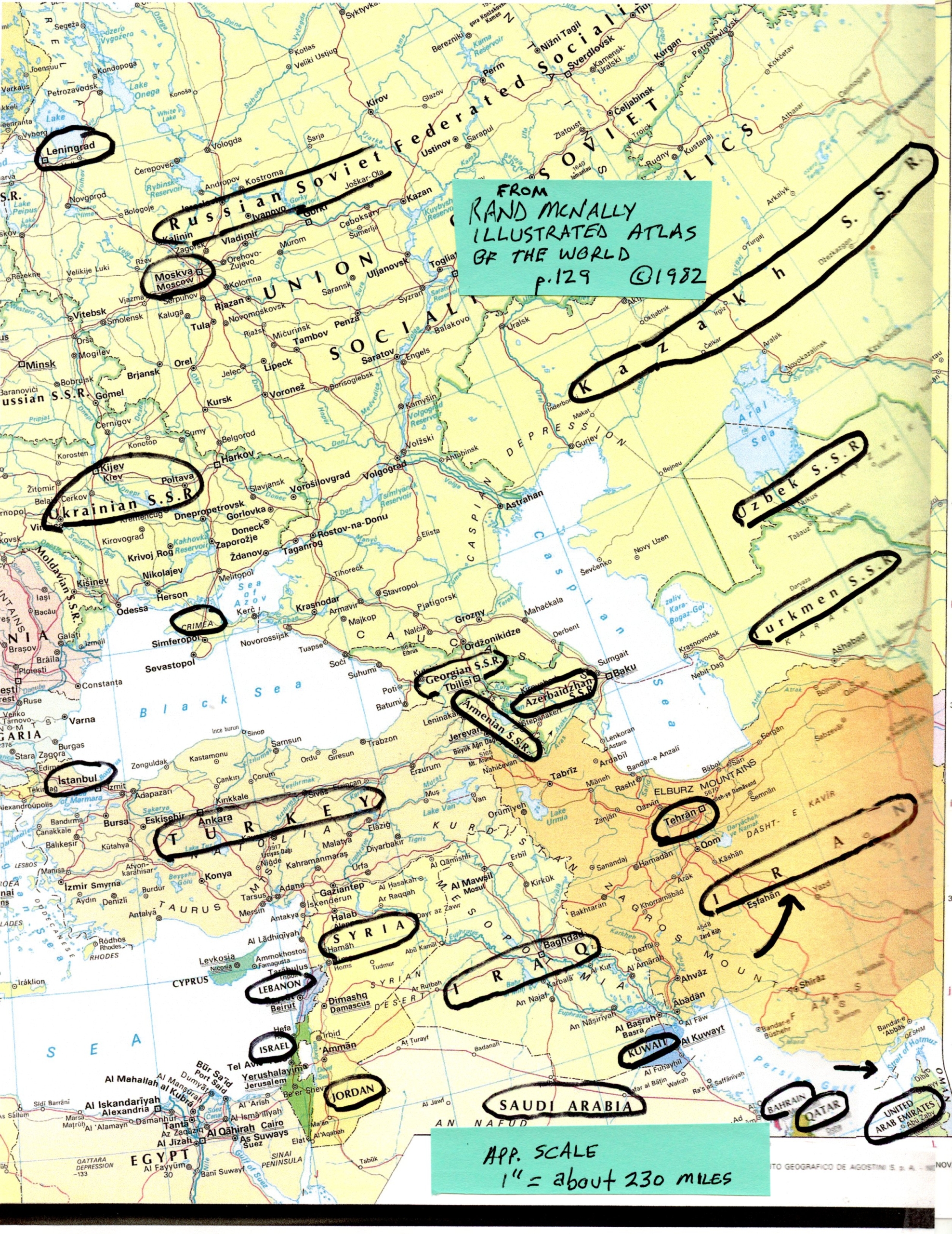
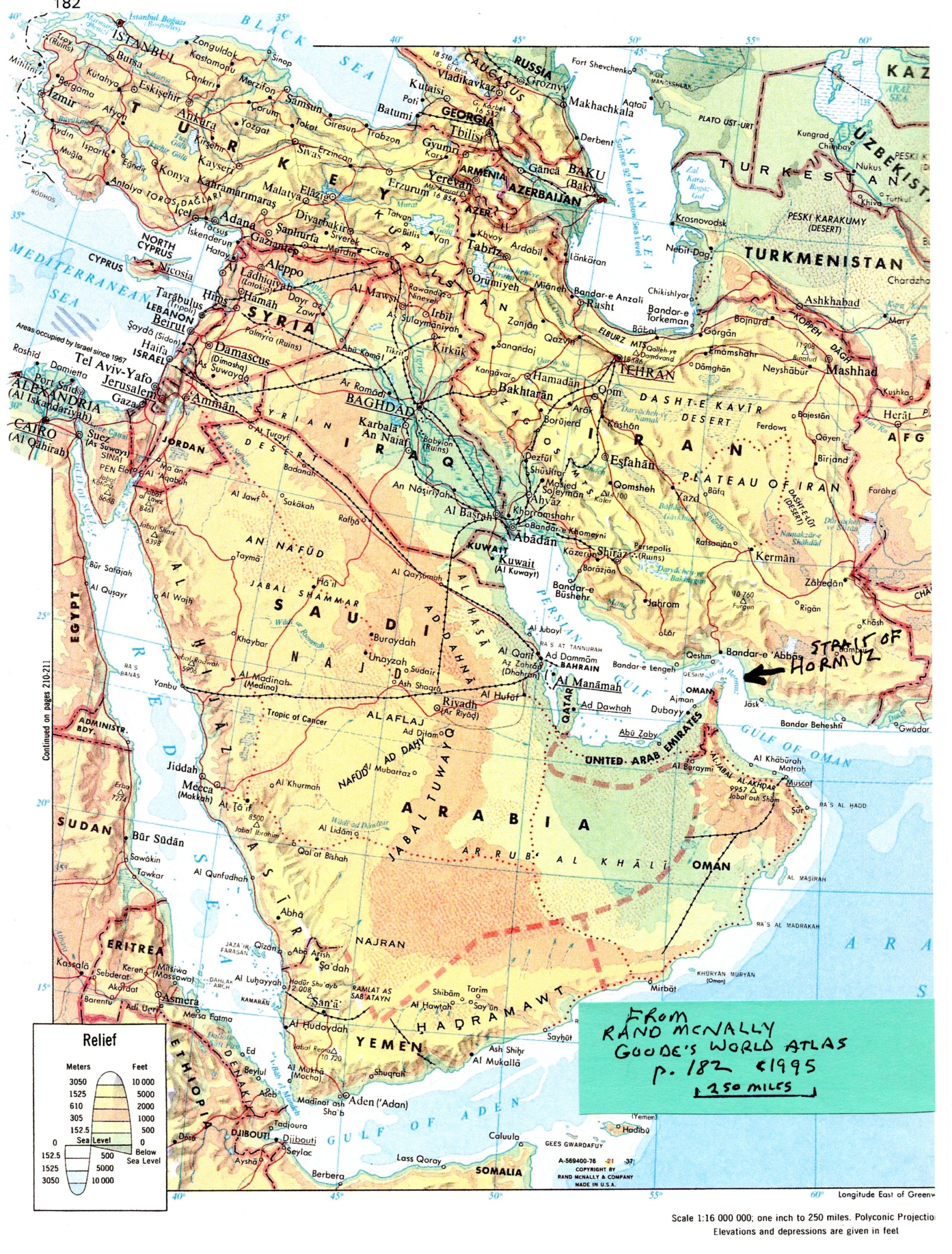
Here is another old (1982) map of the setting for Epic Fury.  See also earlier posts (Feb 24 and Mar 3, 2026)

Below map in pdf format: Iran 1982 focus Saudi Arabia.  Note especially Kuwait and the Strait of Hormuz at opposite ends of the Persian Gulf.

I have noticed that the official conversation about the history leading to today’s war seems to focus on events about 47 years ago – 1979, the year the U.S. Embassy staff were taken hostage in Teheran.  I was in my 30s then, and followed political developments carefully.  Of course, there is lots of preceding and subsequent history in the country and region, but that gets little emphasis.  The apparent coalition of Israel and the U.S. and history with the government of Iran is also in the forefront.  (Of course, the other 47, influencing the defining of contemporary history, is the 47th President of the United States.  Everything for PR….)

With this in mind, I offer a couple of short ‘snips’ about IranI took from the 51 pages in my 1978 edition of Encyclopedia Britannica: Iran 1978 Britannica.

1978 was the year before the hostage stage, thus the article from which the snips were taken is silent on that specific event and is also silent on important facts like Mosadegh, the Shah, the CIA, 1954….

The snips – the pdf is about one page – relate to the people of Iran, and Iran petroleum  history.  Remember, this information is now near 50 years in the past.  It is only a small part of a much longer article about Iran, a large country with lots of history.

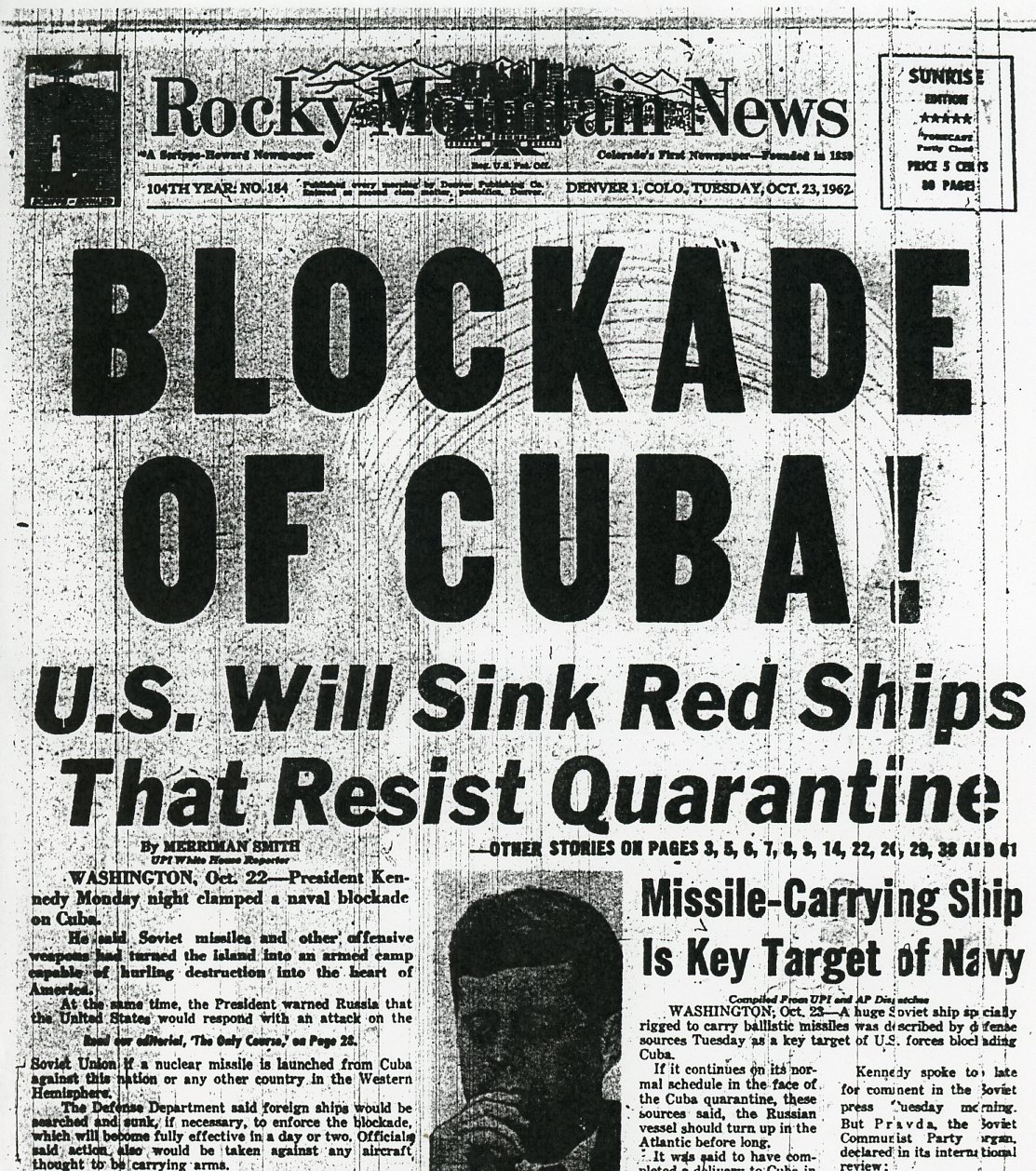
Personal thoughts as of March 14, 2026: Our country is no stranger to war; and my family is no stranger to military service, including myself in the earliest Vietnam era years of 1962-63 (Cuban Missile Crisis happened on my watch as an Army Private at Ft. Carson, Colorado).  Here’s what we read in the Rocky Mountain News the day after President Kennedy addressed the nation: Cuba002

Currently, my nephew is a Marine Sergeant who’s been on active duty since 2018.  In about three weeks we’ll be at his wedding.  His spouse to be is daughter of a Marine family.

On and on.  The military, and how it functions,  is not something abstract to me.

For whatever reason, my thoughts recently have gone back to another less sexy U.S. war called Desert Storm,   It was a short war in early 1991, and it involved aggressive moves by Iraq towards neighboring Kuwait.  (The battle theater then was probably generally from Saudi Arabia into Kuwait.  For the combatants, their theater was a tiny speck of sand, even as compared with Kuwait, small as it is.)

I don’t recall many judgements against that war in 1991.  I’ll leave that to individual opinions.  It wasn’t an impulsive move.  Desert Storm was so short that the anti-war coalition had little time to get organized and do anything.  Best I recall, Iraq didn’t really. jump into the public war conversation again until after 9-11-01, 10 years later, when Iraq/Saddam became the U.S. target even though they seemed to have nothing to do with 9-11 itself.

For me, in Jan. 1991,I remember being in my car in early evening when the war began.  I recall where I was at the time. The car radio announced beginning of U.S. action against Iraq.  Back home I quickly got familiar with Wolf Blitzer, who was just getting started with the also youthful CNN, giving non-stop reports on what he was seeing on the ground in Saudi Arabia.  Wolf was at the right place at the right time for a young journalist.

The next morning I was going down the stairs from my condo and there was a strong smell of alcohol.  In the stairwell I came across a paper bag full of empty booze bottles.  Probably, somebody had had far too much to drink the night before, and I was smelling the remnants of last night.  Whoever had the bag was probably still drunk, and dropped the bag enroute to the dumpster in the garage.  I’m guessing the bombing and the booze had some direct relation to each other.  At least that’s my story, over 30 years later.

In the next days, I happened to be at the West Bank of the UofM and an anti-war presence had settled in.

Back home, Newsweek included an invitation to write letters to soldiers at the front.  I wrote, and early on got a reply from a guy who’d dropped out of the UofM months earlier and went in the Army to what he had anticipated to be safe duty in Germany.  He was about finding himself – an honorable course for lots of young people then and now.

Bruce found out what those in service all learn.  Your assignment is part of your responsibilty – you go where you are told.  In his case, it was the dismal sands of the Arabian peninsula, dealing with all the uncertainties and indignities facing a ‘boots on the ground’ GI.  From Germany he’d been assigned to war in the desert.

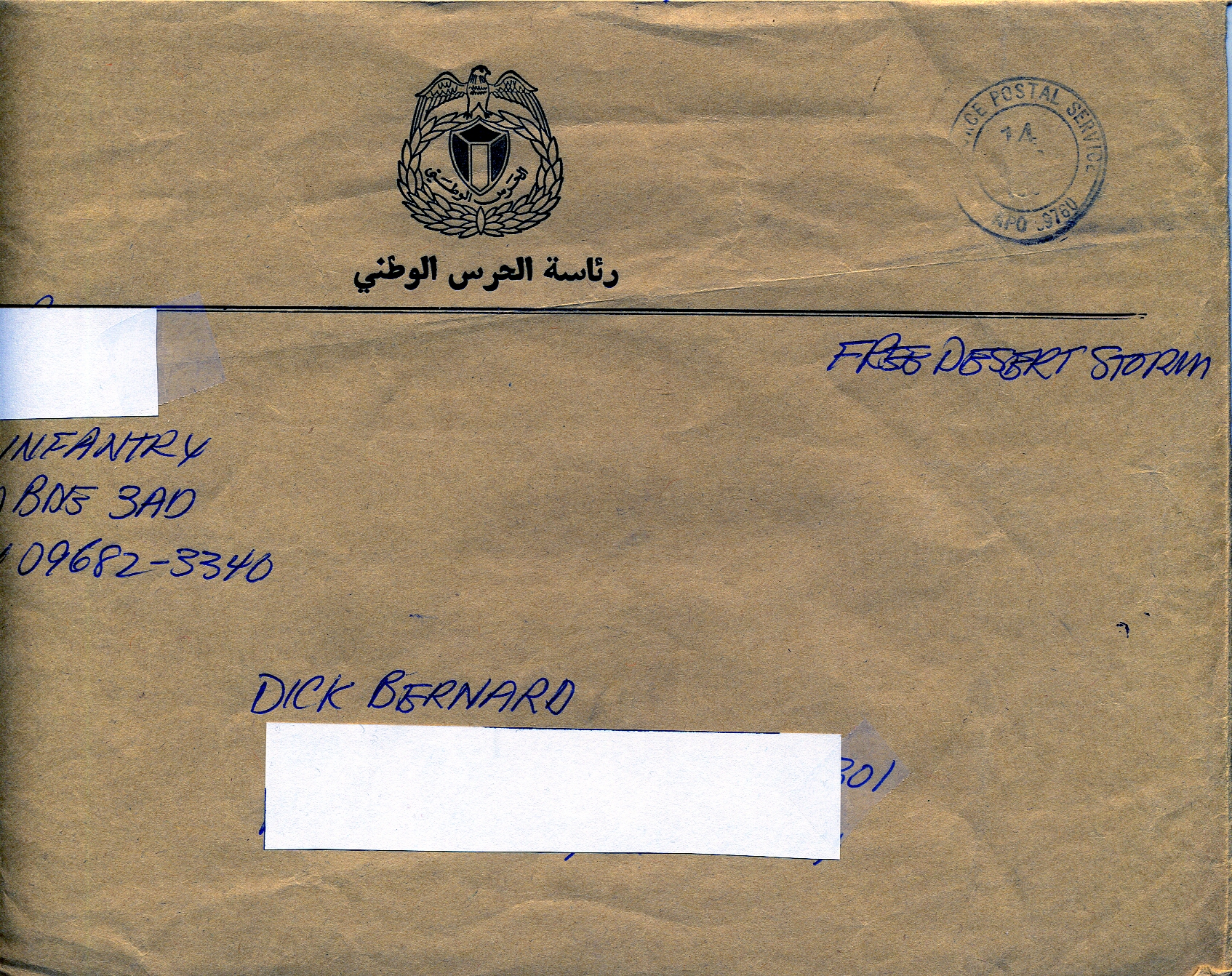
Apparently, Bruce shared my address with another GI, who also wrote me a letter.  In all there were several letters from the front, and they all came in envelopes like this:

Years later I tracked found where Bruce lived and sent the letters to him.

He responded.  By then he was apparently pretty successful, I gathered, in the money business.  We had only that single exchange.

I wonder what he thinks of what is going on today in the same area of the world?

That’s my “war story” for now.  Does it remind you of one or more of yours?

Etcetera

Paul Krugman and Heather Cox Richardson discuss the oil situation, March 10, 2026

Friday, March 6, was Jesse Jackson’s memorial in Chicago.  Here is President Barack Obama’s powerful eulogy.

COMMENTS (more at end)

from Chuck: “What we really have here is a vast war machine, a false neocon foreign policy narrative and an infrastructure of Empire so deeply embedded in the very warp and woof of America’s process of governance that the outcomes of elections have become essentially immaterial.” – David Stockman,  “The Stupidest — and Potentially Most Dangerous — War Since 1945” [2026]

from Larry: Thanks for the commentary and map…will study, just took a glance and looks interesting, commentable..

from Catherine: I’m sick to death of examining wars. They are always motivated by the same things: power, money, and control. They are always caused by bully men. Until an interested god — if there is one, which I doubt — waves a wand and turns everyone into a Buddhist, I see no hope for what’s left of our world.

from Jay: thank you for the great post, very interesting / informative, enjoyed reading it!

Bombing Iran

There is so much happening at this moment especially in the Iran area that I want to add some items to the essential conversation.  We all need to be directly involved.

Here’s a rough map I adapted from an old Atlas I have which helps define the area.  This is from 1982, so the map is of the then USSR, but it serves the purpose (the USSR ceased existence in the early 1990s).   I particularly ask you to note the Persian Gulf and Strait of Hormuz at lower right (note arrow), and the Israel area at lower left.  The photo is also available on pdf form here: Iran and area 1982.  Iran, not all of which is shown on the map, is 2 1/2 times the size of Texas and has about 3 times the population.  It is a very large country.

Adapted from Rand McNally World Atlas c1982 p. 129

Where do I stand on the current situation?  I am not a Pacifist in the purist sense.  On the other hand, after 9-11-01 I was one of the few who thought that going to war to avenge 9-11-01 would not have a good outcome, and I said so, publicly.  War is never a solution – the end of one war begets the next, as we learned after WWI.

In the current situation I am most interested in how history will be defined – where history begins.

Iran has a very long recorded history – the U.S. is barely in its infancy in comparison.  With respect to learning about Iran and “the west”, anyone with an interest should seek out a source that goes back at least to the beginning of the oil era (1900s forward), especially the political history.  (Every now and then I refer back to my 1977 edition of Britannica for such insights.  The section on Iran is over 50 pages.) If you know someone of Iranian ancestry, ask their opinion.  They will not necessarily speak with one voice.

Personally, I did a “preemptive” post entitled Iran the day before the 2026 State of the Union.  It can be read here.  You’ll note I directly quote two Iranian-Americans on the issue.

Personally, I remember President Jimmy Carter’s visit to Minnesota in 1978 to sign legislation relating to use of the Boundary Waters area.  It was not universally supported by Minnesotans (see #2 on this from Minnesota Public Radio).   I recall that Iran entered in.  I was at the then-Minneapolis Convention Center the day Carter spoke, with heckling from folks with “STOP” signs.   This demo and Carters visit didn’t relate to Iran, of course, but I do remember, that day, having to walk past a phalanx of protestors with grocery bag masks over their heads, apparently protesting the U.S. support of the Shah of Iran, though I had no idea, then, what that was all about.  (Here’s some history of visits by the Shah to the U.S.  Note the reference to Mossadeq – he’s part of the story, too.)

POSTNOTE: Here is Heather Cox Richardson’s March 2 Letters from an American on the current issue.

ON A SEPARATE TOPIC:  Coincidentally the bombing of Iran started on the same day as my local political convention, which I attended in full.  So, basically, none of us had much of a notion of what was happening outside our venue.  Here is what I wrote about the convention itself, if you are interested.

COMMENTS (more at end of post):

from Carol, from CNN.com:

Americans living in the Gulf tell CNN that they are frustrated by the US government’s response in the region, with some saying they prefer to stay in their adopted home while others are heeding the warning to leave.

In the United Arab Emirates in particular, several Americans tell CNN that they have more confidence in Abu Dhabi’s leadership than Washington’s.

Kiran Ali, the creator of a WhatsApp group chat with 800 American women living in Dubai, says the overwhelming sentiment from members is trust in the UAE, “coupled with a bit of (a) disturbed feeling towards the US for not fronting money for evacuation, for not doing more to make sure US citizens are safe.”

She said that the US State Department’s call to immediately evacuate the region, despite airspaces being broadly closed, conflicts with the guidance it continues to give on the phone to shelter in place.

Other Americans living in the UAE tell CNN they prefer the uncertainty of missile interceptions to the risk of their kids experiencing a mass school shooting in the US.

“The cynic in me knows that my daughter has more of a chance of being hit by a bullet in the US than a drone in Dubai, so we feel very comfortable about seeing this through,” one man said.

from Fred: I’m a map guy and this one works very well. Easy to read and get a better feel for the proximity of the nations. Circled nation names helps as you scan it.

from Joyce, from recent Charles Pierce column in Esquire:

As a Catholic Christian from birth, I have come to wish devoutly that two things had happened in the early days, when the Jesus Movement was just getting rolling. First, that Saul had gotten back on his horse and hightailed it back to Tarsus and never written a word about this charismatic carpenter he never met. And second, that Patmos had been destroyed in a massive volcanic eruption an hour before John in his cave had set stylus to papyrus. We could have avoided a lot of extra-Jesus foolishness down through the millennia. Case in point, from Jonathan Larsen’s Substack:

A combat-unit commander told non-commissioned officers at a briefing Monday that the Iran war is part of God’s plan and that Pres. Donald Trump was “anointed by Jesus to light the signal fire in Iran to cause Armageddon and mark his return to Earth,” according to a complaint by a non-commissioned officer. From Saturday morning through Monday night, more than 110 similar complaints about commanders in every branch of the military had been logged by the Military Religious Freedom Foundation (MRFF). The complaints came from more than 40 different units spread across at least 30 military installations, the MRFF told me Monday night.

Take command responsibility away from these people immediately—and yes, that includes the Secretary of Talking About War, who committed his life to the Precious Blood of Jack Daniels years ago—because they are telling soldiers that they are naught but cannon fodder in an eschatological conflict. That is not only completely banana-pants but also directly in conflict with the words of the Founder himself as recorded by Matthew, the former imperial revenue officer, in the 24th

chapter of his reminiscences.

Then if any man shall say unto you, Lo, here is Christ, or there; believe it not. For there shall arise false Christs, and false prophets, and shall shew great signs and wonders; insomuch that, if it were possible, they shall deceive the very elect. … But about that day or hour no one knows, not even the angels in heaven, nor the Son, but only the Father.

The officer corps can sit down and shut up.

from a long time friend with very deep roots in the Middle East area:        It was appropriate for you to look back to 1950 and mention the Shah in your discussion, but you neglected the most important event from that period. In 1949 Iran had freed themselves from other powers and established a democracy patterned after our American democracy.  I can still remember young girls running around in short skirts like the girls were doing in the United States.  Then next came the actions taken by the US in support of this new democracy.  Instead of supporting it, our CIA joined forces with the British Intelligence Agency and worked to destroy this democracy and return it to the rule of the Shah.  When the British are involved, there is a caste system involved.  I worked with three individuals who were part of that Privileged Caste System, and in spite of all the factual information that they had, they would not accept the premise that they were a part of that Privileged Caste System.  It was all the horrible things that the US did to the Iranian democracy that resulted in the Iranians pleading “Death to America”, something that you would have also done if they had done such horrible things to you.  That was the most important point that your discussion had overlooked.

The British Government is one of the most horrible in the world, which doesn’t always extend to the population, but generally does.  Remember the actions taken by the early British settlers that were working to take land away from the Native Americans folks in the [Indian] Reservation and surrounding areas so they could farm if.  I doubt if there was ever a treaty with the Native Americans that the British settlers ever honored.  And I believe that I shared with you the horrible things that were done to the Native Americans in the [ ] Reservation and surrounding areas that had fled to northern Canada where they could find food and were then herded back to the [ ] Reservation and held there until most of them starved to death. That British culture is in general a horrible culture, and I am bothered by how much of it has extended to America.

from Leila:  Seems like Israel finally found the right time to persuade trump to invade.  He has claimed to be Iran’s friend of the non religious sect; hope he’ll be respectful and know when to leave.

Iran has survived kings, coups, revolutions, sanctions, and isolation.  Iranians aren’t naive anymore they understand geopolitics and how the world works.  I am hopeful for an eventual regime change.


An inspiring day

PRENOTE March 1, 2026: Coincident with the convention described below came news that the U.S. had begun to bomb Iran.  A few days ago, I started a post about Iran which you may wish to look at and comment on.  It is here.  Note: at the time I published this post, I had no idea that the events of this past weekend would take place in Iran.

This very evening from my sister, this recommendation, about 40 minutes on YouTube.  Voices of alarm come from all sectors and I have appreciated listening to Rick Steves as he comments on assaults to our democracy – I recommend Traveler and American Democracy with Rick Steves.   Rick is a historian but better known for his travel guides and encouragement of getting to know other cultures better.”  At the same place, following Rick Steves, is the Lutheran Bishop, Shelly Bryan Wee, who he references in his talk.  Her message is also very worthwhile.

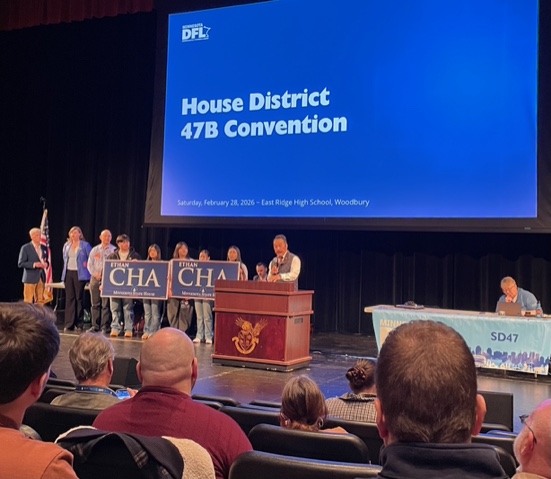
Rep. Ethan Cha speaks at SD47 Convention Feb. 28, 2026. At left in the photo are Steve Sandell, previous Rep for the District, and Sen. Amanda Hemmingsen-Jaeger, who had been my state representative.

My Saturday was spent in the auditorium of a local high school, as a delegate to the Minnesota Senate District 47 DFL (Democrat) Political Convention.  There were over 200 of us in attendance, from among over 400 who could have attended as full delegates.  It was an excellent turnout.

Each state has its own system, and each party its own structure.  In Minnesota, Precinct caucuses some weeks ago were the first essentially neighborhood gatherings to pick representatives to the formal political process.  Saturday, the elected Democrat delegates gathered to consider resolutions, listen to candidates, and select delegates to the next formal step in the process: the Congressional District Convention which in our case is May 3 (CD 4 in Maplewood); thence the state convention May 29-31 in Rochester.

I have attended a lot of these biennial conventions over the years.  They reflect the diversity of constituencies and complexity of the issues facing a society such as ours.  One speaker asked for a show of hands of those who were attending their first such convention.  I wasn’t in a position to see most of the auditorium, but apparently a large percentage were rookies, which is very positive.

I can call Saturday “an inspiring day” because it was well organized and the process worked.  While it was exhausting, it was worth the investment of time.  I did not seek delegate status to the next level.  But I was involved, as were all the others, in selecting delegates to the next level.

So, what happens in the five or so hours we 200 people spent in the auditorium at East Ridge High School?

Much of our time this particular day was off the printed agenda: an opportunity to hear from assorted elected officials and candidates for office.

In all, I noted 20 such speakers, including Minnesota Lieutenant Governor Peggy Flanagan; U.S. Senator Amy Klobuchar; Congresspersons Betty McCollum and Angie Craig; our three state legislators; Secretary of State Steve Simon and a broad assortment of others, either in or seeking some elected office or other.  We like to criticize ‘politicians’, but these folks are charged with the representation of all of us – not a simple task.  Showing up at events like ours is important for candidates.  (There are 67 Senate and 134 House districts in Minnesota.  Our district represents three of the 201.  Statewide candidates in particular have a lot of geography to cover while running for office.  The three minutes or so in front of a local audience is important.)

What comprises the platform – the philosophy – of my party is built from the base of resolutions generated at the local level.

In our case, at the precinct caucus level citizens properly submitted 76 resolutions in 14 different categories.  This year more than usual related to the general category I would call ICE – Immigration issues.  We each were given a ballot, and we could support no more than 38 of them.  I voted for 23.  Our convention was “allowed 38 resolutions to move on for state convention consideration”.   Volunteer delegate committees do the work of sifting and sorting the final choices.  (The actual resolutions can be viewed here: 2026 SD47 RESOLUTIONS.  (These are as submitted by local delegates, and approved in their local caucus.)

The final event of the day was to elect 17 delegates and 17 alternate delegate (CD4) and 2 delegates and 2 alternates (CD2).  (Part of our Senate District is CD2).  The task seems impossible, given we are a group who mostly don’t know each other, and have differing points of view.)

The DFL over the years has refined the process of selecting delegates through what is called the “walking sub-caucus”.  In its most simple iteration, any delegate can propose an affinity group around a candidate or issue.  I didn’t write any of this down, but it appeared that there were as many as 15-20 of these small groups; these were winnowed down to those which were ‘viable’ – those who had sufficient persons to qualify for one delegate.  A time certain is allowed to reach viability and there is likely a certain amount of ‘horse-trading’ to  secure more delegates, or share excess delegates with others.

The process works very well, and is very orderly.  The group I was in qualified for two delegates and two alternates, and according to the rules half need to be male, half female.

I was exhausted when I got home, and I was glad I came.

I’m confident that the next levels will be similarly orderly.

POSTNOTE:  As noted, Saturday afternoon “I was exhausted”.  I attend Catholic Mass most every Sunday, and this particular weekend I felt too tired.  But this morning I went anyway, and I’m glad I did.  The Gospel for today was the Transfiguration, MT 17:1-9.  Father Tasto, a preacher extraordinaire, made a point in this sermon that I wish I could have in hard copy, but I will try to reconstruct from memory here.  He said that all of us, if we thought about it, could identify certain transfiguration experiences in our own life – something happened which changed our life.

As he wrapped up his sermon, he noted that we are in a divided country, now in our 250th year.  He suggested to all of us that we might take the time to reflect on where we are as a country at this time in history; and where our country has been; and finally, where  our country is going.  Makes a lot of sense to me, regardless of one’s personal belief.

I’m adding the Johan van Parys commentary in the church newsletter for this morning, should you be interested in a little more: Johan van Parys Transfiguration Feb 27 28 2026.