
French Canada and the American Revolution
Please see note at end of post.
Today, July 1, is Dominion Day in Canada. The link is to the Canadian Government descriptor of the day.
My father’s ancestry is 100% French-Canadian (mom was 100% German).
Remi Roy, one of my numerous French-Canadian cousins, and valued friend, recently provided a very interesting summary of the Quebec Act of 1774 which relates to the near-miss of Quebec becoming the 14th colony of the infant United States. The map below, as well as the text of Remi’s summary of the history, follow.
Following Remi’s summary is another provided by my long-time friend Dr. Virgil Benoit, in November, 2010.
I have known both Remi and Virgil for many years, and they are very well informed. I’m privileged to know them. Remi lives in Montreal and Virgil in Red Lake Falls MN area. They are both retired professors.
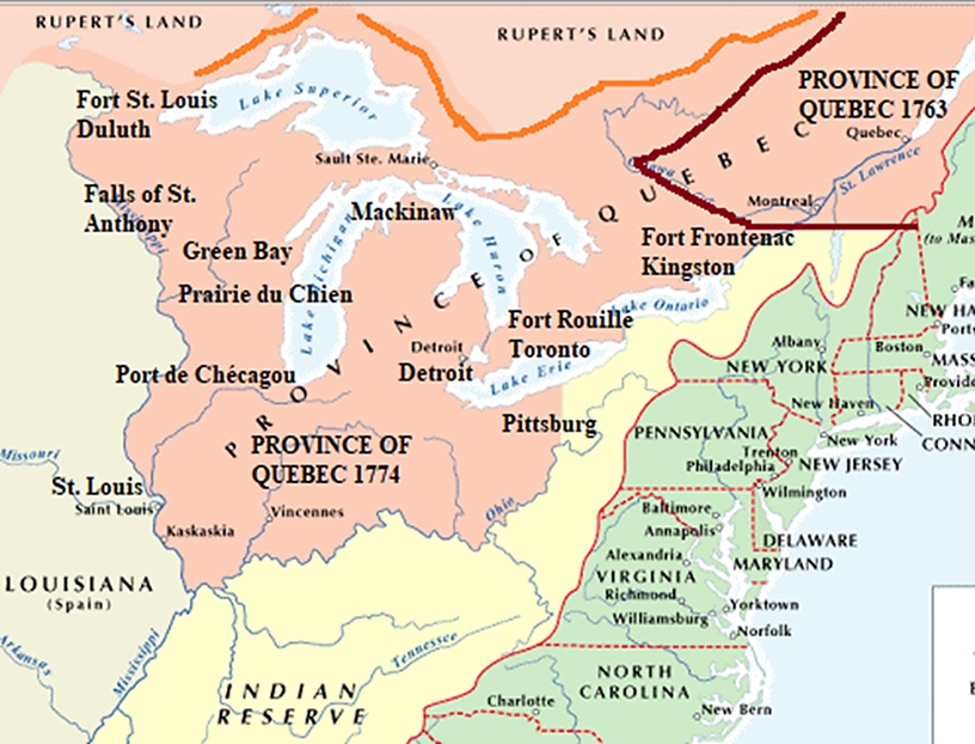
Quebec and the to-be United States in 1774
Remi Roy’s summary:
Under the Quebec Act of 1774, the boundaries of the Province of Quebec were massively expanded—stretching south to the Ohio River and west all the way to the Mississippi River.
For a brief nine-year window until the Treaty of Paris in 1783, Quebec encompassed the entire “Old Northwest,” including modern-day Ohio, Indiana, Illinois, Michigan, Wisconsin, and eastern Minnesota.
The Demographic Reality
If you had travelled through this newly expanded wilderness in 1774 and crossed paths with a non-Indigenous person, you could confidently assume they spoke French.
While the British map claimed this territory on paper, the ground reality was entirely different:
Why Britain Kept it French
The British Parliament enacted this massive expansion out of pure pragmatism. They knew a few hundred British redcoats couldn’t possibly control millions of acres of wilderness if the local populations revolted.
By passing the Quebec Act, Britain achieved two major strategic goals:
This move absolutely infuriated the American colonists out east—who labeled it one of the “Intolerable Acts”—and helped spark the American Revolution just a year later.
The Modern Footprint
Because the western border of Quebec was anchored to the upper Mississippi River, the expansion traveled right through the modern St. Paul-Minneapolis metropolitan area, cutting off at St. Anthony Falls.
If you live in the Twin Cities metro today, this means that everything east of the Mississippi River was briefly part of Quebec. If you are standing in any of these modern counties, you are standing on what was technically French-administered, British-owned Canadian soil in 1774:
Here is Virgil Benoit’s summary written November, 2010, and used in my family French-Canadian family history in 2010: Quebec Act of 1774 per Virgil Benoit 2010 (2).
Remi added some additional commentary on June 30 2026 after I sent him Virgils commentary: “as you know, some of our ancestors in Bellechase [QC] were sympathetic to the American English colonists and even participated in the Revolutionary War against the British. Attached is something that I previously wrote about this.”
THE ROLE OF FRENCH CANADIANS IN THE AMERICAN REVOLUTION
Most Canadiens remained neutral during the American Revolution. They saw it as a fratricidal fight between two English camps. In general, they wished for a pox on both houses of the English factions. Most saw the English colonists as liars. However, some Canadiens sided with the revolutionaries and participated in the Revolutionary War.
Recruited initially in Québec and later among Canadien refugees in the northern New York colony, the Second Canadian Regiment (also known as “Congress’s Own”) fought alongside English-speaking Americans against the British. Organized on a French-style four-battalion structure, these soldiers earned a reputation for exceptional discipline and combat performance at Staten Island, Brandywine, and Germantown. They called themselves les patriotes, sharing a deep-seated grievance against the British Crown with their English-speaking American allies. The patriotes hoped that, with French intervention, a revolutionary victory might eventually lead to France returning to govern Canada.
Most significantly, the Canadian Regiment played a vital role in the Siege of Yorktown. On September 24, 1781, Colonel Moses Hazen was given command of the Second Brigade in the Marquis de Lafayette’s Light Division—placing his Canadien soldiers directly under Lafayette’s command. They took part in the critical siege operations that ultimately forced the British surrender.
At Yorktown, where French forces outnumbered the revolutionaries, a fascinating linguistic dynamic existed. While the regular French Army arriving from Europe was composed of men from various provinces who spoke distinct regional dialects, the Canadien soldiers spoke a remarkably unified colonial French. Generationally removed from Europe, the Canadiens had developed a standardized speech that stood out even alongside their metropolitan French allies.
Because they had taken up arms against the British Crown, these men and their families became the United States’ earliest refugees, forced to flee French Canada during the Continental Army’s retreat from Canada in 1776. Unable to return home after the war, many eventually settled in the Refugee Tract of upstate New York, which was officially organized as Clinton County, with the Town of Champlain among its first settlements. It became the first “Little Canada” in the United States and served as a starting point for early French-Canadian migration into the American Midwest.
In the decades that followed, most French Canadians—who considered themselves American simply by virtue of the continent they shared, just as American as the residents of the United States—viewed the Americans of the young republic with a mix of wariness and admiration. This admiration for the republican values and democracy of their southern neighbours ran deep. In 1837, it even culminated in an armed rebellion in Lower Canada, where patriotes fought to overthrow British colonial rule and establish an independent, French-speaking republic explicitly modelled on the United States. In the decades following the failed rebellion, driven by both economic desperation and this enduring admiration, close to one million French Canadians— almost half the population of Quebec—immigrated to the United States and became proud US citizens.
In stark contrast to this affinity for the United States, French Canadians often looked down upon English Canadians—many of whom were descendants of the tens of thousands of United States Loyalists who had fled north—viewing them as Américains manqués: failed, second-class Americans who preferred the monarchy to democracy. In fact, by 1800, roughly 80% of English speakers in Canada were loyalist refugees from the new American Republic. This massive influx explains why the standard English-Canadian accent developed in ways virtually identical to that of many in the United States.
The language of the French Canadians was Canadian, American, and profoundly North American. It was the lingua franca of the Great Plains for 200 years. Although their ancestral roots lay on different shores, first the French and later the English-speaking pioneers were bound together by the shared physical reality of the wilderness. They endured the same climates, navigated the same landscapes, and experienced the same natural world. This lived experience forged a shared North American worldview and a sense of belonging that transcended linguistic divides. The demands of the frontier shaped both North American English and North American French, distancing them from their European origins. In this way, these two languages became more similar to one another in feeling and spirit than to the dialects of the Old World.
POSTNOTE: July 3 I’ll have some observations as an ordinary person about the first 250 years of our country. I will be including a half dozen or so other comments from others. I will likely post in early morning.
COMMENTS (more at end of post)
from Fred: I always enjoy looking at maps showing the spurious/dubious French claims re their “Province of Quebec.” Those “lands” were under control of Jolly King George III and his loyal minions in the nearly-created US of A. As you will recall, Colonials invaded the so-called Canada several times and made legal claims to the land. Then the aptly named French and Indian War (we were fighting both the French and Indians, of course) and cleared things up.
response from Dick: The English settlement of what became the U.S. far exceeded the number of French who came to what is now Quebec. These two, along with Spain, “sliced and diced” North America over the years. We live with the results – even with all the present day chaos, North American generally is quite the place.
from SAK in England:
This is fascinating!
As pre-high school students we studied history & geography of course. Usually teachers “simplified” matters for us. Thus the European religious wars were Catholic vs Protestants (or reformation vs counter-reformation). One teacher however, may she rest in eternal peace, refused to simplify & respected our capacity for complexity & nuance. In fact she encouraged us to investigate & research beyond the prescribed academic syllabus. Thus we learnt that Catholic France sided with Protestant parts of Europe sometimes etc. However wars often have little to do with religion. During those school days I got a book called The Age of Progress (1789-1870) by Irene Collins because I was fascinated by the French revolution, Napoleon etc. Well the revolution was certainly not very religious at all – you will find articles etc on the dechristianisation of France in that period. Tens of thousands of priests were exiled, hundreds executed. Yet a paragraph in the book starts as follows:
“In the early days of the Revolution, Frenchmen imagined that wars were the sport of kings and that in the new era of popular sovereignty France would live in peace and brotherly love with her neighbours. In May 1790 the Constituent Assembly formally renounced all wars of conquest and declared that the French nation would never use its forces against the liberty of any people [remember how Trump railed against foreign wars!?]. By the winter of 1791, however, war had begun to appear necessary in defence of the Revolution. . . . More agreed with Vergniaud when he argued, in January 1792, that France should attack the Emperor before he attacked her. . . . Brissot himself confidently believed that French armies would be welcomed by oppressed peoples of Europe. . . . he was attacked by Robespierre in a great debate in January 1792. French armies would receive no welcome in Europe, Robespierre said, for ‘no-one loves armed missionaries‘. Nor would liberty triumph at home, for war would strengthen the hands of the king and his ministers. “
Robespierre lost the argument & Europe went to war for more than 20 years . . .
These were post enlightenment times and in many places there was a quick rush to liberalise and an equally hasty dash to supress the liberal trend and revert to tradition & conservatism. I really enjoyed a book by a Swedish author Per Olov Enquist: The Visit of the Royal Physician which brings to life the events in the Danish court of Christian VII – that bubbly 1770s period. An “enlightened” German physician becomes the court’s doctor. The King is mentally challenged & the physician seizes the opportunity to dramatically change & liberalise Denmark in 16 months using what we now call “executive orders”! British King George III, mentioned by Fred’s comment on your piece, sends his very young daughter Caroline to become Christian VIII’s wife only the King is not “interested”. She has a liaison with the German physician. The counter reformist traditionalist faction composed of the King’s mother, some religious elements & other conservative politicians react violently quashing the reforms & executing the physician. Interestingly the author, although on the liberal side, does not deprive the conservatives of redeeming features, thus a priest actually cares for the physician & his soul etc. I think one of the points Enquist is making is that the very speed of reform made the violent reaction inevitable & total. The pendulum swings. Another point is the use of the body & sexual issues (the liaison) as political weapon. A third might be the unelected technocrats pushing change & the ensuing reaction. Finally the King is mentally weak & unstable. The question of who is in control then becomes who is whispering in the King’s ear. The executive then becomes more of a symbol around which factions manoeuvre. Do you think all this has resonance somewhere today!? Hmmm
Your piece also explains why the Quebecois speak French somewhat “differently” 😊. I am told that it harks back to an older spoken French just as the Spanish of Latin America bears resemblance to an older Spanish. I wonder if that is true.
Another thing I noticed is how fast things change in the US/North America. In 250 years so much has happened. And even now the technological advances & political developments are again scary! Celebrations are in order but so is the examination of history & the learning therefrom.
Many thanks & kind regards.
I am a Canadian living in Winnipeg, Manitoba, but I grew up in Montreal, Quebec. I recently bought a book about Benjamin Franklin’s failure in the invasion of Canada during the American Revolution. Virgil can say what he likes, but the fact is that French Canadians living in Quebec at the time did not join the American military expedition led by Benedict Arnold which invaded Quebec and did not support Benjamin Franklin’s overtures in Montreal. American revolutionaries expected French Canadians to support them in separating from the British Crown. Most historians would agree that this did not happen, possibly because like many Black slaves who supported the British and Indigenous tribes, they believed they would be better off under the British government. My earliest ancestor came to Quebec in 1806. He was a private in the British Army that had fought Napoleon. These British regiments were sent to Quebec and Ontario to protect Canada against American invasion. Both the invasion during the American Revolution and War of 1812 were failures. Most Americans are not taught about these invasions of Canada or later Fenian Raids. Louis Riel, the French Metis leader, also chose to remain part of Canada believing that the French Metis would be better able to keep their French and Michif languages in Canada rather than joining the USA as part of Minnesota. Two great-great grandfathers fought the Americans at the Battle of Lundy’s Lane in the Niagara Peninsula and sent them packing back to New York State. I am proud of my British military ancestors. One was Private Charles Davis and the other was Sgt. John Pierce who settled in Ontario near Ottawa. Ruth Swan
Interesting read. I understand that Quebec didn’t join the Americans because they feared the new USA would be anti-Catholic. You covered that well. I have wondered why the maritimes didn’t join the Americans.
Your commentary is fascinating, Ruth, and it resonates deeply with my own family history and research. Your research on the Red River Valley Métis is truly amazing. Some of my ancestors moved from the United States to a Métis village in the Red River Valley that became St. Jean Baptiste. The Métis helped them survive the first years, and some in the family married Métis. You are rightly proud of your ancestors.
Interestingly, while your ancestor arrived in Canada in 1806 as part of the British regiments sent to protect the country, a woman in my grandmother’s maternal line moved from Quebec to the United States that very same year. Six generations of her lineage lived in the USA before the family eventually moved back to Canada. Yet, when she passed away in 1998, she still preferred to speak to me in French—a profound testament to the exact cultural resilience and survival (la survivance) you described.
The majority of native French-speaking Canadians have always believed that their cultural survival was best secured within Canada. However, as you noted, there was certainly sympathy toward our southern neighbours. During the Rebellions of 1837, republican leaders like Louis-Joseph Papineau deeply admired American democracy, and during his subsequent exile in the U.S., he even explored the idea of annexation. Had a union with the United States actually occurred, it is highly likely the French language would have eventually disappeared into the massive American melting pot.
Fortunately, the vast majority of French Canadians recognized this danger. In 1812, they fought alongside Métis and Indigenous allies to repel American invaders, playing a crucial role in defending the country. At that time, French Canadians outnumbered English Canadians roughly three to one. In Upper Canada (Ontario), a significant portion of the English-speaking population consisted of “Late Loyalists”—American settlers who had migrated north for cheap land rather than political loyalty. British authorities were shocked to find that many of these English speakers sided with or aided the American invaders, while virtually all French Canadians stood firmly with the Crown. The backbone of the militia at the time was overwhelmingly French-Canadian.
In fact, when the British spoke of the “Canadian militia” during the War of 1812, they explicitly meant the French Canadians. It wasn’t until much later that English speakers broadly identified as “Canadian.” When my grandmother referred to someone as “Canadien,” she strictly meant “French Canadian,” as did all French Canadians of her generation. The evolution of that identity took time; when my father went to Europe in World War II, he deployed as a British subject, but he returned home feeling distinctly Canadian—reflecting a shift that would soon be codified by the Canadian Citizenship Act of 1946, which legally formalized Canadian citizenship for the first time.
It is equally true that French Canadians maintained a deep admiration for American dynamism. The one million who emigrated to the United States in the 19th and 20th centuries did so out of stark economic necessity, and most fully intended for it to be temporary. It was precisely in response to this devastating “grande saignée”—and the looming threat of cultural assimilation it brought—that the very first true Canadian nationalists emerged from the French-Canadian elite. Leaders like Henri Bourassa envisioned a country defined by its own dual identity, strong enough to provide for its people and remain independent of both British imperialism and American expansionism.
I have a suspicion that there were as many truths and passionate feelings about this subject as there were French Canadians themselves. It all also depended upon the moment and the place — both of which were constantly changing in a volatile time. No truth is the only truth. My ancestor who left Quebec for America came in 1865 and he absolutely had no plans to ever return to Canada, where only starvation and discrimination awaited him and his family. It was a different story for those who migrated down to the factory villages of New England. There’s no neat and tidy story, just as there is none at this very messy moment of our own time. Fascinating subject!
Dick, I have a box of John Rivard things that need to go to Virgil’s former department. How can I arrange this?
It was a very informative and well written piece. Keep writing Dick, and keep shining.